From Idea to First Paying Customer

You have a business idea and no idea what to do first. This course takes you from that idea to a signed paid pilot - a real customer paying real money - without writing code or hiring anyone.

  • Free
  • No sign-up
  • 5 modules
  • Evenings & weekends pace
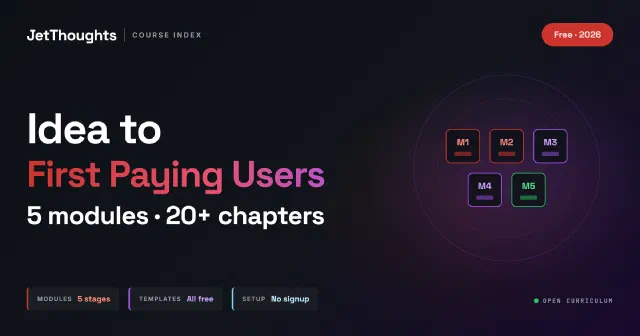
JetThoughts course landing cover showing 5 modules (Hypothesis, Validate, Design, Build, First Customer) on the route from idea to first paying users

Five modules take you from that idea to a signed paid pilot: test demand with strangers, interview the people who respond, turn their words into a one-page brief, build the MVP yourself with no-code tools, and charge your first customer before you ship.

The first checkpoint comes fast. Two to three weeks in, at an evenings-and-weekends pace, you’ll know whether the idea is worth building at all - a go/iterate/kill verdict on your Founding Hypothesis (the one-sentence version of your idea: who the customer is, what problem you solve, why they’d pick you) from real demand data instead of polite nods from friends.

Need orientation first? See the Quickstart (3 min), FAQ (the most common blockers), or How This Course Works (full route overview).

Returning? Skip to the syllabus ↓

Why this course exists

The five mistakes below sink more first products than bad code does - we have watched each one play out in rescue projects since 2005. The course heads each one off:

  • Building an entire MVP (minimum viable product - the first working version) before verifying anyone will pay for it - Modules 1 and 2 show you what validation actually looks like before you spend a single dollar.
  • Asking friends if they like the idea and mistaking their polite nods for market demand - Module 2 hands you five questions that extract real signal instead of hypothetical praise.
  • Writing a 15-page feature wishlist instead of a one-page problem spec - Module 3 constrains your scope to what actually matters to the customer.
  • Believing you have to drop $50,000 on an engineering team to launch - Module 4 walks you through a self-serve stack of free-tier tools you can use without writing code.
  • Offering free pilots indefinitely because asking for money feels intimidating - Module 5 gives you the exact script to charge your first customer before you ship.

Take this course if

  • You are a first-time founder with an idea
  • You want the fastest route from that idea to your first paying customer
  • You can read a Stripe invoice but not a GitHub commit
  • You have never systematically validated a business before
  • You might have tinkered with no-code tools, but you want a structured path instead of guessing

Skip this course if you want to learn to code or hand off founder judgment to someone else.

Module map

Read the modules in order. Each module’s output is the next module’s input, and each leaves you with at least one fill-in-the-blank artifact - the “You leave with” line on every card below. The 6 artifacts bundle into a single Google Drive folder - your Founder OS - that doubles as your decision log. If you ever raise, the same folder is the evidence pack investors fund.

Module 1

Hypothesis & Smoke Test

Output: a one-sentence Founding Hypothesis + a live smoke-test page (a landing page describing your unbuilt product, to see whether strangers sign up) with a Stripe price button.
Start here if you don't have a one-sentence Founding Hypothesis yet, or you have one but never tested demand with a landing page.

  1. 1.1 Form Your Founding Hypothesis
  2. 1.2 Smoke Test: Build the Page with an AI Builder
  3. 1.3 Wire Tracking Before Traffic Starts
  4. 1.4 Smoke Test: Run It and Read the Signal
  5. 1.5 Price Your Hypothesis on the Smoke-Test Page

Optional reference: AI stress-test for the blanks · See it in action: Mia builds TutorMatch - a full Module 1 walkthrough

You leave with: a Founding Hypothesis, demand data from 300 cold strangers, and a price test - all collected before you've built anything.

Module 2

Validate the Problem

Output: 10 Mom Test interviews (customer conversations run under rules that stop people from politely lying to you - ask about past behavior, never pitch) + a prototype built with Lovable (an AI app builder that turns text prompts into working screens), shown to 5 of them.
Start here if you've never talked to 10+ potential customers about the problem you want to solve.

  1. 2.1 The Mom Test: Ask About the Past, Not the Future
  2. 2.2 Sharpen Your Question List with AI Personas optional
    Skip if you've interviewed before. The Mom Test in 2.1 is the core; this chapter rehearses your questions with AI personas first.
  3. 2.3a Find 10 People: Where to Look
  4. 2.3b Find 10 People: What to Say
  5. 2.4 Build a Clickable Prototype

Templates in this module: Interview Script · Validated Problem Statement · Outreach Sequence · Mom Test Synthesis

You leave with: 10 scored interview transcripts and a prototype 5 real customers have clicked through - evidence you can quote back to yourself when doubt creeps in.

Module 3

Design from Evidence

Output: one-page Product Brief drafted from interview transcripts.
Start here if you've validated the problem but don't have a one-page Product Brief.

  1. 3.1 The One-Page Product Brief (Vibe PRD)
  2. 3.2 Quality-check Your Brief: Features to Outcomes

Template in this module: Vibe PRD · Course glossary (reference, not in the linear path): Five Tech Words to Stop Nodding At

You leave with: a one-page Product Brief where every feature traces back to something a customer actually said.

Module 4

Build It Yourself

Output: a live MVP at a real URL, built on Lovable + Supabase (a hosted database with user login built in) + Stripe, ownership locked Day 1.
Start here if you have a Product Brief and need to build the MVP.

  1. 4.1 Should You Hire? The 2026 Decision Tree
  2. 4.2 Who Owns Your GitHub, AWS, and Database?
  3. 4.3a The Self-Serve MVP Stack: Tools & Setup
  4. 4.3b The Self-Serve MVP Stack: Build Phases
  5. 4.4 Vibe Coding Done Right: 5 Ceiling Signals optional
    Skip on first pass. Come back when your no-code build hits a wall - a feature you can't add, a query you can't tune, an auth flow Lovable can't handle.

Templates in this module: Build Path Decision Worksheet · Ownership Checklist · Self-Serve Stack Walkthrough

You leave with: a live MVP at a real URL that you built and you own - every account in your name from Day 1.

Module 5

First Paying Customer

Output: one paying customer through a deliberately chosen channel.
Start here if your MVP is live but you don't have a paying customer with a signed pilot.

  1. 5.1 Your First Customer Is Not a Marketing Problem
  2. 5.2 Choose Your Channel Before You Send One Message optional
    Skip if you already have a channel in mind (LinkedIn, cold email, or personal network). The core path is 5.3a→b→c (personal network) → 5.4 (paid pilot).
  3. 5.3a Build Your 50-Name Network List
  4. 5.3b Write the Outreach Message
  5. 5.3c Send, Track, and Read the Replies
  6. 5.4 Charge Before You Ship: The Paid Pilot Contract
  7. 5.5 Going Outbound Without a Sales Team optional
    Skip if your personal network in 5.3a→c produced your first 10 customers. This is the systematic path for when warm intros run out.

Template in this module: First Paying Customer Operating Kit

You leave with: a signed paid pilot and your first dollar from a customer, not a favor.

What this course does NOT cover

To save your time, here is what we intentionally exclude. None of these are needed for the promised result (idea → first paying customer):

  • How to code. The course assumes zero coding ability. Lovable + Supabase + Stripe handle the technical side.
  • How to hire a CTO or build an engineering team. Hiring is covered as a build-path decision (Chapter 4.1), not as an org-design course.
  • How to raise venture capital. The course produces the artifacts investors want to see. It does not teach pitch decks or fundraising mechanics.
  • How to manage a 20-person engineering team. Friday Demo Rule + Weekly Dev Report (in Going Further) cover early-stage management; full org management is out of scope.
  • Mobile-only or marketplace-only specifics. Examples use SaaS + B2B + B2C patterns. Mobile apps and two-sided marketplaces have their own playbooks.
  • Legal incorporation, taxes, IP filings. Use a lawyer or a service like Stripe Atlas, Clerky, or Firstbase.
  • SEO, content marketing, paid acquisition at scale. Module 5 covers first-10-customers outbound. Scaling acquisition is a separate discipline.

If you need something on this list, the course won’t help with it.

Going further (after first paying customer)

These conditional chapters kick in once you’ve passed the Module 5 gate. Read each one only when its trigger fires.

Diagnose what’s slowing growth

Working with a dev agency in the AI era

Manage a hired team without writing code

Already started building?

A side-path for readers who are further along. If you just have an idea or a half-built prototype you’re tinkering with, skip to Module 1.

If you are already typing, or paying someone an hourly rate to type for you, run these steps before you approve any more work.

  1. Check who owns the GitHub, AWS, database, and domain accounts. If it’s not you, fix that today. - Ownership Audit
  2. Demand one Friday demo with working software only - no Jira tickets, no slides, no “almost done.” - Friday Demo Rule
  3. Require a plain-English weekly report: what shipped, what’s blocked, what’s next. - Weekly Dev Report
  4. Stop specifying features. Quality-check your scope against actual user outcomes before the build gets out of hand. - Stop Specifying Features
  5. If your build is stalled and you’re not sure whether to fix it or start over, run the salvage-vs-rebuild decision tree first. - Salvage vs Rebuild Decision Tree
  6. If your team is shipping AI features, check the vendor contract. Make sure per-question AI costs aren’t passing through to your invoice. - “We Use AI” Follow-Up Questions

If this course saved you from building something nobody wanted, send it to a founder friend.

Who built this

Built by JetThoughts. We’ve run a Rails-first dev shop since 2005. The course is what we wish every founder had on their desk before the first build decision.