5.2 · Choose Your Channel Before You Send One Message

Module 5 · Step 2 of 5 · From Idea to First Paying Customer
Input: 10 Mom Test interview transcripts from Module 2 + your live MVP from Module 4 (Ch 4.3b) + the ICP (Ideal Customer Profile - the specific kind of person your hypothesis names; introduced in Ch 1.1) you sharpened across Modules 1-2
Output: one channel hypothesis committed long enough to read the signal
TL;DR: Pick one channel from your interview evidence and commit for a full send/reply/follow-up arc. Channel-hopping is the most common newbie mistake - you can’t read a signal you never let stabilize.
The channel-flailing pattern: switch every 10 days - LinkedIn for two weeks, cold email for two weeks, a Slack community for two weeks, back to LinkedIn. Six weeks in, 8 conversations, zero paid pilots, and no idea which channel actually worked.
The fix is rarely “find a smarter channel.” It’s pick one channel from your interview evidence and stick with it through a full send/reply/follow-up arc. Same six weeks on LinkedIn alone produces 11 conversations, 2 paid pilots, and a clear hypothesis about what to test next.
The pattern: four channels, no commitment, and no way to tell which channel had worked because none of them had been run long enough to read.
You ran 10 interviews in Module 2. Your interviewees told you exactly how they find tools like yours. They just did not use the word “channel” when they said it.
This chapter is about listening to what they actually said and committing to one channel before you try anything else.
The commitment rule
Stick with one channel long enough to read the signal, not chase the algorithm. A cold-email sequence needs time to deliver, more time for replies to accumulate, and more time still before the “not now” replies reveal whether the non-replies are disinterest or bad timing.
Run a batch, call the channel dead because you got 2 replies right away, and you just threw away the signal.
| Phase | Activity | Expected signal | Decision checkpoint |
|---|---|---|---|
| Send phase | Build list, send the first batch | 1 reply = normal; panic is common | Do not switch channels |
| Reply phase | Replies arrive, book demos | A handful of demos booked = channel reaches buyer | First real signal the channel works |
| Follow-up phase | Follow-ups + a fresh batch | A paid conversation or two start, reply rate stabilizes | Rate becomes predictable |
| Decision phase | Evaluate all signals | Reply rate >5%? Demos → paid? Right buyer? | If all 3 = no, diagnose script/filter before switching |
The rule is not a ritual. It is the minimum data window that separates “this channel does not work” from “I ran this channel for a few days and panicked.”
How to pick from interview evidence
Your 10 interview transcripts from Module 2 already contain the channel signal. Pull them up and look for three types of clues:
| Clue type | Question to ask | What it signals |
|---|---|---|
| Discovery language | “How do you currently find tools like this?” | Direct answers: “Slack group” = community; “Google search” = SEO; “network referral” = LinkedIn/email; “Twitter” = social |
| Where they showed up | Did they come from a community post or LinkedIn outreach? | If 7 of 10 came from one channel, that channel already converts for recruitment → will convert for sales |
| Daily workflow | “What tools do you use every day?” | Notion + Slack users won’t find you in cold email; they find you in community or template gallery |
Go through each transcript. Mark the channel signals. You will see a pattern across 10 interviews that you cannot see in any single conversation.
Channel-fit scoring
Not every channel fits every product. Four dimensions narrow the field before you spend a single hour:
| Dimension | Question | Scoring rule |
|---|---|---|
| Price point | Can you afford the channel’s acquisition cost model? Use the price you tested in Chapter 1.5 as the input here. | <$50/mo tested = free/organic only; $200-$500/mo = LinkedIn; >$500/mo = outbound calls viable |
| Buyer type | Where do your must-have buyers actually live online? | Individuals = social + Reddit; B2B = LinkedIn + email + professional communities |
| Your time budget | What can you honestly sustain through a full send/reply/follow-up arc? | LinkedIn 20-30 min/10 msgs; cold email 5-8 min/10 msgs; community 45 min/post + no daily mgmt |
| Interview signal | What did your 10 transcripts actually say? | Count mentions per channel; 7-of-10 = louder than gut feeling |
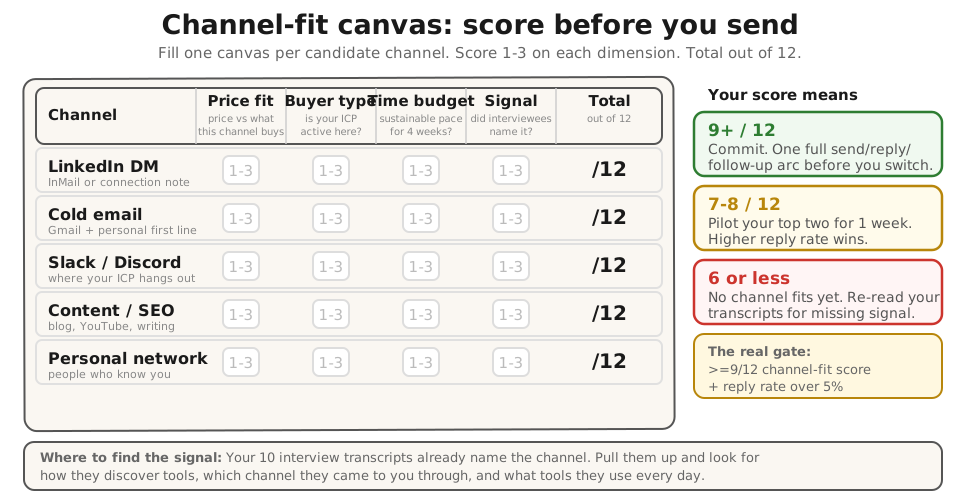
Score each candidate channel 1-3 on all four dimensions (1 = poor fit, 2 = moderate, 3 = strong). Add to get 12-point total.
Threshold rule. ≥9/12 = clear pick, commit to that channel. 7-8/12 = run a 1-week pilot on your top 2 channels first to break the tie; the higher reply rate wins. ≤6/12 = no channel is a strong fit; revisit your 10 interview transcripts for missing signal (channel-mention, daily-workflow, where-they-already-buy) before scaling outbound at all. Picking a 6/12 channel and committing is the failure mode the scoring exists to prevent.
The 4 channels for newbie B2B and B2C
At this stage you are choosing from four options. Here is what each one actually requires:
| Channel | Best for | Requires | Red flag |
|---|---|---|---|
| LinkedIn DM | B2B SaaS/services, professional buyers, job-title filtering, $200+/mo | 1-2 hrs/week; Sales Navigator trial or Apollo.io free tier (credit-based: ~100 email credits + ~10 export credits/mo); one clear filter (title + company + industry) | Buyer is not a professional (freelancer, solo creator, non-employee) |
| Cold email | Any B2B with verified work emails; cheaper at volume | Separate sending domain; free tool (Instantly / Smartlead); 30-50 emails from Apollo / Hunter (25 searches/mo free tier) | Open rate <20% after first batch = domain rep or subject lines broken; fix before scale |
| Community outreach | B2B and prosumer where buyers already gather in Slack/Discord/forum | Must be a genuine participant first; one signal-quality post per sprint (not per week); spend 2 weeks commenting before posting product or get banned permanently | Joining this week then immediately selling = permanent ban from the community |
| Social organic | B2C and prosumer, visual products (apps, productivity tools, demos); buyer discovery from peers/influencers | A sustained posting cadence; format shows product working (screen recordings, before/after, results) | Never posted before AND can’t commit to the early low-visibility stretch |
| Engineering as Marketing | Any B2B or prosumer where your ICP searches for tactical solutions; zero-CAC organic SEO | One free no-code micro-tool (calculator, checklist, grader, template) that solves one micro-problem for your ICP; build it on Carrd/Tally/Notion in an afternoon | Your ICP doesn’t search for tactical tooling (they buy via referral or sales call); the micro-tool solves a toy problem nobody actually has |
Pick the one that matches your buyer type, your price point, and your honest time budget - then commit.
Engineering as Marketing: the zero-CAC (Customer Acquisition Cost - what you spend to land one customer) channel. Building a free micro-tool (a pricing calculator, a checklist generator, a “which plan is right for you” grader) on a free no-code stack (Carrd + Tally + Notion) attracts targeted organic search traffic. Users who find the tool useful are pre-warmed leads for your main product. The tool ranks for long-tail SEO keywords your competitors ignore. One afternoon to build, zero monthly cost, and the traffic compounds over months. Unlike content marketing (blog posts), a functional tool has a different backlink profile and ranks for different intent - someone searching “SaaS pricing calculator for [vertical]” is closer to buying than someone searching “how to price SaaS.” The tool is not your product - it’s a free side door that feeds your product’s waitlist.
AI-augmented channel research
After you pull the signal from your transcripts, run one Claude prompt to pressure-test your hypothesis before you commit to it:
I am a founder building [product description in one sentence].
My must-have user is [specific buyer persona: title, company size, industry].
My price point is [monthly or per-seat price].
From 10 customer interviews, I heard these channel signals:
- [Quote or paraphrase from interview 1]
- [Quote or paraphrase from interview 2]
- [... up to 5 signals]
I am considering [channel A] vs [channel B] for my first stretch of outbound.
Based on the buyer persona and interview signals, which channel is more likely to reach them in the mode where they are open to discovering new tools? What would I need to believe for [channel A] to be right vs [channel B]?
Claude cannot guarantee the right answer - it does not know your specific market. But it will surface the assumptions behind each choice and flag contradictions you missed.
Run the prompt against your own transcripts. If your interview evidence points to one channel (8 of 10 saying “I found it on LinkedIn”) while your gut points to another (cold email feels safer), name the gap to yourself: which signal are you ignoring, and why?
The prompt is a forcing function, not a crystal ball. The real data comes from running the channel.
Fast-path exit: skip the worksheet if your interviews already named a channel. If your Ch 2.3 (a + b) interview transcripts pointed to a clear channel (e.g., 7+ of 10 interviewees found tools through LinkedIn, or 5+ named a specific Slack community), jump to Part 3: The Commitment at the bottom of the worksheet. Write your commitment statement and move to Ch 5.3. The full worksheet is for founders still deciding between channels. It’s a diagnostic, not a gate.
Module 5 AI critic/simulator block
The Claude prompt in the section above is the Module 5 critic layer. It pressure-tests your channel hypothesis against interview evidence, surfaces assumptions behind each choice, and flags contradictions between what your transcripts said and what your gut says.
What AI cannot prove or substitute:
- Which channel will actually convert (only a real send/reply/follow-up arc can)
- Your reply rate, demo rate, or paid-conversation rate (only real messages to real buyers can)
- Whether the channel degrades over time (only sustained use reveals this)
The real gate: ≥9/12 channel-fit score + a full send/reply/follow-up arc with reply rate >5%.
Optional: auto-parse social media for leads. WorthBuild (1 free report/month) scans Reddit, Twitter/X, and LinkedIn for posts matching your ICP’s problem description and returns a list of named people publicly complaining about the thing you solve. Use it to seed your outreach list when the manual reading in Ch 2.3 (a + b) didn’t produce enough names. The free tier gives you one batch per month - save it until you have exhausted your hand-picked list and need fresh contacts.
Channel Selection Worksheet
Fill this out before you send message one. It prevents the wasted-effort cycle of channel-hopping.
Part 1: Interview Evidence
Go through each interview transcript. For each one, note any channel signal the interviewee gave - directly or indirectly.
| Interview # | Interviewee role | Channel signal (direct quote or paraphrase) | Channel type implied |
|---|---|---|---|
| 1 | |||
| 2 | |||
| 3 | |||
| 4 | |||
| 5 | |||
| 6 | |||
| 7 | |||
| 8 | |||
| 9 | |||
| 10 |
Tally by channel type:
- LinkedIn mentions: ___
- Email / newsletter mentions: ___
- Community / Slack / Discord mentions: ___
- Social (Twitter, Reddit, TikTok) mentions: ___
- Search / Google mentions: ___
- Word of mouth / referral mentions: ___
Strongest signal (channel with most mentions): _______________
Part 2: Channel-Fit Score
Score each candidate channel 1-3 on the four dimensions (1 = poor fit, 2 = moderate, 3 = strong). Add the four to a total out of 12. Use the per-channel guidance below as the anchor.
LinkedIn DM → B2B SaaS, $200+/month. Pick when: buyer is a professional, title and company size filter cleanly, 1-2 hours/week available. Skip when: buyer is a freelancer, solo creator, or under 30 years old.
- Price fit: ___ / Buyer type fit: ___ / Time budget fit: ___ / Interview signal fit: ___ / Total: ___
Cold email → Any B2B with verified work emails. Pick when: you have 30-50 verified emails, a sending domain that is not your main domain, deliverability you can monitor. Skip when: open rates stay below 20% after batch 1 (domain or subject line is broken; fix before scale).
- Price fit: ___ / Buyer type fit: ___ / Time budget fit: ___ / Interview signal fit: ___ / Total: ___
Community outreach → B2B and prosumer where buyers already gather. Pick when: a specific Slack/Discord/forum exists, you are already a participant, you can post one signal-quality post per sprint. Skip when: you joined this week (spend two weeks commenting before posting product, or get banned permanently).
- Price fit: ___ / Buyer type fit: ___ / Time budget fit: ___ / Interview signal fit: ___ / Total: ___
Social organic → B2C and prosumer with a visible product. Pick when: a sustained posting cadence is realistic, format shows the product working (screen recordings, before/after, results). Skip when: you have never posted content before and cannot commit to the early stretch of posting into a void.
- Price fit: ___ / Buyer type fit: ___ / Time budget fit: ___ / Interview signal fit: ___ / Total: ___
Highest-scoring channel: _______________
Part 3: The Commitment
Write this down. Literally write it. Skip this step and you are the founder who hops channels at the first cricket.
My chosen channel: [channel name]
Why this channel:
1. Interview evidence: [which interviewees, what they said]
2. Buyer type match: [why this channel reaches my buyer]
3. Price point math: [estimated cost per lead vs my price point]
4. Time budget: [time per batch I will actually spend]
I will not switch channels until I have run a full send/reply/follow-up arc.
At the evaluation point, I will check:
- Reply rate (target: >5%)
- Demo-to-conversation rate (target: >20%)
- Any paid conversations started (target: ≥1)
If all three targets missed: diagnose the filter and script first, then consider a channel switch.
Keep this in the same Google Sheet as your interview transcripts. Look at it before you send each batch.
The decision matters more than the channel itself. Committing to one channel and iterating on the script beats splitting your time across three by a wide margin, because the learning loop is tighter.
With 30 focused messages you get a reply rate you can diagnose; with 10 messages spread across three channels you get nothing you can act on.
Pick the channel your interviews point to, write it down, and give it a real run before you question it.
The first place to apply this is your personal network in Chapter 5.3a (Build Your 50-Name Network List). Once that is exhausted, going outbound without a sales team covers the tactics for running the channel you just chose: the filter, the script, the Calendly-to-Stripe pipeline, and what the reply rate actually means.
What to do tomorrow
- Open the worksheet above and score each of the 4 channels against your customer interview answers. Pick the one that maps to the most evidence.
- Write the channel name + your commitment statement in a Notion doc. The clock starts the day you send your first outbound message.
- Read Chapter 5.3a - Build Your 50-Name Network List before your first send - that’s the playbook for getting the first conversations on the channel you just picked.
Module 5, Step 2 of 5 - channel selection is the decision before any outreach tactic. Finish the worksheet above before you open a single sales tool. Next: 5.3a · Build Your 50-Name Network List Course: From Idea to First Paying Customer
Pick the channel your interviews already named, commit to it long enough to read the signal, and stop running pilots against your own attention.
Further reading
- Lenny Rachitsky, How today’s fastest growing B2B businesses found their first ten customers - the channel breakdown across Figma, Stripe, Slack, Notion. Channel choice is the first lever, not the last.
- Brian Balfour, Why Product Market Fit Isn’t Enough - the case for channel-model fit as a distinct requirement from product-market fit. Strong reading for any founder who has a working product but no acquisition motion.
- Andrew Chen, The Law of Shitty Clickthroughs - why every channel degrades over time and why early-stage founders need to pick the channel that works now, not the channel that worked for a more established company 3 years ago.
- First Round Capital, From 1 to 1,000 Users - channel selection stories from Airbnb, Tinder, Etsy, Reddit, including how each picked their first acquisition channel based on where their early customers actually lived online.
Done when: Your worksheet is filled, one channel is chosen, and you have written your commitment statement (channel name + why + evaluation criteria).
Next click: 5.3a · Build Your 50-Name Network List
If blocked: If no channel scores ≥9/12, your interview transcripts are missing channel signal. Re-read the transcripts looking for “how do you find tools like this” and “what tools do you use every day” - the answers are already in there.
Case Study: Tomas & Mia
Tomas: Channel scoring: LinkedIn (9/12 - controllers are there), cold email (8/12), Reddit (5/12). Commits to LinkedIn + cold email. Scoring: 8.0/10.
Mia: Channel scoring: Facebook groups (9/12 - parents are there daily), school referrals (7/12), Instagram (5/12). Commits to Facebook groups + school district referrals.
Built by JetThoughts as part of the From Idea to First Paying Customer curriculum.