In this module
Module 2 · Lesson 2.4 · [CORE] · From Idea to First Paying Customer
Input: a 30-name list from Part 1: Where to Look - specific people you can name because you read what they posted
Output: 10 interview calls booked and the first outreach batch sent - you’ll run the calls with the Lesson 2.1 script, then score them in Lesson 2.5
Progress: M2 · 4 of 6
Read Lesson 2.3 - Where to Look first. It covers the ICP mapping, reading threads, and building the 30-name list. You need that list before the templates below will work - generic openers collapse to 1-5% reply rates.
How this lesson relates to Lesson 2.6: this lesson recruits 10 fresh interviewees and runs PAST-BEHAVIOR interviews about whether the problem is real. Lesson 2.6 takes the 5 strongest-signal interviewees from these 10 and runs a DIFFERENT kind of session - silent observation while they click through a throwaway Lovable prototype. Same recruitment pool; different methodology; sequential, not parallel.
This is interview recruitment, not sales. You’re asking for time and insight, not money - different message template, different channels, different reciprocity. Don’t use the Lesson 5.7 cold-email script here; it scares interview subjects who don’t yet know you have a product.
What to write so they don’t ignore you #
Send 30 messages staggered, not in one burst. A handful a day, by hand, beats a single bulk-send. In outreach runs we’ve coached, reply rates land around 20-30% when each message names a specific post you read - 2-3 booked calls per batch of 30; stack batches until 10 calls are on the calendar.
You can do this from Gmail and a NeetoCal booking link. Reply by hand - the back-and-forth is where the interview actually gets booked. Too slow at 6 a day? The full reference covers Gmail multi-send and the part-time batch-send variant.
The Day-0 message that has to work #
The Day-0 message is the one that has to work - the whole sequence rests on a first line that names something they actually wrote. Copy it verbatim, replace the brackets with their words from when you read where they’re complaining in Part 1, not yours:
Subject: your post about [THEIR_EXACT_WORDS]
Hi [NAME] - you wrote that [ONE SPECIFIC LINE FROM THEIR POST, PARAPHRASED]. I’m researching exactly that problem and would trade 20 minutes for everything you learned the hard way. No pitch, nothing to sell - I don’t even have a product yet. Would [DAY] or [DAY] work? Booking link if that’s easier: [NEETOCAL LINK]
Full 3-message sequence (Day 0 + Day 3 bump + Day 7 close) - copy it from the Outreach Sequence Template.
That three-message shape is the whole engine. It collapses to 1-5% with a generic “love to pick your brain” opener - the difference is the reading you did in Part 1 to find named people. The full reference has the bad-first-draft teardown (why each generic line dies) and the LinkedIn-DM variation.
Why people say yes (or don’t) #
Teresa Torres names three reasons a stranger turns down an interview ask, and the sequence above already answers two of them (Product Talk):
- Limited time - ask for 20 minutes, not “a quick chat” or an open-ended hour. The Day-0 template already does this.
- Unclear benefit - say what they get out of it. Talking about their own expertise to someone actually listening is the benefit; the opener leans on it.
- Fear of the unknown - people hesitate when they can’t picture how the time will be spent. This is the one most first drafts skip. Tell them exactly what happens with one added sentence: “We’ll walk through what happened the last time you [PROBLEM] - no prep, no pitch.” Drop it into the Day-0 message right after the ask.
Volume targets #
Work through the 30-name list first, then extend it with Part 1’s second-degree searches until 10 interviews are booked - plan on 50-100 messages total. Target a reply rate of 20% or higher. Under 10% means your opener is too generic or you’re in the wrong channel - rewrite the Day-0 message before sending more. 10-20% is workable: let the sequence run and tighten the subject line on the next batch. Of the replies who say yes, expect roughly half or more to actually show. If your show rate drops below 50%, add a 24-hour reminder message and confirm the meeting time the day before.
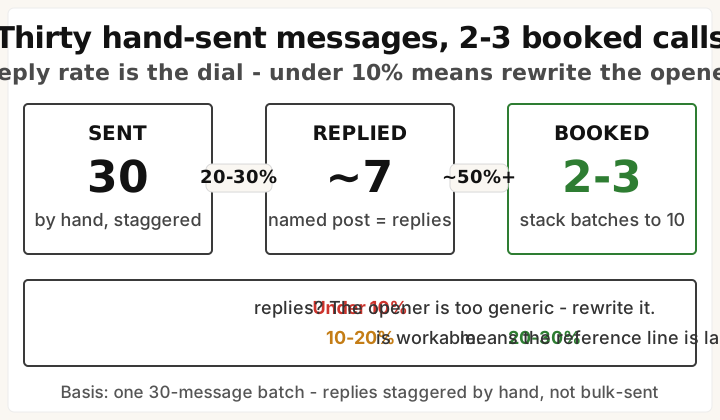
Success check: every subject line in your sent folder names a post the person wrote, replies run 20% or better, and 2-3 calls from the batch are on your calendar. Then stack batches until 10 calls are on the calendar - Done below fires at 10, not at the first batch.
If this fails: replies stall under 10% after the first batch.
- Why: the Day-0 message reads like a template - the first line doesn’t prove you read their post.
- Fix: rewrite the subject line to quote their exact words and resend to the next 10 names only. Compare the two rates before working through the rest of the list.
Three tracks to 10 booked calls #
Cold outreach is the main track. Two others run alongside it when they fit:
- Research panel - if your ICP can’t be reached cold (a CFO at a regulated bank, an oncology nurse), a paid panel like User Interviews or Respondent books screened interviewees for a few hundred dollars. Use it only when replies run thin.
- Smoke-test landing page - the page from Lesson 1.4 doubles as your warmest opener: “You signed up for the waitlist on [PAGE] last Tuesday - up for a 20-minute call?”
Both tracks, the parallel-run logic, and the part-time founder’s batch-send variant are in the full reference.
While the replies trickle in #
Booking 10 calls takes 2-4 weeks - messages go out, a few replies land, and you send the next batch. The calendar sits half-full for days at a stretch, and it’s easy to stop pushing new messages out.
Don’t wait for all 10 before you start. The day a third call is booked, start running interviews with the Lesson 2.1 script - early calls tell you fast whether your questions are landing, and you can fix them before the later ones. While the replies come in, set up the kit in one sitting: open the 2.1 five-question script, make a blank one-page notes doc you’ll copy for each person, and put your 20-minute slots into your NeetoCal link so booking is one click for them.
Come back when 3 calls are booked - and run them, don’t hold for 10. Keep the outreach batches going in the background until the calendar hits 10. Evening-only, with a couple of hours a week? Run the calls first and resume outreach the week after.
Done: 10 interview calls are booked on your calendar and you have sent the first batch of outreach messages.
You have now: question list (2.1-2.2) + 30-name list (2.3) + 10 booked interviews (2.4). The problem itself is still unvalidated - the interviews you run next test it.
Next: return to 2.1 · The Mom Test to run the interviews using the 5-question script, then move to Mom Test Synthesis to score the transcripts. The full reference has the complete artifact chain from booked call to validated problem statement.
If blocked: see “If this fails” above. If your ICP can’t be reached cold, switch to a paid research panel (User Interviews or Respondent).
Deeper reference: Message teardowns, the panel fallback, the slow-path variant, and the post-booking artifact chain
See it in action: Module 2 walkthrough: Mia interviews ten parents
Built by JetThoughts as part of the From Idea to First Paying Customer curriculum.