Reference companion to Lesson 5.2 · Choose Your Channel Before You Send One Message - the commitment-rule phase table, how to read channel signals from your interview transcripts, the 4-dimension channel-fit scoring, the 4-channel comparison, the Engineering-as-Marketing side door, and the full fill-in worksheet. Read the micro-lesson first for the commitment rule and the ≥9/12 score; return here when you want the full worksheet and the four-channel comparison.
The commitment rule, phase by phase #
Stick with one channel long enough to read the signal, not chase the algorithm. A cold-email sequence needs time to deliver, more time for replies to accumulate, and more time still before the “not now” replies reveal whether the non-replies are disinterest or bad timing.
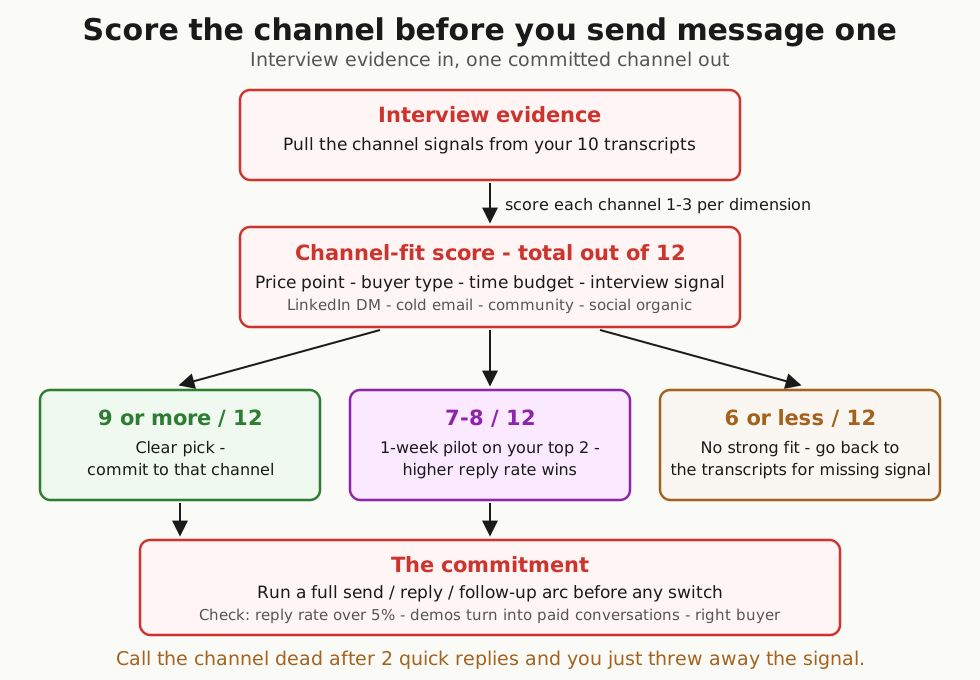
Run a batch, call the channel dead because you got 2 replies right away, and you just threw away the signal.
| Phase | Activity | Expected signal | Decision checkpoint |
|---|---|---|---|
| Send phase | Build list, send the first batch | 1 reply = normal; panic is common | Do not switch channels |
| Reply phase | Replies arrive, book demos | A handful of demos booked = channel reaches buyer | First real signal the channel works |
| Follow-up phase | Follow-ups + a fresh batch | A paid conversation or two start, reply rate stabilizes | Rate becomes predictable |
| Decision phase | Evaluate all signals | Reply rate >5%? Demos → paid? Right buyer? | If all 3 = no, diagnose script/filter before switching |
The rule is not a ritual. It is the minimum data window that separates “this channel does not work” from “I ran this channel for a few days and panicked.”
How to pick from interview evidence #
Your 10 interview transcripts from Module 2 already contain the channel signal. Pull them up and look for three types of clues:
| Clue type | Question to ask | What it signals |
|---|---|---|
| Discovery language | “How do you currently find tools like this?” | Direct answers: “Slack group” = community; “Google search” = SEO; “network referral” = LinkedIn/email; “Twitter” = social |
| Where they showed up | Did they come from a community post or LinkedIn outreach? | If 7 of 10 came from one channel, that channel already converts for recruitment → will convert for sales |
| Daily workflow | “What tools do you use every day?” | Notion + Slack users won’t find you in cold email; they find you in community or template gallery |
Go through each transcript. Mark the channel signals. You will see a pattern across 10 interviews that you cannot see in any single conversation.
Channel-fit scoring, in full #
Not every channel fits every product. Four dimensions narrow the field before you spend a single hour:
| Dimension | Question | Scoring rule |
|---|---|---|
| Price point | Can you afford the channel’s acquisition cost model? Use the price you tested in Lesson 1.5 as the input here. | <$50/mo tested = free/organic only; $200-$500/mo = LinkedIn; >$500/mo = outbound calls viable |
| Buyer type | Where do your must-have buyers actually live online? | Individuals = social + Reddit; B2B = LinkedIn + email + professional communities |
| Your time budget | What can you honestly sustain through a full send/reply/follow-up arc? | LinkedIn 20-30 min/10 msgs; cold email 5-8 min/10 msgs; community 45 min/post + no daily mgmt |
| Interview signal | What did your 10 transcripts actually say? | Count mentions per channel; 7-of-10 = louder than gut feeling |
Score each candidate channel 1-3 on all four dimensions (1 = poor fit, 2 = moderate, 3 = strong). Add to get 12-point total.
Threshold rule. ≥9/12 = clear pick, commit to that channel. 7-8/12 = run a 1-week pilot on your top 2 channels first to break the tie; the higher reply rate wins. ≤6/12 = no channel is a strong fit; revisit your 10 interview transcripts for missing signal (channel-mention, daily-workflow, where-they-already-buy) before scaling outbound at all. Picking a 6/12 channel and committing is the failure mode the scoring exists to prevent.
The 4 channels for newbie B2B and B2C #
At this stage you are choosing from four options. Here is what each one actually requires:
| Channel | Best for | Requires | Red flag |
|---|---|---|---|
| LinkedIn DM | B2B SaaS/services, professional buyers, job-title filtering, $200+/mo | 1-2 hrs/week; Sales Navigator trial or Apollo.io free tier (credit-based free tier); one clear filter (title + company + industry) | Buyer is not a professional (freelancer, solo creator, non-employee) |
| Cold email | Any B2B with verified work emails; cheaper at volume | Separate sending domain; free tool (Instantly / Smartlead); 30-50 emails from Apollo / Hunter (free tier available) | Open rate (share of recipients who open your email) <20% after first batch = domain rep or subject lines broken; fix before scale |
| Community outreach | B2B and prosumer where buyers already gather in Slack/Discord/forum | Must be a genuine participant first; one signal-quality post per sprint (not per week); spend 2 weeks commenting before posting product or get banned permanently | Joining this week then immediately selling = permanent ban from the community |
| Social organic | B2C and prosumer, visual products (apps, productivity tools, demos); buyer discovery from peers/influencers | A sustained posting cadence; format shows product working (screen recordings, before/after, results) | Never posted before AND can’t commit to the early low-visibility stretch |
Pick the one that matches your buyer type, your price point, and your honest time budget - then commit.
A fifth play: Engineering as Marketing - a slower-burn, zero-CAC (Customer Acquisition Cost - what you spend to land one customer) option, not one of the four channels you score above. Building a free micro-tool (a pricing calculator, a checklist generator, a “which plan is right for you” grader) on a free no-code stack (Carrd + Tally + Notion) attracts targeted organic search traffic. Users who find the tool useful are pre-warmed leads for your main product. The tool ranks for long-tail SEO keywords your competitors ignore. One afternoon to build, zero monthly cost, and the traffic compounds over months. Unlike content marketing (blog posts), a functional tool has a different backlink profile and ranks for different intent - someone searching “SaaS pricing calculator for [VERTICAL]” is closer to buying than someone searching “how to price SaaS.” The tool is not your product - it’s a free side door that feeds your product’s waitlist.
Channel Selection Worksheet #
Fill this out before you send message one. It prevents the wasted-effort cycle of channel-hopping.
Fast-path exit: skip the worksheet if your interviews already named a channel. If your Lesson 2.3-2.4 interview transcripts pointed to a clear channel (e.g., 7+ of 10 interviewees found tools through LinkedIn, or 5+ named a specific Slack community), jump to Part 3: The Commitment below. Write your commitment statement and move to Lesson 5.3. The full worksheet is for founders still deciding between channels. Use it to decide between channels; skipping it does not block anything.
Part 1: Interview Evidence #
Go through each interview transcript. For each one, note any channel signal the interviewee gave - directly or indirectly.
| # | Interviewee role | Channel signal (quote or paraphrase) | Channel type implied |
|---|---|---|---|
| 1 | |||
| 2 | |||
| 3 | |||
| 4 | |||
| 5 | |||
| 6 | |||
| 7 | |||
| 8 | |||
| 9 | |||
| 10 |
Tally by channel type
Part 2: Channel-Fit Score #
Score each candidate channel 1-3 on the four dimensions (1 = poor fit, 2 = moderate, 3 = strong). Add the four to a total out of 12. Use the per-channel guidance below as the anchor.
LinkedIn DM → B2B SaaS, $200+/month. Pick when: buyer is a professional, title and company size filter cleanly, 1-2 hours/week available. Skip when: buyer is a freelancer, solo creator, or someone whose work life happens outside LinkedIn (your 5.1 interviewees will have told you where they actually hang out).
Cold email → Any B2B with verified work emails. Pick when: you have 30-50 verified emails, a sending domain that is not your main domain, deliverability you can monitor. Skip when: open rates stay below 20% after batch 1 (domain or subject line is broken; fix before scale).
Community outreach → B2B and prosumer where buyers already gather. Pick when: a specific Slack/Discord/forum exists, you are already a participant, you can post one signal-quality post per sprint. Skip when: you joined this week (spend two weeks commenting before posting product, or get banned permanently).
Social organic → B2C and prosumer with a visible product. Pick when: a sustained posting cadence is realistic, format shows the product working (screen recordings, before/after, results). Skip when: you have never posted content before and cannot commit to the early stretch of posting into a void.
Part 3: The Commitment #
Write this down. Literally write it. Skip this step and you are the founder who hops channels at the first cricket.
Why this channel - note the evidence beside each:
- Interview evidence: which interviewees, and what they said
- Buyer type match: why this channel reaches my buyer
- Price point math: estimated cost per lead vs my price point
- Time budget: time per batch I will actually spend
Keep this in the same Google Sheet as your interview transcripts. Look at it before you send each batch.
Further reading #
- Lenny Rachitsky, How today’s fastest growing B2B businesses found their first ten customers - the channel breakdown across Figma, Stripe, Slack, Notion. Channel choice is the first lever, not the last.
- Brian Balfour, Why Product Market Fit Isn’t Enough - the case for channel-model fit as a distinct requirement from product-market fit. Strong reading for any founder who has a working product but no acquisition motion.
- Andrew Chen, The Law of Shitty Clickthroughs - why every channel degrades over time and why early-stage founders need to pick the channel that works now, not the channel that worked for a more established company 3 years ago.
- Lenny Rachitsky, How the biggest consumer apps got their first 1,000 users - channel selection stories from Airbnb, Tinder, Etsy, Reddit, including how each picked their first acquisition channel based on where their early customers actually lived online.
Built by JetThoughts as a companion reference to the From Idea to First Paying Customer free curriculum.