In this module
Module 1 · Lesson 1.1 · [CORE] · From Idea to First Paying Customer
Input: a rough idea, an instinct, or something half-built you’ve been tinkering with
Output: your idea rewritten as a one-sentence bet - your strategic advantage stated plainly, your riskiest assumptions exposed as five blanks you’ll test against cold strangers (1.2-1.5) and in Module 2’s ten interviews
Progress: M1 · 1 of 5
You’ve told five people about your idea. They all said “that sounds great” - which told you nothing. This lesson replaces polite nods with a single sentence you can actually test.
A first-time founder usually treats their strategy as a fact (“parents need this”) or as a guess they hope is right. This lesson treats it as a hypothesis: a bet written down so it can be proven wrong. Writing the bet as one sentence forces two things onto paper - why anyone would switch to you (your strategic advantage), and the assumptions hiding inside your idea. Each assumption becomes a blank you can test with a small, cheap experiment before you build anything.
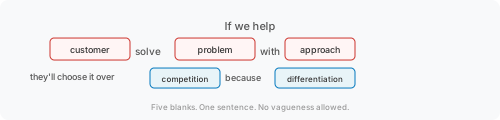
A Founding Hypothesis is a fill-in-the-blanks sentence (Mad Libs style) from Jake Knapp and John Zeratsky’s Click (2025):
“If we help
[CUSTOMER]solve[PROBLEM]with[APPROACH], they’ll choose it over[COMPETITION]because[DIFFERENTIATION].”
Five blanks. One sentence - not a deck - because a sentence can’t hide vague thinking, and because you’ll reuse it everywhere: it feeds your landing-page headline in 1.2 (reshaped into a customer-plus-outcome one-liner) and tells Module 2 who to interview and which problem to ask about (you keep the sentence to yourself in interviews - pitching it contaminates the answers). The discipline is filling all five blanks with specifics, not categories.
Each blank is an assumption, and each assumption has a test waiting for it later in the course:
| Blank | Where it gets tested |
|---|---|
[CUSTOMER] + [PROBLEM] | Strangers recognize themselves in your headline (1.2), then ten Mom Test interviews confirm the pain (Module 2) |
[APPROACH] | A clickable prototype in front of 5 interviewees (Module 2) |
[COMPETITION] + [DIFFERENTIATION] | 300 cold strangers convert on your page - or don’t (1.4) |
| The whole bet: will they pay? | The Stripe price test (1.5) |
Why this works: when the sentence is vague, people nod politely because there’s nothing to disagree with; when it’s specific, they push back - and the pushback is what you’re after:
- Bad: “We help small businesses save time with automation.” - Nobody can argue with this. Nobody can validate it either.
- Good: “If we help solo chiropractors solve insurance-claim resubmission with a one-click resubmit, they pick it over billing services that take 14 days and charge 8% of recovered claims.” - A chiropractor either says “I dealt with this last Tuesday” or “that’s not my problem.” Both are useful.
What makes a blank specific:
[CUSTOMER]: the specific person - “solo chiropractors,” not “small businesses”[PROBLEM]: what they tried and failed at in the last 30 days, in their words[APPROACH]: the shape of your solution - “one-click resubmit,” not “AI-powered workflow”[COMPETITION]: what they currently use (a spreadsheet, a billing service, “doing nothing”)[DIFFERENTIATION]: why they’d switch - faster or cheaper, with numbers
Can’t tell whether a blank is specific enough to bet on? The validation tools field guide walks three AI tools that stress-test your five blanks in about ten minutes - a structured second opinion before you commit the sentence and start booking interviews.
First Sitting: Write the Sentence (15-20 Minutes) #
You don’t need a free evening for this - one sitting tonight, phone or laptop, is enough. Scoring comes later, in a separate sitting.
Write:
- Open a blank note. Write the Mad Libs frame at the top.
- Fill each blank with the most specific noun you can. If a blank says “small businesses,” rewrite it until it names one person in one industry.
- Find one real person complaining about your
[PROBLEM]- search Reddit or G2 reviews using the words you just wrote into the blank. Paste their exact quote under your sentence. One quote is enough for tonight. If ten minutes of searching turns up nobody complaining, write that down too - it’s an early warning about the blank, and Module 2’s interviews will settle it.- Save the note to a Google Doc titled
Founding Hypothesis - [TODAY'S_DATE], inside a new Google Drive folder calledFounder OS- every module adds an artifact to that folder, and by the course’s end it is your evidence pack. You’ll paste the sentence verbatim into Lessons 1.2, 1.4, and 1.5. Module 2 uses it too - to choose who you interview and what you ask about - but you never read it to an interviewee.
The sentence exists, and one stranger’s complaint sits under it. Close the laptop if you’re done for tonight - the scoring pass reads better with fresh eyes anyway.
Second Sitting: Score It (About 20 Minutes) #
Score each lens 1-5. Be honest - this is for you, not an investor deck.
| Lens | Question (score 1-5) |
|---|---|
| Customer | Would they pick this on a Friday afternoon between meetings? |
| Pragmatic | Can you ship something with what you have today? |
| Growth | How does the customer hear about you, and how many are there? |
| Money | Do the unit economics work? (Would one customer bring in more than they cost to serve? Leave blank if pre-revenue.) |
Success check: read your sentence to one person who has never heard the idea - they say “that’s my problem” or “not me,” not “sounds great.” Then total your lenses: ≥14/20 (or ≥11/15 if Money is blank) AND no lens below 2. Write the score next to your sentence in the Founder OS doc.
If this fails: your sentence scores below 14 or has a lens at 1.
- Why: a blank is still a category, not a specific noun.
- Fix: go back to the quote you pasted in the first sitting and collect two or three more like it (Reddit, G2 reviews, or a conversation you had). The fastest way: the copy-paste research prompt in Lesson 1.2 hands Perplexity your
[CUSTOMER]and[PROBLEM]blanks and returns 5-8 sourced quotes. Replace your[PROBLEM]blank with their exact words. If the first sitting’s search found nobody complaining, leave the[PROBLEM]blank as a placeholder and complete 1.2 - you’ll fill it after Module 2 interviews.
If this fails: every blank is specific but the sentence still sounds generic.
- Why: you’re writing in market-research language instead of customer language.
- Fix: read the sentence aloud to one stranger. If they say “wait, can you say that again,” rewrite the blank they tripped on. Three reads is normal.
Read your sentence aloud to yourself. Which blank would you bet $100 is wrong? Write that blank’s name at the bottom of your Google Doc - that’s your riskiest assumption, and it’s the one Module 1 tests first.
Done: Founding Hypothesis written, scored ≥14/20 (or ≥11/15 if pre-revenue), no lens below 2, saved.
You have now: a one-sentence Founding Hypothesis with your riskiest assumption flagged (1.1). This is the seed for everything else in Module 1.
Before you close the doc: if you already know which evening this week you’ll build the landing page (1.2), drop a 90-minute block on your calendar now.
Next: 1.2 · Build Your Smoke-Test Page with an AI Page Builder - turns your hypothesis into a landing page that explains your offer to potential customers.
If blocked: see “If this fails” above. If you still can’t fill the blanks, run the deep-research prompt on the full sprint reference to find real customer complaints to anchor your blanks.
See it in action: Module 1 walkthrough: Mia builds TutorMatch
Built by JetThoughts as part of the From Idea to First Paying Customer free curriculum.