In this module
Module 3 · Lesson 3.2 · [CORE] - the quality gate on your 3.1 brief · From Idea to First Paying Customer
Input: a one-page Product Brief (from Lesson 3.1)
Output: a one-page Product Brief rewritten so engineers and AI agents stop overengineering
Progress: M3 · 2 of 2
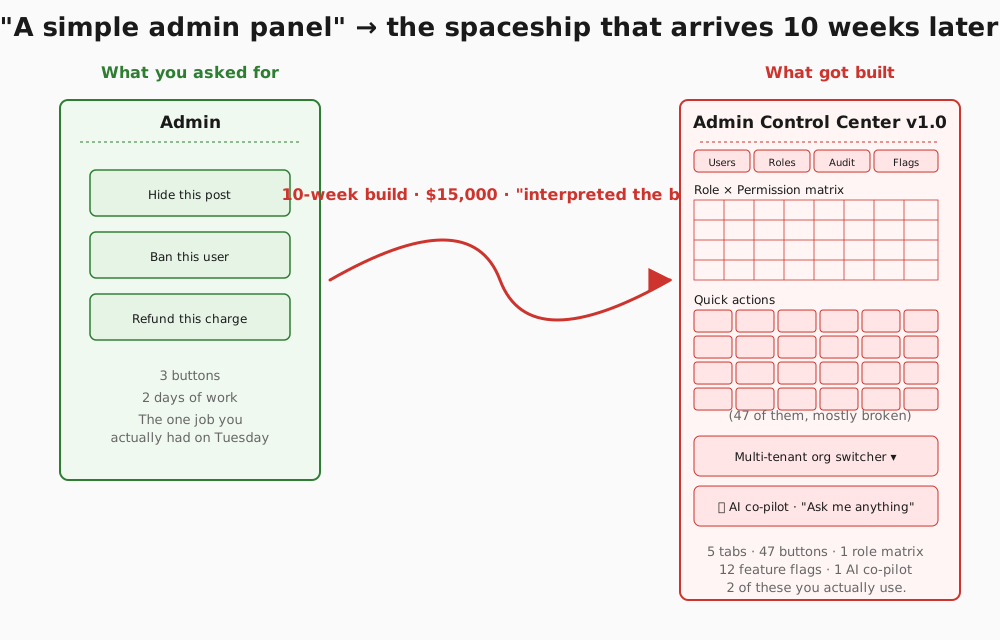
Send a builder four words - “build a simple admin panel” - and you get back 47 buttons, role permissions, an audit log, and an AI co-pilot nobody asked for. This lesson is the 20-minute rewrite that makes the builder ship the three buttons you actually meant, not the spaceship.
The Section 3 you fix here is the exact text Module 4 pastes into Lovable. It is not a rewrite for style - it is the check that decides whether the builder ships what you meant or a bigger thing you’ll spend the quarter deleting.
Why feature briefs overbuild #
Engineers and AI agents fill vague requests from training data - big-company SaaS panels, GitHub-scraped baselines, the busiest version of whatever they last saw. A feature word in isolation (“CSV export,” “user roles”) has no anchor to your actual job, so the builder invents the missing context. An outcome-shaped request leaves no blanks to fill - the moment, the action, the deadline, and the result are already on the page.
The three-part shape that constrains every spec #
Rewrite every feature noun in three parts. Each part forecloses a category of overbuild.
- When [TRIGGER_CONTEXT] - the specific situation that activates the need. Names the moment, the day, the deadline, the surrounding tools. “When I prepare the weekly investor report” tells the builder this happens once a week, that there is a deck, that there is a 4pm call. No real-time streaming dashboard for something that happens on a Tuesday afternoon.
- I want [action + budget] - a verb on a concrete object, with a limit. “I want to grab the top 5 metrics in 30 seconds” is a verb (grab), an object (the 5 metrics), and a budget (30 seconds). No 12-metric dashboard, no async export queue (background machinery that builds the file and emails it later).
- So I can [OUTCOME] - the result that proves the build worked. “So I can paste them into the deck before the 4pm call” is a finish line the builder holds every feature suggestion up against: does the audit log help you paste before 4pm? No? Cut it.
Put the three parts together and the builder has no gaps left to guess at. Drop any one - the timeframe, the action, or the outcome - and the gap gets filled from training data instead of your intent.
Same job, written both ways:
Feature shape: “Build a CSV export button on the dashboard.” The builder ships a reporting module with three dashboards, scheduled email exports, role-based access, a date-range picker, and an audit log. Six weeks. You used the button once a week.
Outcome shape: “When I prepare the weekly investor report, I want to grab the top 5 metrics in 30 seconds, so I can paste them into the deck before the 4pm call.” The builder ships one button that copies five hard-coded metrics to the clipboard. Ninety minutes. The next investor email goes out before the deck opens.
A second worked pair (the CRM module), the priced-out comparison table, and the full AI-reviewer test protocol live in the deeper reference.
Do this now #
- Open your filled-in one-page brief from Lesson 3.1. Find Section 3 (“What you’re building”). Read it out loud. Any sentence that leans on a noun-shaped feature (“a CSV button,” “a CRM,” “user roles,” “a settings page”) is feature-shaped - mark it.
- Rewrite each marked sentence in the When / I want / So I can shape. The when names a specific moment with a deadline; the I want names a verb and a budget; the so I can names a result you can measure that week.
- Share the rewritten section with your engineer or your AI agent and ask one question: “What would you build differently from this brief than from the feature list?” Their first answer is the scope you were about to lose.
Success check: every line of Section 3 names a moment and a result, not a piece of software - and the peer’s answer stays inside your Section 3 scope and no-go list.
The pass/fail rubric. The brief PASSES only if the peer’s answer stays inside your scope - the features in Section 3 and the items NOT in your no-go list. It FAILS if their answer names anything you cut in the no-go list, OR includes 2+ items outside it (your scope is too vague). No peer handy? Paste Section 3 + Section 5 into Claude or ChatGPT and ask it to name 5 things it would build that are NOT in your no-go list. Same signal, no calendar coordination.
If this fails: the reviewer names 2+ things outside your no-go list.
- Why: Section 3 is still vague - it names software parts, not moments and results, so the reviewer fills the gaps from training data.
- Fix: tighten the When / I want / So I can shape on the loosest line and ask a fresh reviewer. Do NOT advance to Module 4 with a failed brief - the Lovable build inherits the fuzziness.
Artifacts you carry out of Module 3 #
After Lessons 3.1-3.2 you have five artifacts. Each feeds a specific downstream destination - this is the map:
| Artifact | Where it goes next |
|---|---|
| One-Page Product Brief / Vibe PRD (3.1 output) | Lesson 4.1 build-path decision + Lesson 4.3-4.4 Lovable kickoff prompt. The single source of truth Module 4 builds from. |
| Outcome-shaped feature list (3.2 rewrite of Section 3 in job-story form) | Lesson 4.1 contractor SOW (Statement of Work - the document that tells a contractor exactly what to build) if you route to hire + Lesson 4.3-4.4 Lovable prompt body. Replaces the noun-shaped feature list that causes overbuild. |
| No-Go list (5-8 items cut from 3.1 Section 5) | Lesson 4.3-4.4 self-serve scope guard + Lesson 4.5 ceiling-signal monitoring. |
| Audience-of-one fork (AI agent / junior dev / senior team, from 3.1) | Lesson 4.1 build-path routing - decides whether the brief goes to Lovable or a contractor. |
| Quality-check verdict (3.2 - did the peer answer cleanly?) | Checkpoint before Module 4. If the peer cannot answer cleanly, return here and rewrite Section 3 first. |
Done: every line of Section 3 is rewritten in the When / I want / So I can shape, and one quality-check pass (peer, AI, or the manual question) names nothing outside your Section 3 scope and no-go list.
You have now: the complete Module 3 output - a one-page Product Brief with an outcome-shaped Section 3, a no-go list of 5-8 items, and a passed quality check, all in your
Founder OSfolder. This is the page Module 4 builds from.Next: 4.1 · Should You Hire? The 2026 Decision Tree - it reads the brief you just quality-checked as its input.
If blocked: see “If this fails” above.
Deeper reference: The second worked pair, the priced-out comparison, the full AI-reviewer protocol, and stack-ranking outcomes with real users
Module 3 closes here. Before opening Module 4, you should have: (1) a one-page Product Brief with 5 sections filled in (Lesson 3.1), (2) Section 3 rewritten as outcome-shaped job stories in the When / I want / So I can form (this lesson), (3) a no-go list of 5-8 items (Lesson 3.1 Section 5), and (4) a passed quality-check verdict - a peer or AI reviewer names nothing outside your Section 3 scope and no-go list (this lesson). All four in your
Founder OSfolder. Missing one? Go back - Module 4 reads the brief into Lovable prompts, and a half-written brief produces a half-working MVP.
See it in action: Module 3 walkthrough: Mia writes the one-page brief
Built by JetThoughts as part of the From Idea to First Paying Customer curriculum.