If you’re stuck, start here. These are the questions founders ask most often - read the 2-3 that match your situation and get back to the build. If your question isn’t here, try the course’s Quickstart path or the How This Course Works overview.
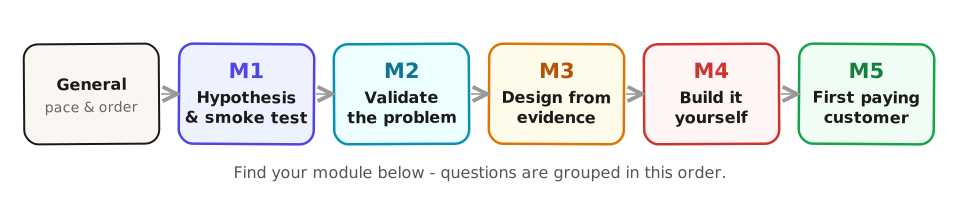
Module 1 - Hypothesis & Smoke Test #
Q: My hypothesis sentence still sounds vague after 3 drafts. What now?
Write it at the specificity level of “solo chiropractors in Pennsylvania who spend 30 minutes re-entering insurance claim codes from a PDF every Tuesday.” Not “healthcare professionals who want to save time.” If you can’t name the industry, the company size, and the specific 30-minute moment, you’re not there yet. Go back to Lesson 1.1 and fill each blank with a real person in mind.
Q: My landing page got zero signups from 300 visitors. Is the idea dead?
Maybe. Under 3% conversion on cold traffic is the kill-or-pivot band in Lesson 1.4’s decision table - and zero is well under it. But first: check your tracking. Did you install Microsoft Clarity? Watch 10 session replays. Common failure modes: the form is broken, the page takes 5+ seconds to load on mobile, or your headline is too vague. Fix those and re-run before you kill the idea. The smoke test chapter walks the four copy blocks that decide whether the page converts.
Q: My Stripe account verification is taking 3+ days. Can I skip the price button?
Don’t skip - sign up for Stripe tonight and let it verify in the background while you build the landing page. Verification takes 1-3 business days. If you wait until launch day to create the account, you block on a wait you could have run in parallel. If it’s already been 3+ days, check your email for a Stripe support message asking for business documents.
Q: Which landing page builder should I use?
Mixo (~60 seconds from idea to page). If the templates don’t fit, Carrd (no-code drag-drop). Don’t comparison-shop for a week - you’re testing demand, not builders. Lesson 1.2 has the workflow for both.
Module 2 - Validate the Problem #
Q: I can’t find anyone to interview. I’ve searched everywhere.
Two fixes: (1) Your hypothesis is too vague - “small business owners” is not a searchable ICP (Ideal Customer Profile - the specific kind of person your hypothesis names). Tighten to “12-person law-firm office manager.” (2) Search second-degree keywords: “boarding costs” instead of “pet sitter.” The Lesson 2.3 chapter has the AI prompt that generates 8 communities + 5 search strings from your hypothesis.
Q: Everyone I interview says “sounds great” but nobody gives me real data.
Your questions are probably hypothetical-shaped. “Would you use a tool like this?” generates polite yeses from anyone. Switch to past-tense: “When was the last time you dealt with [PROBLEM]? Walk me through what happened.” The Mom Test chapter has the 5-question template that fixes this.
Q: Should I skip the AI persona rehearsal (Lesson 2.2)?
If you’ve run customer interviews before and your questions reliably produce concrete past-tense answers, skip it - go straight to Lesson 2.3. If this is your first time running Mom Test interviews, the 90-minute rehearsal catches broken question shapes before they waste real interview slots.
Q: Fewer than 7 of my 10 interviewees have actually spent time or money on the problem. What does that mean?
Pivot or kill, depending on the count. The Lesson 2.5 gate reads: 7 or more of 10 interviewees with real past spend = build, 4-6 = pivot, under 4 = kill. Before you pivot, check: are you interviewing the right ICP? If you interviewed 10 chiropractors and the problem isn’t real for them, but 3 mentioned a related problem they DO care about, build a new hypothesis around that problem and re-validate.
Module 3 - Design from Evidence #
Q: My Product Brief keeps growing beyond one page. How do I cut it?
If a feature in Section 3 doesn’t trace back to a verbatim quote from a Module 2 interview, cut it. If you can’t name which interviewee said they needed it, it’s your feature, not theirs. The Lesson 3.2 chapter has the quality-gate that catches scope creep before you open Lovable.
Q: Claude keeps naming features that aren’t on my no-go list. My brief keeps failing.
Your Section 3 is too vague. Rewrite every feature as a “When / I want / So I can” job story. “CSV export” becomes “When I prepare the weekly investor report, I want to grab the top 5 metrics in 30 seconds, so I can paste them into the deck before the 4pm call.” The engineer has nothing left to invent.
Module 4 - Build It Yourself #
Q: I don’t know whether to hire or build myself.
Run the Lesson 4.1 decision tree. The default answer for a first-time solo founder with a validated brief: build it yourself with Lovable + Supabase + Stripe. Hiring triggers when you hit a Lesson 4.5 ceiling signal - not before.
Q: The 12 rules checklist is overwhelming. Where do I even start?
Only 3 rules need to be true before you open Lovable: (1) your one-page brief passed the Lesson 3.2 quality-gate, (2) you scoped one workflow for one persona, (3) GitHub sync is on in Lovable Settings. The other 9 rules fire inline during the build. Lesson 4.3 teaches the 3 pre-flight rules; the full stack reference has all 12.
Q: Lovable generated a sprawling admin panel from my one-page brief.
Your brief’s Section 3 is feature-shaped. Go back to Lesson 3.2 and rewrite every feature as a “When / I want / So I can” outcome before you re-prompt Lovable. Then use the AI critic block in Lesson 4.3 to audit your build against your brief.
Module 5 - First Paying Customer #
Q: I’m terrified of asking for money. How do I start?
The deposit is a test of whether the problem is real - not a test of whether you deserve to be paid. Send the DPA template to your warmest lead first. A deposit at kickoff is easier to ask for than a full-price sale. The Lesson 5.6 chapter has the exact contract template.
Q: My personal network only has 5 names. What do I do?
Five is enough to start. Message all five before you try cold outbound - people who already know you reply and close at many times the rate of cold strangers, which is why Lesson 5.3 runs the warm list first. If your network truly has zero applicable names, skip to Lesson 5.7 cold outbound.
Q: The customer wants to start free and convert later. Should I accept?
No. A verbal yes is not a paid pilot. Reframe: the deposit is credited toward year-one ACV (annual contract value - what one customer pays in year one), not added cost. If they still say no, their problem isn’t acute enough - they’re not in your must-have segment. Move to the next lead.
General #
Q: How long does Module 1 take?
Two to three weeks at an evenings-and-weekends pace (the pattern this course is built for). A full-time founder can finish Module 1 in about a week. The calendar is mostly wait time - ad-account approval, the 7-day traffic run, Stripe verification - not work time. The Quickstart is the shortest path - core lessons only.
Q: How long does the full 5-module course take?
A full-time founder: 6-10 weeks - the per-module estimates overlap, because outreach and interviews run while you wait on ads, Stripe, and the build. An evenings-and-weekends founder (2-4 hrs/week): 10-16 weeks.
Q: Do I need to do the modules in order?
Yes. Each module’s output is the next module’s input. The hypothesis you write in Module 1 feeds the landing page. The interviews you run in Module 2 feed the Product Brief. The brief you write in Module 3 feeds the Lovable build. Skip a module and the input to the next one is missing.
Q: I already have a half-built MVP. Where do I start?
If you validated the problem (10+ customer interviews), start at Module 3 - Design from Evidence. If you never validated, start at Module 1. The half-built MVP might be solving a problem nobody has - better to find out now than after launch.
Back to the course: From Idea to First Paying Customer - or jump back into the module you came from. Ready to start? Lesson 1.1 · Form Your Founding Hypothesis.
Built by JetThoughts as part of the From Idea to First Paying Customer curriculum.