Going Further · Manage a Hired Team · From Idea to First Paying Customer
Input: a team in place + a signed SOW
Output: a weekly Friday ritual that surfaces fake progress within 4 weeks
For later. This chapter is for founders with a hired team. Still on the self-serve path? Bookmark it for when you graduate.
What were you actually shown on your last status call? Pull up your notes and read what is on them: a burndown chart, a screenshot of a Jira board with eleven cards in “Done”, a Figma frame the designer updated overnight, a verbal summary that opened with “good progress this week.” Count how many of those are things you could click. On a call that costs a founder $31K a month, the honest count is often zero - a full status meeting that showed no working software at all.
The fix is one Slack message, sent that night:
“From now on we run a 15-minute Friday demo. Loom or live, your choice. Working software only. I want to click everything you show me.”
Send it, and the answer arrives fast: by Friday of week 3, the developers who were coasting surface, and the checkout flow you have tracked for six weeks turns out to be three Postman requests in a Notion doc and a Stripe sandbox key in someone’s .env. You find that out in fifteen minutes, on a recorded call, with no fight.
Why most weekly status calls fail #
The standard weekly call is a slide deck and a Jira tour. The agency lead picks the artifacts, controls the screen, and narrates the week. You leave the call oriented but not informed. Whether anything shipped is a separate question, and the format does not force it. Atlassian’s own writeup on demo meetings flags exactly this drift: status reviews collapse into status theatre when the agenda is “report progress” instead of “show working software.” Make the format about clicking, not slides, and the failure modes get loud fast.
The Friday Demo Rule #
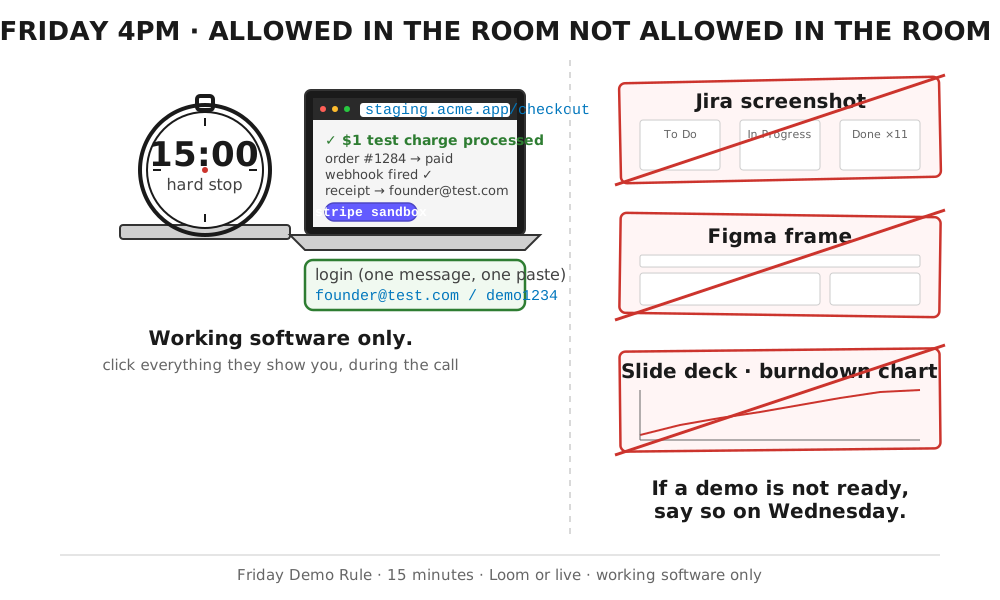
One meeting per week. 15 minutes. Friday at 4pm in your timezone. Loom (a recorded video) or live screenshare. Recorded if it is Loom. The rules are not negotiable, which is the whole point.
Working software only. Figma frames, Jira screenshots, burndown charts, and “here is what we are about to start” all stay out of the meeting. If the team cannot show you a thing you can click, the answer to “did anything ship this week?” is no - and you got that answer in 15 minutes instead of three sprints.
You attend with one question in your head. Can I click everything they show me? You open your laptop, paste each staging URL into your browser as the developer mentions it, and try to reach the screen they just described. If the URL throws a 500 or asks for a login you do not have, interrupt and ask why. Do not save the question for Monday. The point of the recording is so you have proof; the point of the live attendance is so you catch the lie in real time.
Hard stop at 15 minutes. When the demo drifts to 45 minutes, the discipline is gone within a month. The cap is what forces the team to pre-stage clickable URLs instead of debugging on the call. If the team needs longer than 15 minutes to show one week of work, something is wrong - and it is usually that nothing is on staging.
The 7 questions the team answers #
The full Monday-morning Slack template lives in the Friday Demo Template - copy and paste it into Slack on Monday so the team knows the questions before Friday. The seven questions, in the order you ask them on the call:
- What shipped this week? Show the staging URL of one thing the founder can click.
- What did the user do? Walk the feature as the user touches it - click the buttons, submit the form, show the success and failure screens.
- Where is it live for me? Send the URL and the test login in one message; the founder repeats the demo on her own laptop within five minutes.
- What did we cut to ship that? Name what was simplified, removed, or postponed. If nothing was cut, the scope was wrong or the work is not done.
- What is in review but not shipped? Open pull request, named reviewer. If nobody reviewed it, say so.
- What is blocked, and on whom? Named person, the answer the team needs from you, the deadline.
- What is the one thing I should worry about for next week? Not a status update - the actual thing keeping the lead up at night.
The order matters. Question 1 sets the frame: working software, not process. Question 4 catches over-engineering and quiet descopes. Question 7 surfaces real risk before it shows up as a missed sprint.
What good looks like vs what bad looks like #
The texture of the answers is the signal. Every question has a pass shape and a fail shape, and after four Fridays you will know your team’s pattern by sound. For the verbatim Good/Bad examples per question, see the Friday Demo Template.
The two patterns worth knowing in your head, not on a template:
Verb-only answers on Q1. Bad answers describe completion as a feeling (“we finished the Stripe integration”). Good answers point at a URL and walk you to it. If your team gives you Q1 as a verb without a clickable thing, write it down - three weeks of verb-only Q1 answers is a stalled project wearing busy clothes.
Same-name reviewer on Q5. If the same name keeps appearing as the only reviewer for every pull request, you have a bus factor of one. Will Larson on engineering anti-patterns treats the pull request funnel as the load-bearing signal for engineering health. The Friday demo is where you watch that funnel from outside the system. JT’s eight red flags checklist describes the bus-factor failure mode in plain English.
One founder sat through six weeks of “I will send the URL after the call” before her fractional CTO clicked the link the team finally sent and got a 404. The CTO’s first audit found the staging environment had been broken for two months and nobody had escalated it.
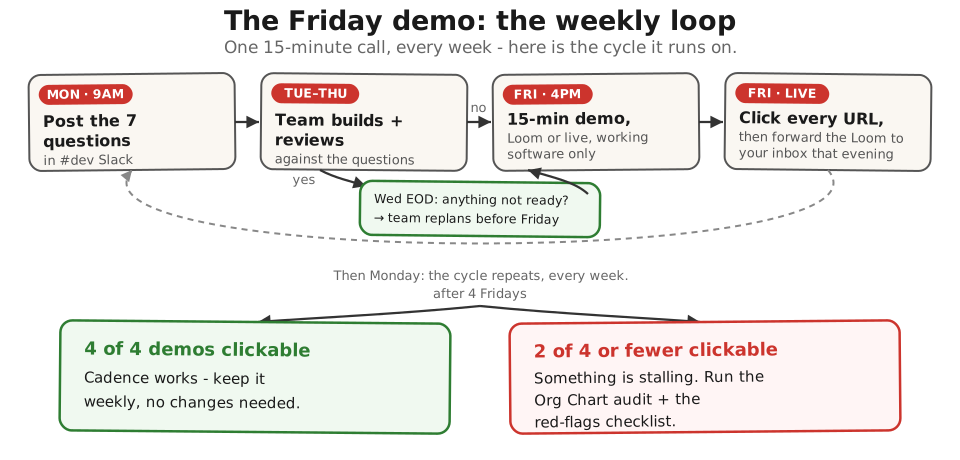
If the four-week score lands at 2 of 4 or fewer, run the Org Chart audit and the eight red flags checklist before adding any new process - the demo cadence is the symptom log, those two are the diagnosis.
What to do tomorrow #
Three actions, in order:
- Block 15 minutes on your calendar this Friday at 4pm. Title it “Friday Demo - Working Software Only.” Add your team. No agenda doc - the agenda is the seven questions, and they are the same every week.
- Check your last four weekly status calls in your notes app. How many produced a staging URL you actually clicked within 24 hours? Zero or one means the format never asked for working software - not that your team lacks effort.
- Send the Friday Demo Template to your team Monday morning. Do not paraphrase the rules - paste them. Teams respect the hard structure more than a polite request they can ignore.
By Friday of week 4, you will know whether your dev team is shipping or stalling, and you will not have read a line of code.
Further reading #
- JetThoughts, Retros Are Your Transparency Tool - the third leg of the transparency stool: the standup proves work, the Friday demo shows working software, the retro shows process health.
- JetThoughts, How to make small, valuable async standups - the daily companion practice; the demo is weekly, the standup keeps the week honest in between.
- Atlassian, Definition of Done - the “is it actually done” reference behind the working-software-only rule.
Built by JetThoughts as part of the From Idea to First Paying Customer curriculum. Authored by the JetThoughts team.