
In this post
“We hit a few blockers this sprint but we’re back on track.” Your project manager has said some version of that on three consecutive Thursday calls, and you have no way to check it.
Retros for non-technical founders are the cheapest fix for exactly that problem, and your dev shop may not be running them at all. Nobody warns you to ask, because retrospectives get written up as a thing engineers do among themselves.
The output of one is a document you can read in ninety seconds without understanding a line of code.
What a retro actually is #
At the end of each work cycle the team spends half an hour on one question: how did the last stretch actually go, and what one or two things should change next time? That half hour is the retro.
The 2020 Scrum Guide defines the event narrowly: the team inspects how the sprint went with regard to people, processes, and tools, identifies the assumptions that led them astray, and decides on the most helpful changes. Scrum.org’s plain-language version is worth five minutes if you want the vocabulary before you raise it with your agency.
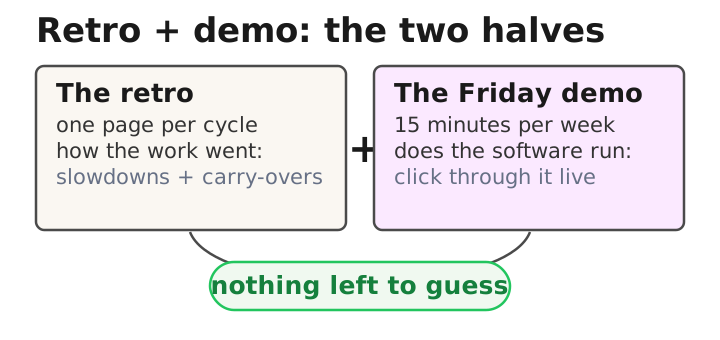
Your Thursday call already covers status, and a demo covers the product itself, where you click through working software and say whether it does what you asked. Retros cover the third thing, which is how the work went: what slowed the team down, what they got wrong, what they intend to change.
There is a daily version of the same idea, covered in three questions that turn standup into proof in our free course. The retro is the slower, more honest sibling of that conversation.
The research is unusually strong for a meeting #
Scott Tannenbaum and Christopher Cerasoli ran a meta-analysis of 46 studies on debriefs across military, medical, and workplace teams. Published in Human Factors in 2013, it found teams that debriefed properly outperformed teams that did not by roughly 20% to 25%.
That is a large effect for something that costs an hour every week or two. It also comes with a condition attached: the studies measured structured debriefs with follow-through, not a group of tired people saying “went fine, next sprint.”
Which is why the thing you check is never whether a retro happened.
What you should get as the founder #
Ask for a one-page summary after each retro. Skip the raw notes, and skip the invitation to sit in, because your presence changes what people say out loud.
Here is the shape of a useful one:
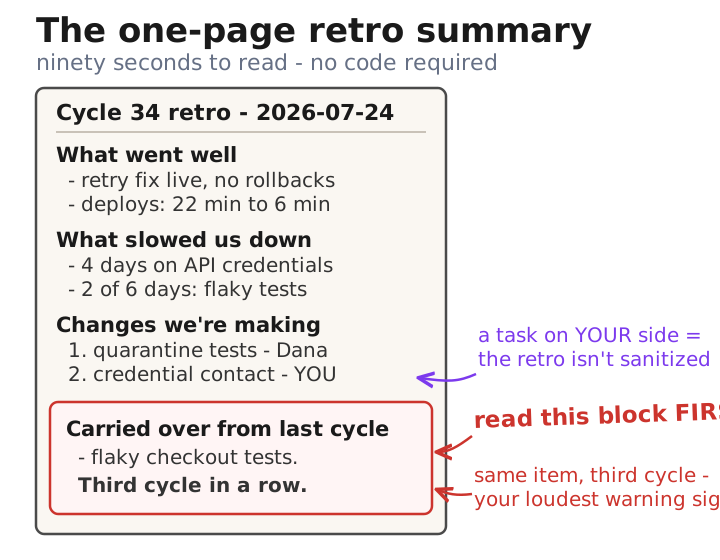
That last block is the whole reason to ask for the document.
The one line that tells you the most #
Read the carried-over section before anything else. An action item that appears in three consecutive retros is a team that has diagnosed a problem, agreed on the fix, and cannot get to it.
- Sometimes that is your fault, because you keep adding scope on top.
- Sometimes the fix is much harder than they said in the room, which is worth a direct question.
- And sometimes the team simply lacks the authority to act: if their developers cannot spend two days on the test suite without a change order from their account manager, the same item will surface forever, which tells you the constraint sits in the commercial relationship rather than in engineering.
Either way it is a live signal you can act on this week without knowing what a flaky test is.
Notice that the sample above puts a task on the founder. A retro that never generates work for your side is a retro that has been sanitized before it reached you, and sanitized retros are the common failure mode rather than missing ones. Stefan Wolpers catalogued twenty-one retrospective anti-patterns if you want to see how many ways this meeting can go quietly hollow.
How to ask for it without starting a fight #
Frame it as a request for a document rather than a change to how they work. Something close to:
“Do you run retrospectives at the end of each cycle? If so, could you send me a short written summary after each one - what went well, what slowed you down, what you’re changing, and anything carried over? I don’t need to attend.”
That phrasing gives them the format and takes the meeting off your calendar in the same sentence, and any team that already runs retros will say yes in under a minute.
Watch what comes back. A team that has been running retros produces the first summary within a cycle, sometimes by forwarding one they already wrote. Teams that have not been running them either start, which is a win, or explain that their process is too lightweight for that, which is the answer you were fishing for. Refusal to write anything down at all belongs on the same list as the other dev shop red flags.
Where this fits with the demo #
A team can write an honest, useful retrospective about a product that still crashes on login. The retro covers how the work went; it says nothing about whether the software actually runs, so it is only half of what you need.
For that you need the other half: a fifteen-minute session where somebody clicks through the actual product in front of you. The Friday demo rule in the course covers the format and the questions to ask during it. Pair the two and you have process health on one page and working software on a screen, which between them close most of the gap that makes founders anxious between invoices.
The habit is not free. An hour per cycle for the meeting, plus the work the team commits to, comes out of the same budget as features. Our own team runs a written retrospective at the end of every seven-day cycle, described in async remote XP practices, and the fixes that come out of it regularly eat a day of the next cycle. It is part of why our client retention runs about 95%, and also why our velocity in any single week looks slower than a shop that skips it.
Both of these are downstream of one habit: knowing what your team is doing through written artifacts rather than reassurance on calls.
Start with one question this week #
On your next call, ask when the team last ran a retrospective and what came out of it.
You will get a specific answer with a date and an action item, or you will get a pause while they reach for one. The pause tells you more than the tidy answer would have, and either way you know something this week that you did not know on Monday.