Going Further · Manage a Hired Team · From Idea to First Paying Customer
Input: a team in place + a signed SOW
Output: a weekly oversight rhythm where the daily standup answers “did anything ship?”
For later. This chapter is for founders with a hired team. Still on the self-serve path? Bookmark it for when you graduate.
“Yesterday I worked on the order flow. Today I am continuing the order flow.” That sentence can repeat every morning for nine weeks on a $25K/month project before anyone clocks that two of the three developers are reading out the same Jira ticket name each day. Forty-seven standups in, the ticket has not moved columns in seven weeks - and a founder can sit on every one of those calls, take notes, and nod, because the standup format never asks the question that would catch it. The three questions below are that question, split into three.
The 3 questions - printable index-card format:
Q1. Show me the staging URL of what shipped yesterday. Q2. Walk me through one PR you reviewed yesterday - what you looked for, what you flagged. Q3. What did we cut, descope, or postpone yesterday to ship that?
Why standups stopped working in 2026 #
Non-technical founders typically inherit the daily standup ritual without ever being told what good looks like. Their PM or agency lead schedules a fifteen-minute call, the team answers three questions in order, and the founder leaves the call feeling oriented. Whether anything shipped is a separate question, and the standup format does not force it. Atlassian’s own guide to daily standups flags exactly this risk: standups drift into status theatre unless someone is asking the questions that surface working software.
AI-augmented developers compound the problem. A single developer can land five pull requests a day with no observable feature progress - refactors, dependency bumps, prompt tweaks, generated tests that pass because they test nothing. The founder watching the call sees motion. The product does not move. Qodo’s 2025 State of AI Code Quality report found AI-generated code produces 1.7x more issues than human-written code at the same line count, and most of those issues hide inside the kind of work that sounds productive in a standup answer.
The three questions below replace the standard format. You do not have to drop the standard format - just bolt these on at the end and watch what happens.
The three questions #
| Question | Pass looks like | Fail looks like | Follow-up when it fails |
|---|---|---|---|
| Q1. Show me the staging URL of what shipped yesterday. | A clickable URL + route + test credentials. You click during the call and reach the screen. | “It’s in PR review.” / “On staging by Friday.” / “I’ll Loom it after standup.” | “What was the blocker?” Listen for a named person + specific tactic, not “still working on it.” |
| Q2. Walk me through one PR you reviewed yesterday - what you flagged. | Named PR # + named reviewer + 2-3 specific things checked (missing test, unauthorized gem, hardcoded key). | “We trust each other’s work.” / “CI caught the issues.” / “Everyone reviews their own when busy.” | “How many distinct reviewers approved code on my repo last week, and what is the average PR-open-to-merge time?” Want ≥2 reviewers and <2 days. |
| Q3. What did we cut, descope, or postpone yesterday to ship that? | A specific cut + the reason (e.g., “dropped the date-range picker because v1 only needs last-30-days, saved two days of front-end work”). | “Nothing was cut.” / Silence. / “We built everything in the spec.” | “Name one backlog item that, if cut today, would have zero impact on this month’s user feedback.” Good answer in <30 seconds. |
The per-question detail below explains the failure modes each question catches, why the answers look the way they do, and how to handle the awkward silence when a developer hears one of these for the first time.
Q1: “Show me the staging URL of what shipped yesterday.” #
The question catches the progress mirage - tickets moving on Jira while nothing reaches a place the founder can click. Pain #12 in our ICP profile and the single most common signal across our rescue engagements.
Pass. A clickable URL with a specific route. “It is live at staging.acme.app/checkout/v2. Use demo@example.com / example-pass-123. The Stripe webhook fires on test card 4242 4242 4242 4242.” You should be able to click it during the call and reach the screen the developer described.
Fail. “It is in PR review.” / “It will be on staging by Friday.” / “I can record a Loom after the standup.” All three mean the same thing: nothing shipped yesterday, and the team is hoping you accept process motion as evidence of product motion. A Loom recorded after the fact is not staging - it is a video the team controls.
Follow-up if fail. Ask: “What was the blocker?” Listen for a specific person (the reviewer, the DevOps engineer, the lead waiting on you) and a specific tactic (the broken migration, the failed CI step). “We are still working on it” is not an answer; it is the absence of one. If the same blocker appears three days running, the standup has surfaced a real problem - good. That is what the question is for.
Q2: “Walk me through one PR you reviewed yesterday - what you looked for, what you flagged.” #
The question catches rubber-stamp reviews and bus factor of one - the failure mode where every pull request gets approved by the same senior in under two minutes, or worse, by another junior who knows less than the author. Will Larson, who ran engineering at Stripe and Carta, treats the pull request funnel as the load-bearing signal for engineering health. Founders should too.
Pass. A named PR number, a named reviewer (not “the team”), and 2-3 specific things the reviewer checked. “PR #847, Priya reviewed it. She flagged a missing test on the refund branch, asked why the Gemfile.lock had a new gem she had not approved, and pushed back on a hardcoded Stripe key in the controller. The author fixed all three and Priya re-approved Tuesday at 4pm.” The texture is what tells you - real reviews leave a trail of pushback.
Fail. “We trust each other’s work.” / “The CI caught the issues.” / “Everyone reviews their own when the others are busy.” First answer means there is no review. Second answer is a fundamental misunderstanding of what CI does - CI catches syntax errors and broken tests, not security gaps, not architectural drift, not the migration that locks the orders table at peak hours. Third answer is the bus factor of one JT’s red-flags checklist warns about.
Follow-up if fail. Ask: “How many reviewers approved code on my repo last week, and what is the average time from PR open to merge?” The first number wants to be at least two distinct humans, ideally three. The second number wants to be under two days. If one reviewer approved 38 of the last 41 PRs with an average time-to-merge of nineteen minutes, that is not review - that is a rubber stamp with a typing delay.
Q3: “What did we cut, descope, or postpone yesterday to ship that?” #
The question catches over-engineering - the failure mode where the team builds three features when the spec asked for one, or builds a custom admin panel for an MVP that needs a Postgres console. Eric Ries defined the MVP as the smallest version that produces validated learning. A team that never cuts anything is not building an MVP; it is building a wishlist.
Pass. A specific thing the team postponed, and the reason. “We postponed the admin override screen because the users do not need it for v1 - we will handle plan changes through a Postgres query for the first month. Saved roughly two days.” The reason matters as much as the cut. “We dropped the date-range picker on the dashboard because the v1 spec only needed last-30-days, and the picker was adding two days of front-end work.” Cuts with reasons mean the team is making product trade-offs out loud.
Fail. “Nothing was cut.” / Silence. / “We built everything in the spec.” The first two mean the team is either over-engineering invisibly or is afraid to admit anything was descoped. The third answer is the most expensive one to hear - it means the team is building exactly what the spec said, including the parts the founder no longer needs, because pushing back on scope feels riskier than billing for two extra weeks.
Follow-up if fail. Ask: “What is one thing in the current sprint backlog that, if we cut it today, would have no impact on this month’s user feedback?” The good answer names something concrete in under thirty seconds. A team that needs five minutes to find anything cut-able is shipping every scope item by default, which is a different way of saying the scope was wrong from kickoff.
How this pairs with the Friday demo #
The three standup questions are the daily proof. The Friday demo is the weekly proof. Together they form a single weekly cadence: five standups answer “did anything ship today?” and Friday answers “what is the working software for the week?” Without both, the daily check feels like nagging and the weekly demo feels like theatre. With both, the daily check feeds the demo - by Friday afternoon the founder already knows what should be on staging because she has been clicking the URLs all week.
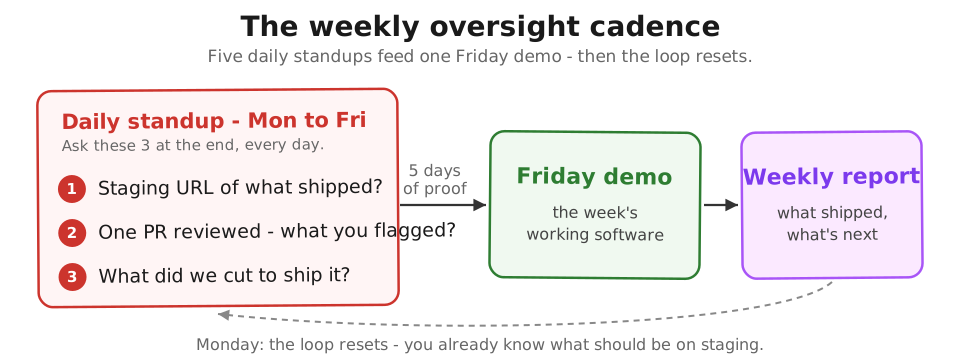
Atlassian’s 2024 update on standups and the Scrum Alliance’s reference on async standups both note that the daily ritual works only when it surfaces blockers. The three questions above are how you make blockers visible. The Friday demo is how you make working software visible. Together they replace the founder’s anxiety about whether the team is shipping with a record of what shipped, week by week. The companion Friday Demo Template holds the full script.
What to do tomorrow #
Print these three questions on an index card and bring it to tomorrow morning’s standup. Do not announce a new format - just ask them at the end, in order, after the team finishes the usual three. Write down the answers in a Notion note or a Loom transcript. Watch for the pass / fail texture: a clickable URL versus a promise, a named reviewer versus “we”, a specific cut versus silence.
After five standups, score the week. Out of five working days, how many produced a clickable staging URL you could hit from your laptop? If the answer is two or fewer, the team is not shipping at the cadence the bill rate implies. If the answer is zero, that is not a standup problem; that is a stalled project, and the standup just told you. Forward your five days of notes to a fractional CTO or developer-friend - ideally before the next sprint planning meeting.
If your team’s PR reviewer count over the same five days is one human approving everything, that is the bus factor problem. If your team cut nothing across five days, that is the over-engineering problem. Same three questions, three different failure modes, each with its own fix.
If most of the week’s answers came back as fails, the problem is not the standup format - the standup is doing its job. The next step is cross-checking your last two weeks of standup notes against the eight red flags checklist, your repo’s PR history, and the names on your reviewers. If three or more flags fire, you have a team problem, not a process problem. The 15-minute team-health assessment is the next read.
Further reading #
- Martin Fowler, It’s Not Just Standing Up: Patterns for Daily Standup Meetings - a deep practitioner reference on what daily standups should produce and when they fail.