In this module
Module 5 · Lesson 5.5 · [CORE] · From Idea to First Paying Customer
Input: 4 message templates + Loom from Lesson 5.4
Output: 50 messages sent, replies tracked, “no” responses diagnosed
Progress: M5 · 5 of 7
You have the list and the message. The order you send them in matters more than the message itself. Send champions first, cold last. And track every reply.
The send sequence in one glance:
- Send the 5 champion messages and 10 hot messages today.
- Send the 15 warm messages a day or two later.
- Send the 20 cold messages once the first replies are in.
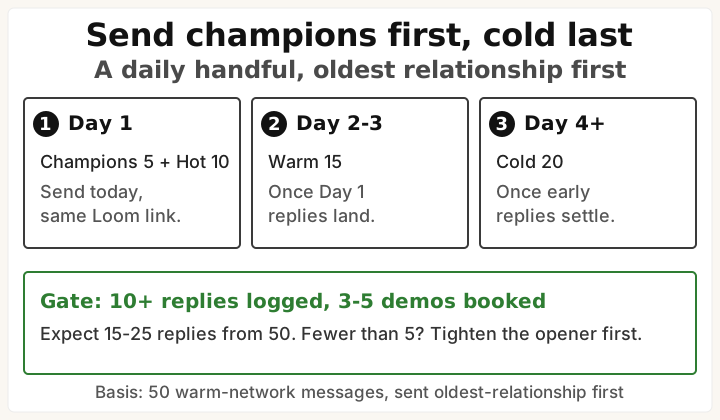
You will hear back from 15-25 of the 50 messages once replies settle. Expect far more replies than any cold list will ever give you - these are people who know you. It is the warmest outreach you will run.
Add four tracking columns to your Sheet: Reply received (date), Reply sentiment (yes/maybe/no/silent), Demo booked (date), Pilot proposed (yes/no).
What the “no” replies actually tell you:
| Pattern | Question to ask | Fix |
|---|---|---|
| The problem moved | “Did you solve this another way?” | They built a workaround. Re-check your 5.1 segment-isolation results. |
| The buying motion is wrong | “Who would make this decision?” | They have the problem but it’s not their call. Get the intro. Your champion becomes a referrer. |
| You missed the brief | “What did I over-solve or under-solve?” | Edit your product and verbatim quotes accordingly. This is the highest-payoff “no” you’ll get. |
A “no” from a cold-bucket name is a non-event. They were never the right name. Move on.
Send:
- Personalize each message’s first line (their name + the specific connection) in your Sheet.
- Send champions + hot today. Use LinkedIn DM or Gmail with the same Loom link.
- Send warm tomorrow or the day after.
- Send cold once early replies settle in.
- Track every reply in the four new columns. Book demos for evenings or weekend mornings.
- Success check: at least 10 replies received across all buckets. Book 3-5 demos.
If this fails: you get fewer than 5 replies.
- Why: your openers aren’t specific enough, or your network is too small for warm motion.
- Fix: tighten the opener on your next 5 messages. If the next 5 still produce under 2 replies, your network is exhausted. Move to Lesson 5.7 cold outbound.
If this fails: a champion says no.
- Why: the problem moved, the buying motion is wrong, or you missed the brief.
- Fix: reply with a single question from the table above. A “no” from a champion is the most expensive feedback you’ll get all year. Extract the signal before you move on.
So when a champion says no, reply and ask why - that answer is worth more than the sale.
Done: 50 messages sent, replies tracked, “no” responses diagnosed.
You have now: warm-network outreach complete (5.3-5.5). Your first paid pilots are one conversation away.
Next: 5.6 · Charge Before You Ship: The Paid Pilot Contract - the one-page DPA and Stripe deposit that converts a demo into a signed pilot.
If blocked: see “If this fails” above. If your warm network produced fewer than 3 demos, move to Lesson 5.7 cold outbound in parallel, not sequentially.
See it in action: Module 5 walkthrough: Mia gets paid
Built by JetThoughts as part of the From Idea to First Paying Customer curriculum.