The default smoke test captures email addresses. The Pieter Levels variant captures dollars instead - a real $1 refundable Stripe charge as the CTA, before the product exists.
This page is the companion writeup for that variant. Use it when an email-only signal isn’t strong enough to commit to a build.
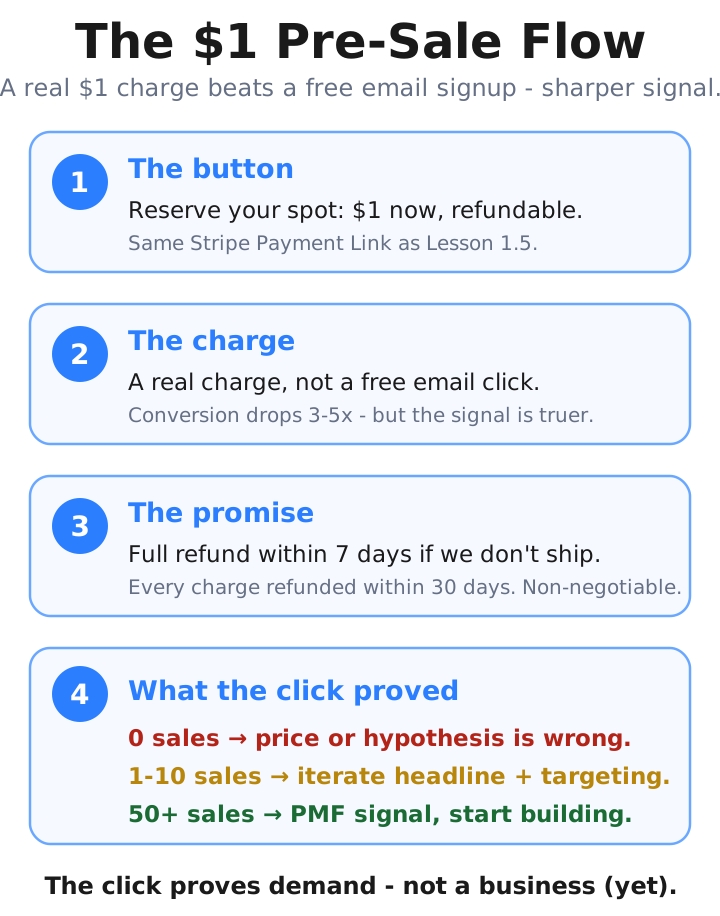
Email signup vs $1 refundable charge #
A waitlist collects curiosity - a free email costs the visitor nothing. Charging even $1 forces a wallet decision. The same 300 cold visitors who would cheerfully give you an email might generate zero payment clicks - and that zero is the validated demand signal you actually need.
The conversion rate drops 3-5x compared to the email-only version. That is the point. The remaining converters are real demand, not curious clickers.
When to use this instead of email-only #
- You ran the email-only smoke test and the signal was strong (>10% conversion); now you want to upgrade to dollar intent before you build.
- Your hypothesis price is high enough ($50+) that the wallet decision is a meaningful gate.
- You’re on your second or third hypothesis and need a sharper signal than email curiosity provides.
If you’re running your first ever smoke test, use the email-only version - it’s faster to set up, and the refund + FTC discipline below adds real overhead.
The setup (15 minutes) #
The Stripe Payment Link mechanic is the same as in Lesson 1.5 (Price Your Hypothesis on the Smoke-Test Page) - read that for the full setup walkthrough. The variant-specific changes:
- CTA copy. Replace “Get on the waitlist” with “Reserve your spot ($1 today, refundable if we don’t ship by [DATE])”. The “$1 today” + “refundable” combination is the load-bearing phrase.
- Thank-you page. “You’re reserved. We’ll email you when we ship. Your $1 is fully refundable. If we don’t ship by [DATE], you get an automatic refund within 7 days. If you change your mind sooner, reply to this email and we’ll refund within 24 hours.”
- Footer disclosure. A one-line “About this pre-order: we are testing demand for [PRODUCT]. If we don’t ship by [DATE], you get an automatic refund. Your $1 charge appears as JTHOUGHTS-RESERVE on your statement.”
- Stripe metadata. Set the product name to your hypothesis title + “(pre-order)”. This shows up on the customer’s bank statement and on the refund record.
Refund discipline (non-negotiable) #
If the test fails (you don’t ship), you refund every $1 charge automatically within 30 days. Two reasons:
- Ethics. People gave you real money for a product that doesn’t exist. The refund is the implicit contract.
- FTC compliance. US FTC pre-order rules require you to ship within 30 days of the charge unless you disclose the delay in writing AND get the buyer’s consent. The landing-page disclosure (“refundable if we don’t ship by [DATE]”) is the written delay notice; completing the checkout is the buyer’s consent to the disclosed delay. The thank-you page repeats the refund promise. Together they satisfy FTC pre-order requirements for the smoke-test window.
Set a calendar reminder for Day 25 of the test window. If you haven’t started the build by then, log into Stripe and refund all charges in one batch (Dashboard > Payments > select all > Refund). Takes 5 minutes.
Reading the result (Levels’ 70-product tiers) #
Based on Pieter Levels’ 70-product startups portfolio - a decade of running this exact test:
| Pre-sale count from a typical traffic spend | What it means | Next move |
|---|---|---|
| 0 sales | Hypothesis or price is wrong | Invalidate; rewrite the hypothesis sentence or the price point |
| 1-10 sales | Hypothesis directionally right; headline or audience wrong | Iterate headline + ad targeting; re-run for one more week |
| 50+ sales | Product-market-fit signal in range | Move to customer interviews and The One-Page Product Brief in parallel; start building |
What this test does NOT prove #
The fake-pre-sale signal tells you the headline + price + audience combination converts at the moment of decision. It does NOT tell you:
- Whether the product will retain users once shipped (that’s Lesson 5.1, the Sean Ellis 40% test).
- Whether the unit economics work at full price (that’s a follow-on test post-launch).
- Whether the people who pre-ordered will actually use the product (that’s interview-stage research - Lesson 2.1, The Mom Test).
The pre-sale is the strongest pre-build demand signal you can buy. It is not validation that you have a business.
Further reading #
- Pieter Levels, the 70-product startups portfolio - this technique in operation across a decade of indie launches.
- Lesson 1.4 (the standard smoke test - run-it phase) and Lesson 1.2 (build the page) - the email-only version this page upgrades.
- Lesson 1.5 (Price Your Hypothesis on the Smoke-Test Page) - the full Stripe Payment Link setup walkthrough.
Built by JetThoughts as part of the From Idea to First Paying Customer curriculum.