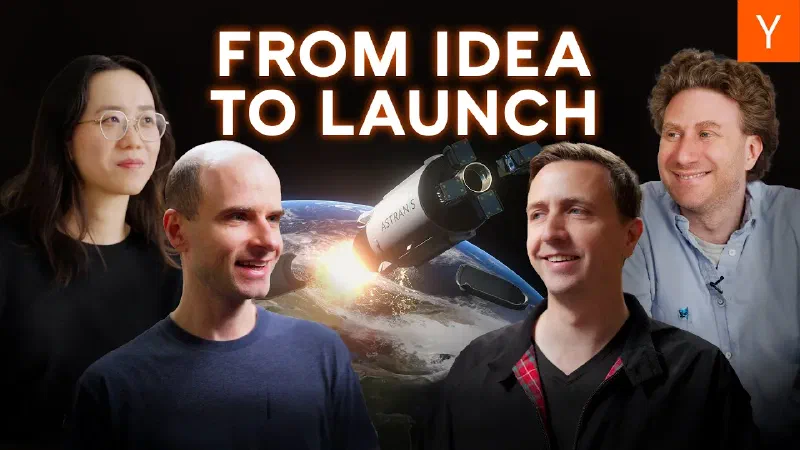
This post summarizes a Y Combinator video, published in October 2024, in which YC visits Astranis, a satellite company it funded in Winter 2016. In 2023 (“last year” in the video) Astranis launched its first commercial satellite, which the video calls a breakthrough for the aerospace industry. The video’s argument is that you do not have to be a billionaire to start a hard tech company. Everything below is the founders’ own account in that video, not independently checked.
Key Takeaways #
- Start small, but not too small: One founder says the minimum viable product for a geostationary telecommunications spacecraft “is not very minimal”, so they chose a first demonstration satellite that would prove they could build one that works in space.
- Set ambitious goals for the batch: Their YC partners told them to show up on demo day with something impressive, because anything not done by then would not matter to investors.
- Scrappy mindset: They built in an apartment on Ikea desks, with a clean room made from PVC pipe and shower curtains.
- Prove it first: A working prototype at demo day answered the objection that the plan seemed impossible.
The Birth of Astranis #
Astranis started in an apartment in downtown San Francisco. In the video, CEO John Gedmark says it was “just me and Ryan” (co-founder Ryan McLinko) hanging out in an apartment. They saw that nobody was taking a new approach, with new technology and next-generation designs, to satellites for geostationary orbit, which Gedmark calls a very valuable orbit.
The Journey Begins #
Gedmark is an aerospace engineer who had spent time on big satellite programs and knew that was not for him. He and McLinko met over 20 years ago through a student space organization and reconnected when McLinko moved to San Francisco to join Planet, which the video calls one of the pioneering space startups. They applied to Y Combinator and did the Winter 2016 batch, when other founders, partly inspired by SpaceX, were starting aerospace companies. In 2016 YC funded three aerospace companies: Astranis, Boom and Relativity Space, which the video says are now all billion-dollar companies.
Setting Goals at Y Combinator #
The founders knew the odds of raising a round big enough to put a satellite in orbit were long, so they set ambitious goals for the batch. They decided to build a first prototype satellite in three months, which they say could take some companies years.
Building the Prototype #
They built the prototype in the apartment. One founder says the core elements are fundamentally simple when you are building a demo rather than a production system. They also built a clean room from PVC piping and shower curtains, sprayed with an anti-static product so the plastic would not generate static that could damage hardware.
Demo Day Success #
At demo day the prototype answered the two reasons not to invest that the video lists: the idea seems impossible, and it might be a science project rather than a business. The video says Astranis raised one of the largest seed rounds YC had seen to that point, enough to launch a satellite.
Growing the Company #
The video says that eight years later Astranis has more than 400 employees and works out of a historic building at Pier 70 in San Francisco. Its manufacturing facility is where flight hardware is built and assembled.
Testing and Launching Satellites #
Astranis tests in-house. The video shows a shaker table that simulates the vibration of a rocket launch and thermal vacuum chambers that test a whole satellite at hard vacuum, each test lasting about seven to ten days. When the video was recorded, Astranis said it was preparing to launch four satellites together on a dedicated Falcon 9. That launch has since happened: see Astranis Launches Four Broadband Satellites With SpaceX.
The Future of Astranis #
An Astranis founder says the company was also developing its next-generation system alongside the four-satellite launch. The video’s host closes by hoping the story inspires more people to start hard tech companies. One company’s path is an example, not evidence about how many founders can repeat it.