In this post
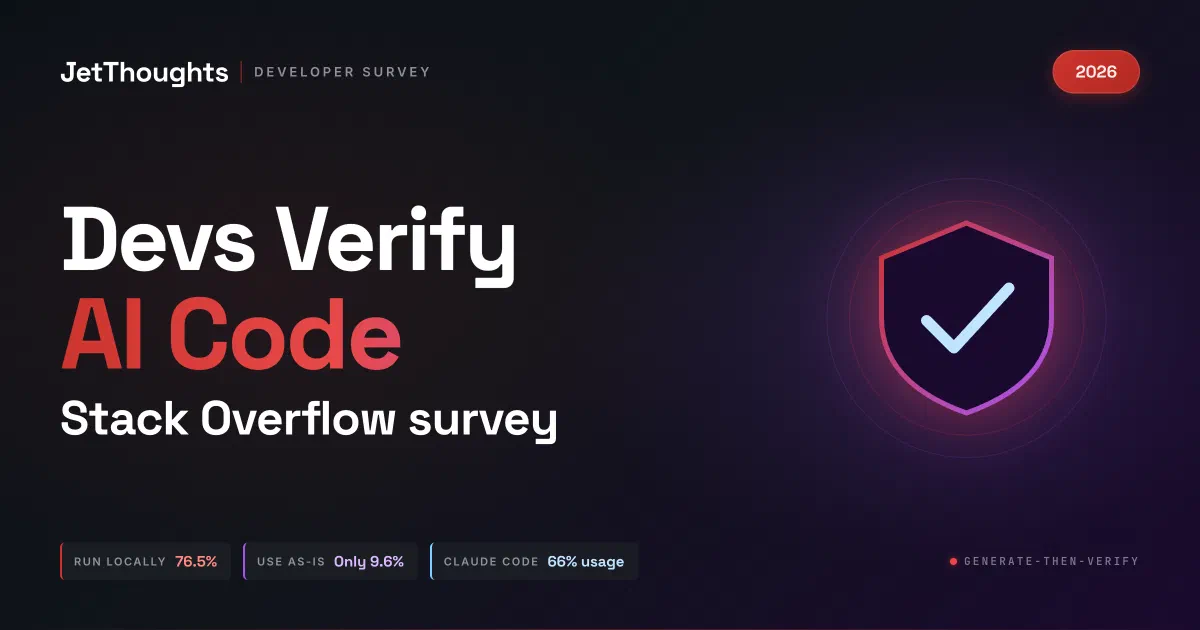
GitHub Copilot is no longer the most-used AI coding tool. Stack Overflow’s 2026 Developer Survey, published October 6 with 30,903 responses from 169 countries, put Claude Code on top at 66%, with Copilot at 59%.
The more useful number is further down the report. Asked what they do after getting an AI answer, 76.5% of developers said they run it locally first, and 63.9% compare it against their codebase. Only 9.6% use the answer as-is.
That gap is the whole story. AI writing code is now normal; trusting it unread is not. If your dev shop can’t tell you how they verify what their agents produce, they’re working like the 9.6%.
The numbers that matter #
AI usage is close to universal: 83% of respondents use at least one AI tool, and 73% of those use one daily. Among the 12,255 developers answering the agent question, Claude Code led at 65.5%, followed by GitHub Copilot at 58.7%, OpenAI Codex at 29.5%, and Cursor at 25.5%, per the survey’s AI tools data.
Trust is where it gets interesting. Of 14,304 respondents, 48% said they trust AI output only when they can easily verify it, and 6.6% trust it for important decisions. Asked how good AI is at complex tasks, 16% said “very well” - and 24% said bad or very poor.
One more number deserves a second look: only 20% use AI for deploying, operating, or troubleshooting production systems. Developers let agents loose on familiar code and keep them away from prod. After a year of agents deleting production databases, that instinct looks justified.
Verification is now the default workflow #
The behavior data reads like a description of how we already work. Run the output locally, compare it against the codebase, inspect the tests and security implications - 53% do that last one explicitly.
We wrote this up as generate-then-verify when it was still a positioning statement. The survey makes it a census result: three out of four developers treat AI output as a draft that has to compile, run, and survive contact with the real codebase before it counts.
The 9.6% who use answers as-is are doing the thing that fills our rescue pipeline. Someone has to ship the apps that arrive with no tests and no error handling, and statistically, it’s them.
What this means when you hire or vet a dev shop #
Survey data turns into a screening question fast. When a shop tells you they “use AI to move faster,” the follow-up that separates the 76.5% from the 9.6% is: walk me through what happens between the agent’s output and a merged pull request.
A good answer names a person and a step - a senior dev reads the diff, CI runs the suite, nothing merges without review. This is the same discipline behind our AI-powered code review setup, where the agent proposes and a human disposes.
A bad answer is a shrug plus a demo. The survey says most of the industry has moved past “the demo looked good” as a quality bar, and the founders who pay for AI-built MVPs that collapse under real users are usually the ones whose shop never made that move.
The tool race is noise; the workflow is the signal #
Claude Code passing Copilot will generate a week of hot takes about which agent to buy. Resist them. A year ago the same chart had different leaders, and 30 agent tools registered at least 1% this time, which means the tooling will keep churning under your feet.
What survived the churn is the shape of the work: agents draft, humans verify, verification is where the seniority lives. What senior developers catch that AI misses hasn’t changed - the survey just measured how many developers now organize their day around catching it.
Pick tools your team likes. Spend the saved energy on the review step, because that’s the part the survey says separates everyone who’s happy with AI from everyone debugging its output at 11pm.
Want a team that works this way by default? See how we work
Related reading #
- Generate, Then Verify - the workflow the survey just measured
- The Quality Tax: AI MVPs Cost More to Fix Than Build - what the 9.6% ship
- What Senior Developers Catch That AI Misses - the human side of the loop