In this post
A healthtech founder paid an offshore AI agency $28K in Q4 2025 for a HIPAA-adjacent intake tool on Rails 8. Six weeks after launch, four percent of the code had test coverage. The patient lookup endpoint had two unsanitized string interpolations in a where clause - the textbook SQL injection vector ActiveRecord’s parameterized queries are designed to prevent. Her HIPAA attorney was already drafting a BAA non-conformance letter for 60 days of exposed PHI. Her $28K MVP became an $89K MVP before her seed round closed.
If you signed an AI-built MVP because the agency promised “faster and cheaper”, that bill is coming. The AI development cost overrun is the line nobody priced into the original quote, and Bug0’s 2026 research found the real total runs 2-3x what teams thought they saved. The shop went quiet on Slack three weeks ago, and you are looking at four months of remediation invoices the original SOW did not anticipate.
Below: the lifecycle math from our 2025-2026 rescue book, why Osmani’s 80% trap kills budgets, and what disciplined AI looks like when it works.
1. The promise versus what the data shows #
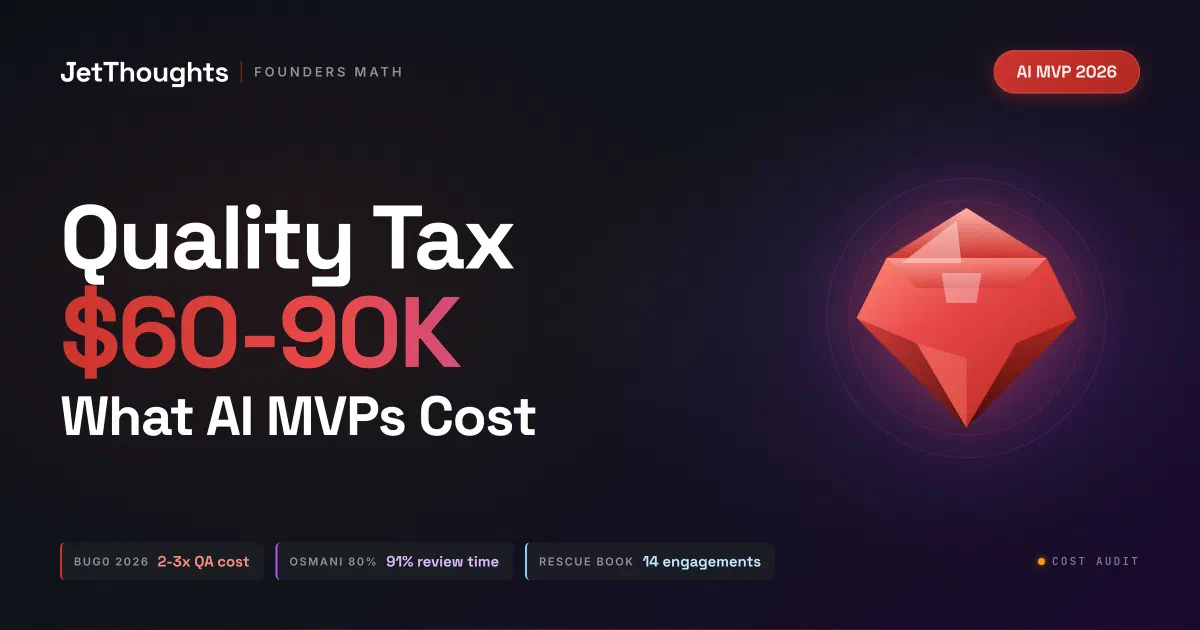
Bug0’s 2026 quality tax research found something agencies don’t put on slide decks: real QA costs run 2-3x higher than budgeted for AI-assisted development, with hidden expenses reaching $55K-$78K per developer per year on a 10-person team. The 60% cost reduction the pitch promised arrives in your inbox, until month three when bug-fix invoices start outpacing the original SOW.
Founders signed those quotes because $30K and three weeks beats $80K and four months on the comparison chart. The chart didn’t show month four through month nine - where the gap between the savings you signed for and the bill you’re paying becomes the quality tax.
2. Bug0’s findings: QA budgets went up, not down #
A SaaS founder running a B2B scheduling tool came to us in Q1 2026 after spending $34K with an AI-first agency on a Rails 8 MVP. Her contract allocated $4K for QA across the 12-week build. By month four post-launch she had paid an outside contractor $19K to write the regression suite the agency never shipped, plus a senior engineer two days a week to triage flaky tests the AI had written against mock data that didn’t match production. Her actual QA spend hit $38K before her seed round closed - 9.5x the line item, $34K MVP turned into a $72K MVP.
Her experience tracks the Bug0 data. For a 10-engineer startup running AI-assisted development, hidden QA costs landed at $750K-$1M per year. A big chunk of that ran through senior engineers cleaning up test suites the AI had generated faster than anyone could review them.
The agency quoted accurately for code generation. They had not quoted for what the generation produced downstream.
3. The 80% trap: why the last 20% is expensive #
Addy Osmani, who runs DevEx for Chrome, named the 80% problem in agentic coding - the dynamic that makes AI MVPs feel cheap until they aren’t. The first 80% is genuinely cheap and fast. Agents produce coherent output that compiles and passes the obvious cases. The last 20% requires exponentially more verification effort because AI errors shifted from syntax bugs to conceptual failures.
Osmani’s framing: the failure mode isn’t an agent that crashes. It’s an agent that succeeds confidently in a wrong direction nobody on the team is still checking.
His data backs the point. Teams with high AI adoption merged 98% more pull requests, but review times went up 91% and average PR sizes increased 154%. The Stack Overflow 2025 Developer Survey found 45.2% of developers cite “debugging AI-generated code is more time-consuming”, and 66% are most frustrated by AI solutions that are “almost right, but not quite.” That last failure mode - almost right - is the one that ships, because nobody on the team wants to be the engineer who blocked a working demo.
Your week-three demo shows the cheap 80%. The architectural decisions underneath - who owns state across three services, what happens when concurrent writes hit the same row - that’s where AI shipped wrong answers, and you’ll surface them one by one over six months.
4. The hidden costs after launch #
The visible cost is the agency invoice. The hidden costs are everything after, and the 2026 data is consistent across sources.
GitClear’s 2025 study analyzed 211 million lines of changed code from 2020 to 2024. Duplication blocks rose eightfold in 2024 versus prior years. Refactoring’s share of changed lines sank from 25% in 2021 to under 10% in 2024. Code churn - lines revised within two weeks of being written - climbed from 5.5% to 7.9%. AI ships code fast and engineers throw away nearly 8% of it within a fortnight, which means your senior is paying for code twice.
Security is its own line item. Veracode’s 2025 study of over 100 LLMs found 45% of generated code contained at least one exploitable security flaw - SQL injection, broken cryptography, cross-site scripting. Each is a remediation project after launch. The AI doesn’t write the patch unless you ask it to, and most founders don’t know to ask.
AI generates a fresh implementation for each prompt without checking what already exists, so a six-month-old AI codebase usually contains five to fifteen slightly different versions of the same business logic. In one Q1 2026 rescue we found three different def overlapping? implementations across three controllers, each with different boundary conditions on <= vs <. Cleaning that up is a senior-engineer task the original $30K invoice did not anticipate.
For more on what these patterns look like in production, see our vibe coding crisis breakdown.
5. The real math: what a $30K AI MVP actually costs #
Founders ask what an AI-built MVP “really” costs in 2026. Here is the math from 14 rescue engagements in the last six quarters.
A typical AI-first quote for a B2B SaaS MVP lands at $25K-$35K for a 3-4 week build. The post-launch invoices we see add up like this:
- Security remediation (the 45% of code with exploitable flaws): $8K-$15K
- Test suite buildout (the AI shipped scaffolding, not coverage): $10K-$18K
- Refactoring duplicate implementations: $6K-$12K
- Performance and concurrency fixes the demo didn’t expose: $5K-$10K
- Production debugging time the founder eats internally: 80-200 engineer-hours
- All-in cost (cash + internal): $60K-$90K, or 2-3x the original quote
Cash line items add $29K-$55K to a $30K starting point. Internal engineer hours add $15K-$35K at market rates. The all-in cost of making an AI-built MVP production-ready lands at $60K-$90K, or 2x to 3x the original quote.
The healthtech founder from the top of this post is the worked example. Her $28K Rails 8 MVP turned into $61K of remediation work over four months: $14K for the security pass, $19K rebuilding the test suite, $11K resolving three different implementations of the same appointment-conflict check, and $17K of tracked engineering hours her in-house engineer logged in Linear once we asked her to start tracking. Her $28K MVP became an $89K MVP, and the BAA letter from her HIPAA attorney demanded a 60-day breach timeline plus audit log retention proof - costs that never touched the engineering invoice.
The economics break four months in, when the code meets a production load it was never tested against. Honeycomb showed p99 on /appointments blowing past 4 seconds the day a 50-clinician group onboarded - the AI had nested includes loading the full patient graph per request.
6. How disciplined AI usage produces different numbers #
The agencies shipping the disasters above run AI without engineering process. Generation happens without TDD, no human reviews the diff, and there’s no security pass before merge. What ships is code that compiles, runs the demo, and breaks under real load.
Our rescue engagements have not been AI rescues. They have been vibe-coding rescues. The difference is process: we write tests first using TDD (Ruby TDD guide), ask AI to generate implementations against those tests, then a human engineer reviews every change before it merges. Architectural decisions stay with senior engineers, not the agent.
That process catches bugs cheaper than the alternatives. A bug caught in TDD costs about ten engineer-minutes. In code review, half an hour. In production, you’re looking at a day of work plus a Slack apology to your biggest customer. Pure vibe-coding shops don’t cut your MVP cost - they move the bug-catching invoice from their billing cycle to yours, and you pay it three months after launch.
A B2B fintech founder, post-Series-A in Q4 2025, had been quoted $42K by an AI-first shop for a 4-week MVP. She engaged us at $58K instead - same scope, 6 weeks, TDD and security pass included. Eight months on, her test coverage sits at 78%, she has added two engineers without a rewrite, and her only post-launch fix was a 6-hour rate-limiting issue in the third-party broker integration that no test could have caught at MVP scope. Sticker price was 38% higher; her 12-month all-in came in 41% lower.
Disciplined AI usage is teachable, and we wrote the walkthrough down. Our free course for non-technical founders covers the same tools-then-build sequence - Lovable, Supabase, Stripe - plus the pre-flight rules that keep AI output honest before you write a line of code. The Self-Serve MVP Stack: Tools & Setup.
7. When AI actually saves money #
AI saves money in two specific conditions, and we’ll be direct about both.
The first is when the work is genuinely throwaway. Prototypes for investor demos, internal tools nobody depends on, marketing copy that gets refreshed quarterly. The 80/20 economics flip in your favor when “almost right” is good enough because nobody’s data is on the line. We use AI heavily for these.
The second is when AI is paired with engineering discipline the AI itself doesn’t provide: TDD before generation, code review after, security pass before merge. AI generates code faster than any human can review it. That speed without discipline compounds into the technical debt your CFO finds in month four. With the discipline wrapping it, it produces real savings - typically 20-30% off a comparable hand-written project. Agencies pitch 60% savings. The honest number is closer to 25% and it holds up at month four.
What doesn’t work is the model most AI-first agencies sell in 2026: generation without verification, shipped to production, charged at “savings” rates. The invoice savings are real. Engineers eat them on Saturdays three to six months later, fixing the parts the AI got 80%-right. (47% of failed startups in our rescue book made this exact mistake.)
If your agency can’t tell you which mode they operate in, you have your answer. (Dev shop red flags covers warning signs, and 5 questions to ask before hiring a dev shop gives you a vetting script.)
Save this as your AI agency vetting test. Before you sign with any AI-first shop, ask three questions: (1) Show me a TDD-driven AI-generated commit. (2) What’s your security review pass for AI code? (3) What does month four post-launch look like for your clients? Vague answers mean the quality tax is already in your future.
Need engineers for this? See how we work
Agencies quote the headline price. The four-month invoice is the one that decides whether your seed round survives.