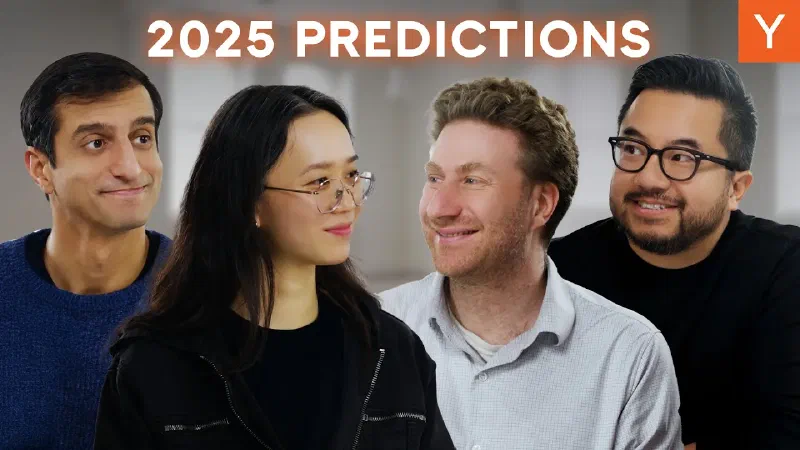
This post summarizes The Lightcone 2025 Forecast, a New Year’s Day 2025 mini-episode of Y Combinator’s Lightcone podcast in which the hosts each make a prediction for 2025. Predictions are opinions, not findings, and these were recorded around the turn of the year 2024 to 2025. We do not score them here.
Key Takeaways #
- One host predicts AI will win more Nobel prizes.
- One host predicts that people will buy something real with a stablecoin during 2025.
- One host argues that if the US government’s DOGE effort cuts spending, interest rates and crypto prices could move.
- One host predicts a real-time video call with an AI avatar that does not feel uncanny.
AI’s Impact on Science #
The first host starts from the 2024 Nobel prizes, which went to work behind AI:
- Physics: John Hopfield and Geoffrey Hinton, “for foundational discoveries and inventions that enable machine learning with artificial neural networks” (Nobel Prize).
- Chemistry: one half to David Baker for computational protein design, and the other half jointly to Demis Hassabis and John Jumper of Google DeepMind for protein structure prediction, which is the AlphaFold work (Nobel Prize).
The host says there are four of the six Nobel prizes left to win, “so why not winning one more”, and wonders whether the next could be in mathematics, given collaboration between OpenAI and the mathematician Terence Tao. It is a guess. Nobel prizes are awarded for work already done, and the host does not claim a date.
Crypto Goes Mainstream #
A second host calls this “a dangerous one to make on camera”: by this time next year, he says, you and everyone you know will have bought at least one real thing, such as a cup of coffee or a book, with a stablecoin.
His reasoning:
- Payments as a marketplace: a payment network has vendors on one side and consumers on the other. Marketplaces are hard to start because of the chicken-and-egg problem, but sticky once solved.
- One side is ready: he says hundreds of millions of people have crypto wallets and could pay with stablecoins such as USDC.
- Merchants are the other side: he says that is the easier half, a traditional sales effort, because there are fewer merchants.
He also points to the collapse of the fintech startup Synapse, which lost user funds, as a case where an open ledger could help trace where money went.
The Role of Interest Rates #
A third host links crypto to interest rates. If DOGE, the effort by Elon Musk and others to reduce government spending (the US Department of Government Efficiency), succeeds, he argues, deficit spending falls, interest rates come down and the economy picks up. Crypto prices, he says, tend to be highly correlated with interest rates, and he then expects Dogecoin to go up in a roundabout way. If DOGE fails, he expects the reverse.
Another host adds that AI may be a strong deflationary force, which could let rates fall without a surge in inflation.
This is one host’s macro argument, delivered on camera as a bet. It is not an established relationship.
AI and Virtual Interactions #
The fourth prediction: in 2024 you could finally have a phone call with an AI that felt natural, because latency got low enough. In 2025, the host expects a Zoom call with a real-time virtual avatar, a face and lip sync that does not feel uncanny. He calls it a “3D Turing test”. He says latency and lip syncing are the things that are bad right now.
Conclusion #
Four predictions from four people at one venture firm: more Nobel prizes touched by AI, stablecoins used for everyday purchases, an interest-rate and crypto link tied to DOGE, and a real-time AI video avatar. If you read them, check for yourself which came true.