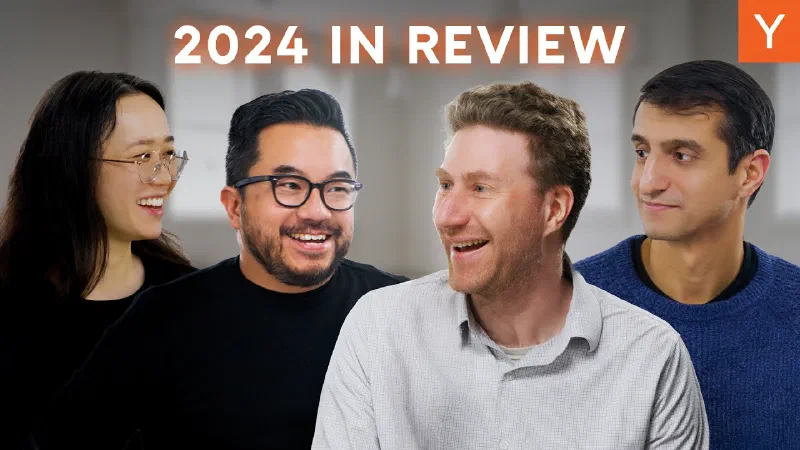
This post summarizes the December 2024 episode of Y Combinator’s Lightcone podcast, “2024: The Year the GPT Wrapper Myth Proved Wrong”. The YC hosts, who say they have collectively funded companies worth hundreds of billions of dollars, look back at the biggest trends, moments and setbacks of the year. Everything below is their view from inside YC, not independent data.
Key Takeaways #
- The hosts say a startup can now reach tens of millions in revenue within 24 months.
- The myth of the GPT wrapper has been debunked.
- Open-source models are changing the game.
- Voice AI and robotics are on the rise.
- The startup hiring landscape is evolving.
The Startup Boom #
One host calls it the wildest thing right now: you can start a company that makes tens of millions of dollars in 24 months from zero, on potentially $2 million to $5 million raised. His example is Opus Clip, which never had to raise a real Series A. The hosts also recall that a year earlier many YC startups got enterprise pilots and there was cynicism about whether they would become revenue. In their experience those pilots have turned into real revenue. They add that it is still early days, and that it’s anyone’s game.
The GPT Wrapper Myth #
Remember when everyone thought that all the value in AI would go to OpenAI? After ChatGPT launched, the hosts say the consensus was that everything built on top of it was a “GPT wrapper” that the ChatGPT store would crush. Their view in 2024: that did not happen. They point to applications not built by OpenAI, such as Perplexity as the breakout consumer application, Glean as probably the breakout enterprise one, and Harvey and PhotoRoom in other areas. Their conclusion is that the GPT wrapper worry was a myth, and that product, sales and responding to user feedback matter more once you have a choice of models.
The Rise of Open Source #
The hosts credit open source with a crucial role in this shift. They say leaked weights forced Meta’s hand to launch Llama, and that during the summer of 2024 it was the first time the top foundation model in the rankings and benchmarks was Llama, which they call a shock to the community. Their argument is that once there is a choice of models, no one can have monopoly pricing, and startups can compete on other things. They also describe founders using several models in one product, a fast one for parsing and a bigger one for harder tasks.
Voice AI: A Promising Frontier #
The hosts call voice AI maybe the most promising vertical for AI right now in terms of traction. Their view is that it will not be one winner: they expect several voice apps even in language learning, and say customer support is not one vertical but many flavors, so a voice agent for an airline differs from one for a bank. They expect both horizontal infrastructure companies and many vertical applications to do well.
Robotics on the Rise #
The hosts say they are working with more founders building robots this year than in any year before. They describe robotics as half AI and half hardware: the AI half is starting to work, while the hardware is still hard and expensive. Their dream case for startups is to build the AI or software piece and run it on commodity hardware, which they say is an open question. They also say robotics hasn’t quite had its ChatGPT moment yet.
The Changing Hiring Landscape #
The hosts say some founders who recently raised seed rounds are not following the classic advice to hire more people. Some plan to have engineers write more processes that use LLMs first, and hire for a role later, maybe after a Series B or C. They also describe founders looking for engineers who are native with an AI coding stack, and using pair-programming interviews to watch candidates use the tools. This is anecdote from a few founders, not survey data.
The Impact of Regulation #
The hosts say the startup world dodged a bullet on regulation: California’s SB 1047 did not become law, and they think some of the Biden executive order is not likely to survive the Trump White House. They add that it’s to be determined what this means in the longer term. Their worry had been that math beyond a certain level could become illegal or require registration, and that startups would face regulatory capture by OpenAI and a few big players.
The Return of In-Person Events #
The hosts say YC is back to a live, in-person Demo Day after the Zoom years, with about 1,200 investors in one room at the Masonic Center. They say the energy of an in-person demo day is something you can’t replicate over Zoom, and that in-person and San Francisco are back.
Conclusion #
The Lightcone hosts see 2024 as the year things broke in favor of startups. That is the view of YC partners describing the companies they fund, so read it as one informed perspective. If you want the full conversation, watch the episode.