In this post
Stop building features nobody wants. Start with customer jobs, then measure what matters.
You’ve Been Here Before #
Your team ships a new feature. Everyone high-fives. Six weeks later, usage data comes in.
Nobody’s using it.
Why? Because we build what WE think customers want, not what THEY actually need.
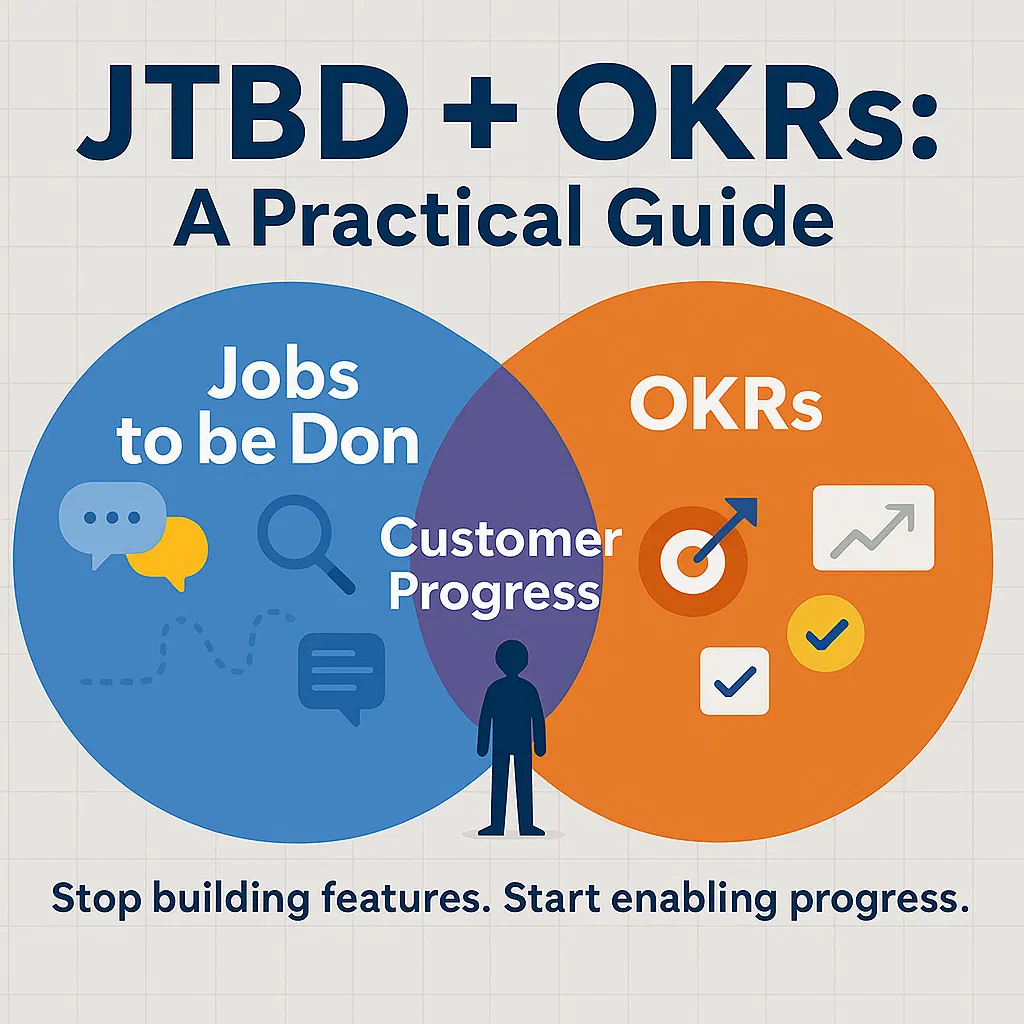
This guide shows you how to fix this problem by combining two powerful frameworks:
- Jobs-to-be-Done (JTBD): Discover what customers truly need
- Objectives and Key Results (OKRs): Measure outcomes that matter
Let’s dive in.
What Are Jobs-to-be-Done? #
People don’t buy products. They hire them to make progress in their lives. That is the Jobs-to-be-Done framing, popularised by Clayton Christensen and colleagues in the HBR article Know Your Customers’ “Jobs to Be Done”.
This isn’t just semantic wordplay. It changes everything.
A well-worn marketing line puts it this way: people don’t want a quarter-inch drill, they want a quarter-inch hole.
This shift forces you to think about outcomes, not features. Ask “What progress is our customer trying to make?” instead of “What should we build next?”
Two illustrations of rewording a job (our examples, not research findings):
- A music app’s job might not be “play music” but “find the right music for my mood right now”
- A food delivery app’s job might not be “deliver food” but “get dinner on the table with no hassle”
Jobs have multiple dimensions:
- Functional: The practical task (complete a project)
- Emotional: How they want to feel (confident, not stressed)
- Social: How they want others to see them (organized, professional)
Understand these dimensions and you’ll build products people actually want to use.
What Are OKRs? #
OKRs turn your strategy into measurable targets.
An Objective is where you want to go. It should be clear and inspiring.
Key Results are how you’ll know you’re getting there. They must be specific and measurable.
Good OKRs have these traits:
- Focused: Few objectives, few key results. Google’s re:Work guide suggests three to five objectives with about three key results each; fewer is easier to track
- Outcome-oriented: Measure results, not tasks
- Measurable: “Increase X from Y to Z by date”
- Ambitious but achievable: Push yourself without setting impossible goals
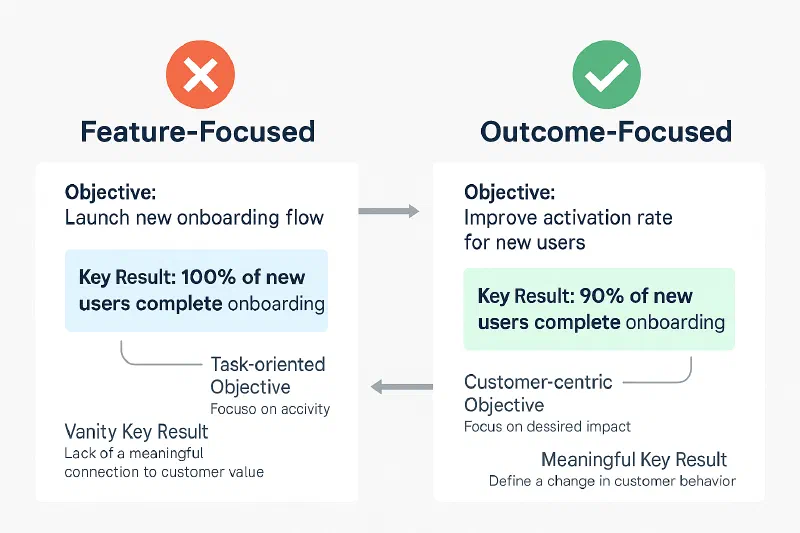
The biggest OKR mistake? Turning them into a task list.
“Launch feature X” is not a Key Result. “Increase user retention from 20% to 30%” is.
Why These Frameworks Work Better Together #
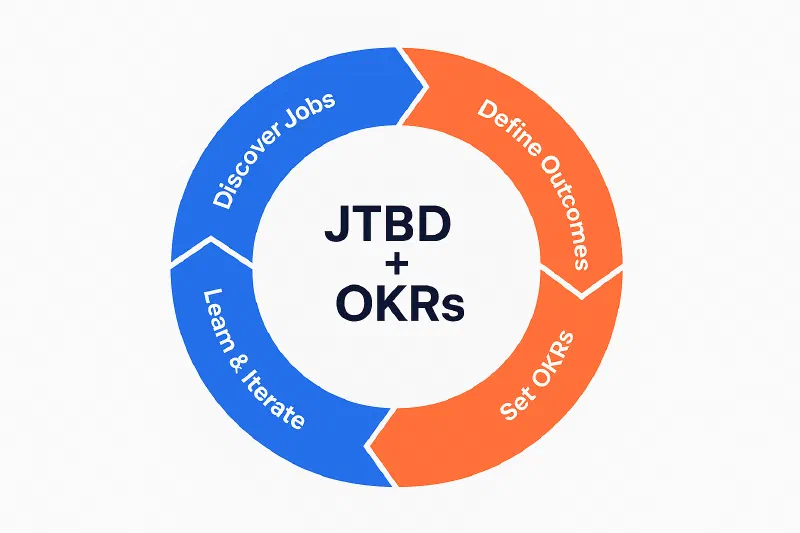
JTBD gives you direction. OKRs give you a map.
JTBD shows what customers need. OKRs track how well you’re meeting those needs.
Together, they create a system where:
- Customer jobs inform what goals matter
- OKRs track progress toward enabling those jobs
- Success means actual customer outcomes, not shipped features
Now, let’s put this into practice.
How to Uncover Jobs: The Timeline Interview #
The best way to discover jobs is through customer interviews that focus on their decision journey.
Here’s how to do it right:
Step 1: Find the Right People #
Talk to customers who recently:
- Started using your product
- Switched from a competitor
- Stopped using your product
Recent decisions are fresher in memory. How many interviews are enough varies; keep going until new interviews stop showing you new patterns.
Step 2: Map Their Timeline #
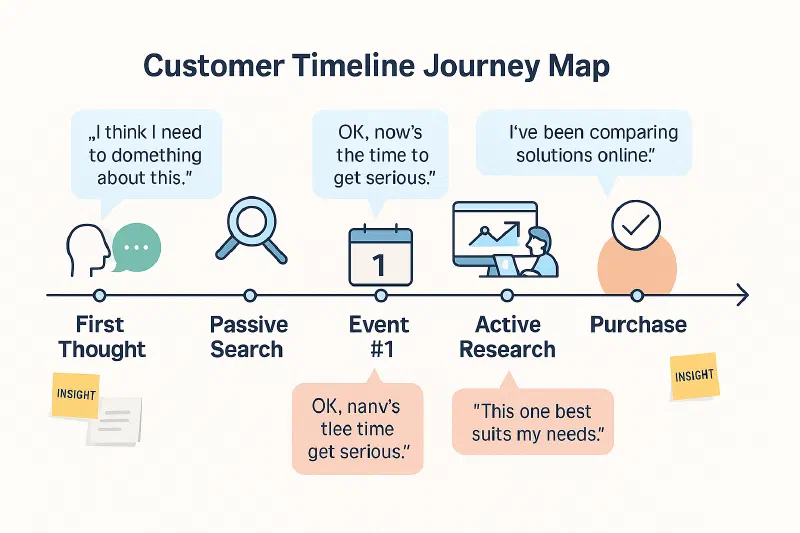
Start at the end (purchase) and work backward to the first moment they realized they had a problem.
Ask these key questions:
Purchase Moment: “When did you sign up for our product? Where were you? What made you decide that day?”
First Thought: “When did you first realize you needed something to help with this problem?”
Passive Phase: “After that first thought, did you look for solutions right away or think about it for a while?”
Active Search: “What pushed you to get serious about finding a solution? How did you research options?”
Decision: “What made you choose our product over others? What almost stopped you?”
Keep asking “Why was that important?” and “How did that make you feel?”
Your goal: Understand their story, not confirm your assumptions.
Step 3: Create a Journey Map #
After interviews, map each customer’s journey:
- First Thought: What triggered their need
- Passive Looking: Initial casual research
- Event #1: What pushed them to serious search
- Active Research: How they evaluated options
- Decision Criteria: What mattered most to them
- Event #2: Final trigger to purchase
- Purchase & Outcome: Did it solve their problem?
This visual timeline reveals patterns and highlights key moments in their decision process.
Step 4: Extract Jobs and Desired Outcomes #
Now identify:
- The primary job statement: What progress was the customer trying to make?
- Desired outcomes: How would they measure success?
For example:
- Job: “Help me coordinate team work so nothing falls through cracks”
- Outcomes: “Minimize time spent tracking status,” “Maximize confidence that nothing is overlooked”
These outcomes will form the foundation for your OKRs.
Turning Jobs into OKRs #
Once you understand customer jobs and outcomes, translate them into OKRs:
Step 1: Define Your Customer-Centric Vision #
Create a simple job statement that captures your product’s purpose.
Example: “Our product helps team leads organize projects so they never miss deadlines.”
Step 2: Select Top Desired Outcomes #
From your interviews, pick the outcomes that:
- Multiple customers mentioned
- Are currently underserved
- Would provide a competitive advantage
Focus on 2-3 key outcomes. Don’t try to tackle everything at once.
Step 3: Turn Outcomes into Objectives #
Phrase objectives as customer outcomes, not features.
Instead of “Launch automation features,” try “Make project coordination effortless for our customers.”
Good objectives are:
- Customer-focused
- Clear but inspiring
- Ambitious but achievable
Step 4: Define Measurable Key Results #
For each objective, write a few key results (Google’s re:Work guide uses about three) that measure success. The numbers below are placeholders to show the shape, not benchmarks:
User behavior metrics: “Reduce average time to set up a project from 1 hour to 30 minutes”
Satisfaction metrics: “Increase ease-of-use rating from 7/10 to 9/10”
Business metrics tied to customer success: “Increase 30-day retention from 40% to 60%”
Each KR needs:
- Current baseline
- Target number
- Deadline
A complete OKR might look like:
Objective: Make project tracking simple for team leads
- KR1: Reduce weekly coordination time from 5 hours to 2 hours by Q4
- KR2: Improve task completion rate from 70% to 90% by Q4
- KR3: Increase NPS for project leads from 30 to 50 by Q4
Notice how each KR links directly to a customer outcome from your research.
Step 5: Track and Learn #
Review progress weekly:
- Are metrics improving?
- If not, what might work better?
- What new customer insights have we found?
At quarter’s end, evaluate:
- Did we hit our targets?
- Did improving these metrics actually delight customers?
- What new jobs or outcomes have we discovered?
Use these insights to set your next round of OKRs.
Common Pitfalls to Avoid #
Here are the biggest mistakes teams make:
JTBD Interview Mistakes #
Leading questions: Bad: “Don’t you think our app is great for collaboration?” Better: “How did you compare different options?”
Hypothetical scenarios: Bad: “Would you use a feature that did X?” Better: “Tell me about the last time you tried to do X.”
Ignoring emotions: Bad: Only asking about features used Better: “How did you feel when that happened?”
OKR Mistakes #
Task-based Key Results: Bad: “Launch feature X” Better: “Increase metric Y by Z%”
Too many objectives: Bad: Many objectives, each with a long list of KRs Better: A handful of objectives, about three KRs each
Set and forget: Bad: Creating OKRs then never discussing them Better: Weekly check-ins on progress
The goal isn’t perfect OKRs. The goal is better customer outcomes.
Two Worked Illustrations (Hypothetical) #
These are made-up examples to show how a job turns into an objective and key results. They are not case studies and the numbers are placeholders.
A Clinic Software Product #
Job: JTBD interviews suggest doctors aren’t looking for “clinic management” but to “finish paperwork quickly and see more patients.”
Objective: “Make our software the time-saving assistant for every clinic doctor.”
Key results could be:
- Reduce documentation time from [current] to [target] minutes per visit
- Reduce reported errors by [target]%
- Raise doctor satisfaction (NPS) from [current] to [target]
Measure the baseline first, then pick targets.
A Fitness App #
Job: interviews suggest users aren’t hiring the app to log data but for “help staying motivated to live healthier.”
Objective: “Become our users’ personal motivator for healthy living.”
Key results could be:
- Increase 4-week retention from [current] to [target]
- Raise a self-reported motivation rating from [current] to [target]
- Increase the share of users hitting weekly goals from [current] to [target]
Then you would test motivation features (streaks, celebrations, social features) against those numbers rather than adding more tracking screens. Whether they work is exactly what the key results are there to tell you.
The Mindset Shift: From Outputs to Outcomes #
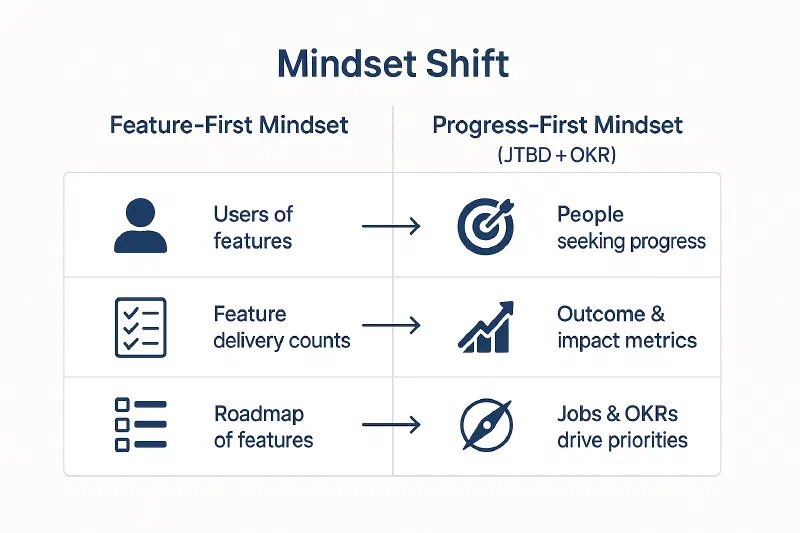
The real power of JTBD + OKRs is the mindset shift they create.
You stop asking: “What features should we build?”
You start asking: “What progress are customers trying to make?”
This shift changes everything:
- Product decisions prioritize customer outcomes over technical interest
- Marketing speaks to progress, not features
- Teams rally around customer success, not shipping deadlines
You measure success by customer outcomes, not your outputs.
Did the customer solve their problem faster, easier, more affordably? That’s what matters, not whether you shipped on time.
Your Action Plan #
Ready to implement JTBD + OKRs? Start here:
- Schedule 5 customer interviews using the timeline approach
- Map their journeys and identify common jobs and outcomes
- Craft a primary job statement for your product
- Select 1-2 key outcomes to focus on
- Create customer-centric objectives and measurable key results
- Track weekly and adjust as needed
This isn’t a one-time exercise. Markets evolve. Customer needs shift. Your product grows.
Make JTBD + OKRs an ongoing practice. Keep listening. Keep measuring what matters.
Bottom Line #
Stop building features. Start enabling progress.
When you understand what job customers hire your product to do, and measure success by how well you help them do that job, you build products people actually want.
And that’s what drives sustainable growth – one delighted customer at a time.