
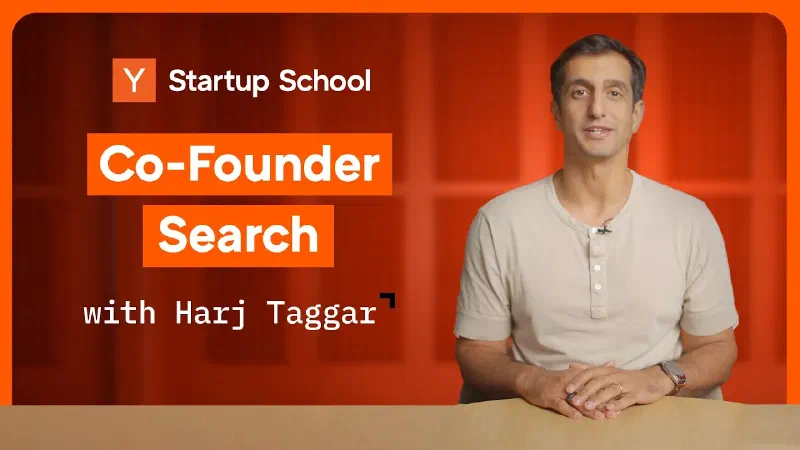
This post summarizes How To Find A Co-Founder, a Startup School talk by Harj Taggar, a group partner at Y Combinator (Y Combinator, September 2024, about 20 minutes). He covers why you need a co-founder, when to start without one, and where to find one. The advice below is his, not ours.
Key Takeaways #
- Importance of Co-Founders: They help share the workload and provide emotional support.
- Finding a Co-Founder: Look within your network and be open to possibilities.
- Maintaining Relationships: Regular communication is key to avoiding conflicts.
Why You Need A Co-Founder #
Starting a company is tough. Here are three reasons why having a co-founder is crucial:
- Shared workload: Taggar says building a startup is a huge amount of work against companies with hundreds of employees, and two people are more working hours per day than one. A co-founder with complementary skills can also do things you can’t and challenge your bad ideas.
- Emotional support: Startups are a roller coaster. Taggar says your co-founder should be all in, the way you are, and can lift you in bad moments. That is why you can’t just hire people later and get the same benefit.
- Pattern matching: He points out that the most successful startups in history had co-founding teams. His examples: Mark Zuckerberg co-founded Facebook with Dustin Moskovitz, and Steve Jobs had Steve Wozniak for the first Apple computer.
Should You Start Without A Co-Founder? #
Taggar says that in about 90% of cases you should put your effort into finding a great co-founder. He sees an exception in the other 10%, when you meet both conditions:
- Go solo if: you have a very specific idea you are passionate about, domain experience that makes you uniquely qualified, and you are an engineer who can start building without a technical co-founder.
- Wait if: you are not an engineer. Then, he says, focus on finding a great technical co-founder.
His example of a solo founder who worked out is Drew Houston of Dropbox. YC initially rejected him as a single founder and told him to get a co-founder. He kept building the MVP while looking for one, and found a great one.
What To Look For In A Co-Founder #
Finding the right co-founder is essential. Here’s what to consider:
- Stress management: Taggar calls this the most important trait, because failed co-founder relationships are, in his words, the number one reason he sees startups fail at YC. The best test is to have worked together under stress. A friend or former colleague is not a guarantee if you never faced real stress together, but you are still more likely to do well with someone you know than with a stranger.
- Shared goals: Ask why they want to start a company and what success looks like for them. Someone who wants a fast-growing, venture-funded company is a poor match for someone who wants a slow, steady lifestyle business.
- Growth potential: If you are building software, at least one co-founder should be technical and able to program. Beyond that, he says not to fixate on their exact skills today. Care more about whether they are smart, willing to learn and able to grow as the startup changes.
Where To Find Co-Founders #
Finding a co-founder can be challenging, but here are some tips:
- Network: People you know. Taggar says the number one blocker he sees is assuming everyone you know is unavailable. Make the ask, and if they say no, ask whom they would pick and request an introduction.
- Projects: Engineers can work on open source projects and attend hackathons and developer meetups.
- Co-founder matching: YC runs a co-founder matching platform. Taggar’s tip is to look for people you have things in common with, who you would probably have met eventually anyway.
Getting Started Together #
Once you find a potential co-founder, how do you start working together?
- Test compatibility: If you don’t already know each other well, spend evenings and weekends on small projects together first. He compares it to a dating period before you commit.
- Have the goals conversation: Talk about why you each want to start a company and what you want out of it.
- Split equity equally by default: Taggar’s reasoning is that the company will take 10 years or more, so who had the idea first matters little over that time.
Common Reasons For Co-Founder Breakups #
Even with the best intentions, co-founder relationships can falter. Here are some common reasons:
- Lack of respect: Taggar says this is the most common reason. It often appears when one co-founder handles sales and the other builds the product, and each decides the other is not doing their job well enough.
- Several people want to be CEO: He says early titles matter little day to day, but the CEO is the person trusted to make the final call on hard decisions.
- Different work ethic expectations: One wants to work all the time, the other wants more balance. Taggar says those relationships get strained under startup pressure.
How To Avoid Breakups #
To maintain a healthy co-founder relationship:
- Don’t avoid disagreements: Taggar’s advice is not to delay hard conversations, because the pressure builds up and comes out in one heated burst.
- Schedule check-ins: He suggests regular one-on-ones. At his own startups he put time on the calendar at the end of every month for a drink or a meal to ask how the two of them were doing.
Source #
- Y Combinator, How To Find A Co-Founder | Startup School, Harj Taggar, YouTube, September 2024. Claims above are taken from the video’s captions.