Template companion to the Hire Track Supplementary Reference. Print Monday morning. Pick your geography, pick your platform, post your role.
One side of paper. Pick the region row. Pick two platforms. Write the job description from the template at the bottom. Post by Monday afternoon.
Geography quick-pick (cost x timezone fit):
- Onshore (US / UK): high cost, timezone-aligned, fast ramp
- LATAM (Mexico, Colombia, Argentina): mid cost, timezone-aligned
- Ukraine (Kyiv, Lviv, Kharkiv) - the default: low cost, deep Rails bench, EU hours with US-East morning overlap
- Upwork / freelance: variable, task-based, no commitment
Why this exists #
The Monday you decide to hire, the map matters more than the job post. Pay $185K base for a San Francisco Senior pitched as “AI-native” and you can still ship one feature every three weeks - a strong coder who has never opened Cursor for a real ship and reviews every contractor PR as if it were a junior’s. Walk the same map instead and the arithmetic changes: a Lviv Rails engineer at $42 an hour clears a 3-day take-home, ships two features by the following sprint, and has a hallucinated Stripe webhook caught in PR review before it merges - a replacement that costs 22% of the original burn. That map was not on one founder’s desk in February. It is on yours now.
How to use this #
Monday morning, alone, 30 minutes. Bring your filled-in one-page brief so you know the backend complexity. Bring your bank statement so you know the budget. Walk the four-row region table, circle the row your scope and budget land in, write the verdict at the top. Then pick two platforms from the six-row list, one primary and one backup. Then copy the job description template, fill in the four fields in square brackets, and post both before lunch.
If you find yourself comparing all four regions for an hour, you are negotiating with yourself. The decision is in your scope (regulated yes/no, async-acceptable yes/no) and your hourly budget. Both are factual.
Total time budget: 30 minutes alone, 30 minutes posting, 0 minutes second-guessing.
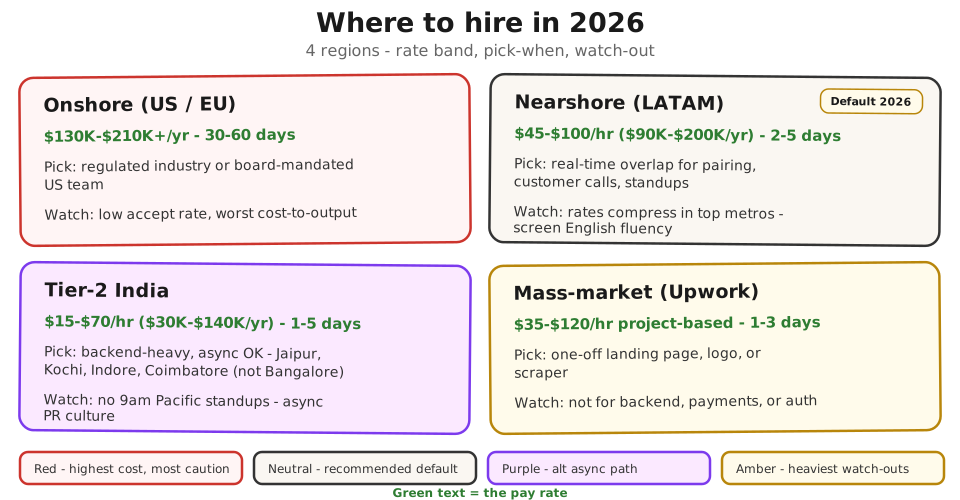
The 4 regions #
Walk the four rows in order. Circle the one your scope and budget land in, then move to the platform list.
The rate bands and hire-cycle times below are our own market reads from placing and hiring engineers through 2025-2026 at JetThoughts, not survey data - treat them as negotiation anchors, and expect your quotes to land inside the band, not on its edges.
| Region | Rate band & time to hire | Pick when | Watch out for |
|---|---|---|---|
| Onshore (US / EU) | $130K - $210K+/yr, 30-60 days | Regulated industry (HIPAA, SOC 2 - the enterprise security audit - with US data residency, fintech license), security clearance, or board-mandated US team | Low offer-acceptance rates and the worst cost-to-output ratio on the map |
| Nearshore (LATAM) | $45 - $100/hr ($90K - $200K annualized), 2-5 days | Full-day real-time overlap for pair programming, customer calls, or daily standups | Rates compressed in the top metros; English fluency varies by candidate - screen for it |
| Ukraine | $30 - $70/hr ($60K - $140K annualized), 1-5 days | The 2026 default: backend-heavy Rails work at the lowest band that still overlaps your morning (Kyiv, Lviv, Kharkiv) - the bench JetThoughts itself hires from | Kyiv afternoon = US-East morning, so plan live standups then; async PR culture the rest of the day; build CLAUDE.md / coding-standards docs before the first PR |
| Mass-market (Upwork) | $35 - $120/hr project-based, 1-3 days | Single landing page, logo, or one-off scraper - anything you’d ship and never touch again | You become the technical interviewer; no platform vetting; NOT for backend, payments, or auth |
The 5 platforms ranked #
Pick two: one primary based on your geography row above, one backup. Do not post on all five.
| Platform | Best for | Pricing |
|---|---|---|
| Toptal | Senior fractional roles, screened top 3% (3-5 days to slate) | $90 - $200/hr |
| Bolster | Largest curated fractional executive marketplace (3-7 days to slate) | Marketplace, transparent |
| LatHire | LATAM nearshore developers, full-time and contract (2-5 days to slate) | $45 - $100/hr |
| JetThoughts | The team behind this course - pre-vetted senior Rails engineers, AI-augmented with senior review, staffing or SOW project work (starts in ~2 weeks) | Staffing quote |
| Upwork | Mass-market freelance for point tasks ONLY (1-3 days to slate) | $35 - $120/hr |
The job description template - copy and paste #
Replace the four fields in square brackets and post on your two chosen platforms. The post screens against the AI-Augmented Developer profile, not the 2018 Senior profile.
=========================================================
ROLE: Senior Engineer (AI-Augmented) - [your framework]
=========================================================

We are hiring a Senior Engineer to ship the [your product
type, e.g. multi-tenant Rails SaaS for [your industry]]
backend that our one-page brief calls for. The role is
fractional or full-time, [your geography preference: LATAM
nearshore / Ukraine / US onshore].

WHAT WE NEED YOU TO DO

- Ship features end-to-end in [Rails / Django / Laravel],
  one PR at a time, against the acceptance criteria in
  our SOW.
- Direct an AI tool (Cursor, Claude Code, Aider, or
  Copilot) for the heavy lifting and review the output
  before it merges.
- Catch the things the model is wrong about: hallucinated
  packages, hallucinated column names, CSRF holes in
  AI-generated auth code, and the rest.
- Pair with our fractional CTO on the architecture-review
  Monday call.

PROFILE WE ARE HIRING

- 5 to 10 years of shipped engineering experience.
- Daily user of at least one of: Cursor, Claude Code,
  Aider, GitHub Copilot. (We will ask to see your
  CLAUDE.md or .cursorrules file.)
- Has shipped AI-generated code to production AND
  reviewed AI-generated code in pull request.
- Can articulate where the model is wrong in your
  framework. (If your answer is "the model is great,
  no issues," this role is not for you.)
- Multiple production ships in [Rails / Django /
  Laravel].

COMPENSATION

[Pick the band that matches your geography row above.
Examples:
- Ukraine: $35 - $55 USD per hour, 30-40 hrs/wk.
- LATAM nearshore: $60 - $90 USD per hour, 30-40 hrs/wk.
- US onshore Senior: $130K - $180K base + equity.]

OUR STACK

- [Your framework + version, e.g. Rails 7]
- Postgres, Heroku or Kamal-on-Hetzner, Stripe, [your
  third-party APIs]
- GitHub for source control, [your test framework] for
  testing, [Sentry / Honeybadger] for errors

TO APPLY

Send: (1) GitHub profile or 3 PR links from production
ships, (2) one-paragraph CLAUDE.md or .cursorrules
philosophy, (3) the bug you would expect Cursor to
introduce in our stack and how you would catch it.

We reply to every application in 5 business days.
Take-home test (3 hours, paid at your hourly rate)
for short-list candidates.
=========================================================
What good looks like vs what bad looks like #
Application response - the AI-direction question #
Bad: “I love Cursor. It is amazing. I use it every day for everything. The model writes 90% of my code now and I rarely have to step in.”
Good: “My CLAUDE.md is 40 lines, mostly conventions for our Rails app: never name a model in the singular, always foreign-key migrations with index, fail fast on bad input. The model invents Stripe webhook handler signatures about every fourth time, so I run a contract test against the Stripe library docs before any payment-handler PR. The model also hallucinates npm packages, which is the slopsquatting attack vector, so I pin every dependency with
npm ciinstead ofnpm installin CI.”
The good answer names the framework conventions, the specific failure mode (hallucinated Stripe signatures, hallucinated packages), and the concrete defense (contract tests, npm ci over npm install). The bad answer is a vibe metric (“amazing”), a percentage estimate that nobody can verify (“90%”), and zero acknowledgement that the model gets things wrong. The bad answer is the 2018 Senior with an AI sticker. The good answer is the 2026 hire.
First intro call - the framework question #
Bad: “I have done a lot of full-stack work. Some Rails, some Node, some Python. I am a polyglot.”
Good: “Rails since 2019. Six production apps shipped, four still in production. The biggest is a [TYPE] app at [SCALE], the smallest is a [TYPE] app at [SCALE]. My most recent Rails ship was [LAST_QUARTER] for [CLIENT_OR_EMPLOYER]. I prefer Postgres over MySQL because [SPECIFIC_REASON]. Happy to walk you through the GitHub history of the most recent app on a screenshare.”
The good answer is countable: years, ships, scale, recent quarter, screenshare offer. The bad answer is a list of frameworks the candidate has touched. Polyglot reads as “no deep ship in any one framework.” For a pre-seed Rails app, you want six Rails ships, not three Rails + three Node + three Python.
Take-home test review - the slopsquatting catch #
Bad: “The candidate’s code passes all tests. Looks clean. I would hire.”
Good: “The candidate’s code passes all tests. The package manifest pulls in
react-toolkit(4 chars off from the realredux-toolkit). I asked. They had not noticed. The model invented the package, npm has a placeholder, and a malicious actor will register it within the week. The candidate did the work without the AI-direction discipline we hired for. Pass.”
The good review reads the dependency manifest as carefully as the application code. The bad review checks the test green and stops there. The slopsquatting attack vector is in the Infosecurity Magazine writeup on AI code supply chain attacks; your candidate must spot this in PR review or you have hired the wrong profile.
What to do tomorrow #
- Write your geography choice and your two platforms at the top of a fresh Notion doc. One line: “Region: [Ukraine / LATAM nearshore / US onshore]. Platforms: [PRIMARY] + [BACKUP]. Posted on [DATE]. First slate by [DEADLINE].”
- Schedule 5 intro calls in the same week. Not three. Not ten. Five gives you a comparison and a rolling shortlist. Each call is 30 minutes. Use the 7-question hiring interview script.
- Take the shortlist of 3-5 candidates to the hiring interview. That section covers the deep-dive interview that catches AI theater. This map gets you to the shortlist; that post gets you to the hire.
If you find yourself ten days in with no shortlist, the bottleneck is the job description, not the platforms. Re-read the AI-Augmented Developer profile in the post and tighten the five profile lines. Generic posts attract generic applicants.
Built by JetThoughts as part of the From Idea to First Paying Customer curriculum.