In this post
OpenAI’s o1 and o3 models are built to work through hard problems step by step before they answer. This post summarizes a short Y Combinator video, How do OpenAI’s o1 and o3 models perform complex reasoning? (January 2025), and checks its main claims against OpenAI’s own write-up of o1.
Key Takeaways #
- o1 uses a chain of thought: it breaks a question into smaller steps before it answers.
- OpenAI says o1 is trained with reinforcement learning to do this, and that it learns to spot and fix its own mistakes and to try another approach when one is not working.
- Chain of thought as a prompting technique predates o1. It was published in 2022.
- OpenAI released o3 on April 16, 2025, after this post’s source video was published.
Understanding The Chain Of Thought Process #
Many of us already used this idea with earlier models such as GPT-4o, by asking it to “think step by step” or to go line by line. The video’s point is that o1 does this by itself: it is not just spitting out answers, it works through the problem in a way that mirrors human reasoning.
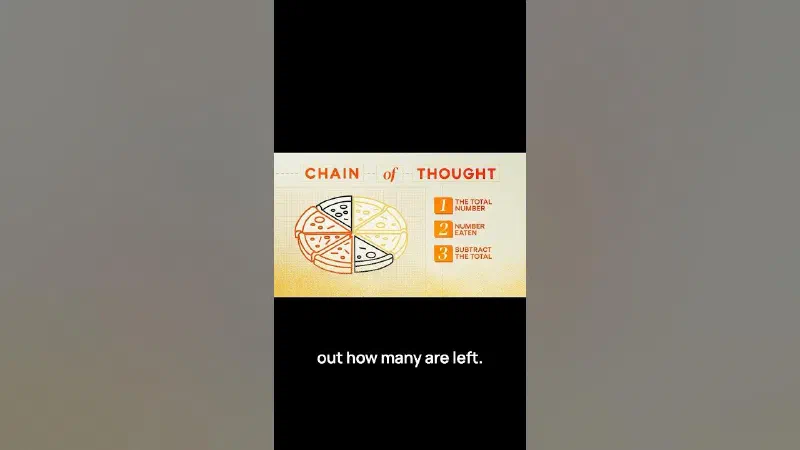
Here is a pizza example in the style the video uses. A pizza is cut into eight slices. John eats three and his friend eats two. How many are left? A chain of thought would run:
- Identify the total slices: the pizza has eight.
- Calculate eaten slices: John eats three and his friend eats two, so five are eaten.
- Subtract: eight minus five leaves three.
The example in the original paper is different. It asks how many tennis balls Roger has after he starts with 5 and buys 2 cans of 3. The worked answer is 5 + 6 = 11 (Wei et al., 2022, Google researchers).
The video says that without the step-by-step breakdown, a language model tends to predict the most likely next token for the whole answer. Writing out the steps gives it a chance to get each one right.
What OpenAI Says o1 Does #
The video’s claims line up with OpenAI’s own description of o1 (September 12, 2024):
- o1 “can produce a long internal chain of thought before responding to the user.”
- Through reinforcement learning, it “learns to recognize and correct its mistakes”, to break tricky steps into simpler ones, and to “try a different approach when the current one isn’t working.”
- OpenAI chose not to show users the raw chain of thought. The model shows a model-written summary of it instead.
That last point matters for debugging. You cannot read the steps the model actually took.
How This Differs From Plain Prompting #
Chain-of-thought prompting is not new: Wei et al. published it in January 2022. What OpenAI describes for o1 is training the model with reinforcement learning to use a chain of thought well. OpenAI reports that o1 improves with more training compute and with more time spent thinking.
OpenAI also says o1 is “not well-suited for all use cases”. In its own human-preference tests, o1-preview was preferred over GPT-4o on reasoning-heavy tasks like data analysis, coding and math, but not on some natural-language tasks.
Where You Might Use It #
The video does not list use cases. Reasoning models fit tasks where the answer depends on several dependent steps: math problems, code with tricky logic, multi-step analysis. For plain writing or simple lookups, a reasoning model can be slower and costlier than you need. Check on your own cases before you switch.
Conclusion #
o1 and o3 are OpenAI’s reasoning models. The video’s core claim, that they work through a problem in steps and correct themselves, matches what OpenAI says about o1. Treat “mirrors human reasoning” as a description, not a proof: OpenAI says the training makes the chain of thought better, and it does not claim the model thinks like a person.