In this post
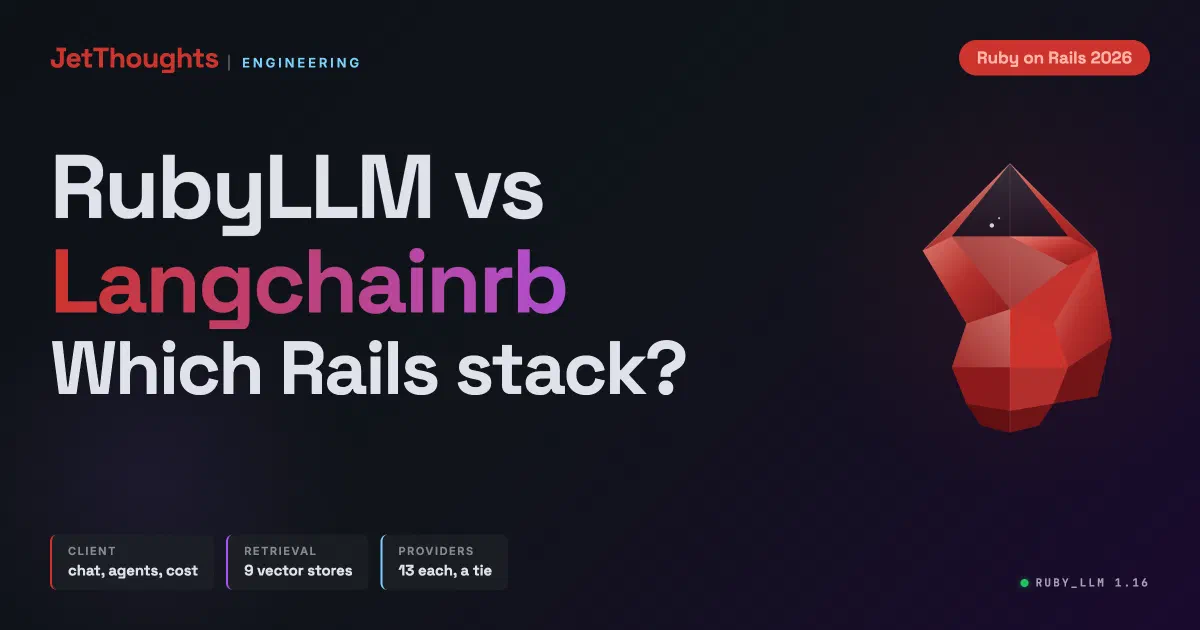
ruby_llm 1.16.0 ships chat.rb, agent.rb, embedding.rb, cost.rb, a model registry and an ActiveRecord integration. langchainrb 0.19.5 ships vectorsearch/, chunker/, loader.rb, output_parsers/ and evals/.
ruby_llm talks to models. langchainrb finds your documents first, then hands them to a model. Work out which of those you need and the rest of the choice gets easy.
What each one ships #
| ruby_llm 1.16.0 | langchainrb 0.19.5 | |
|---|---|---|
| Providers shipped | 13 | 13 |
| Rails integration | generators, acts_as, Railtie | langchainrb_rails, a second gem |
| Cost in money | yes, per token class | token counts only |
| Vector search | no | 9 backends |
| Document loading + chunking | no | yes |
There is a third option, raw HTTP, and it is not in the table because every cell would say “you write it”. It gets its own section further down.
Both ship thirteen providers, so that row will not help you choose.
Neither one gives you upgrades for free. langchainrb is on 0.19.5, so it makes no promise about breaking your code. ruby_llm is past 1.0, but four of its minor releases changed the database schema - it ships upgrade_to_v1_7, v1_9, v1_10 and v1_14 generators to migrate you, and an acts_as_legacy shim so the old API keeps working. Expect migrations either way.
The Rails gap #
ruby_llm ships lib/generators/ruby_llm/ with install, agent, chat_ui, schema and tool, plus an acts_as concern and a Railtie. The install generator writes five migrations and four model classes, because a persisted chat needs Model, Message and ToolCall records behind it. Once they exist, marking the model is two lines:
class Chat < ApplicationRecord
  acts_as_chat
end

chat = Chat.create!(model: "claude-sonnet-4-5")
chat.ask("Summarise this ticket")   # persisted, with messages
For langchainrb you need a second gem, langchainrb_rails, currently on 0.1.12. It also ships four generators - pgvector, pinecone, chroma and prompt - plus an ActiveRecord hook and a Railtie.
Now compare what those generators build. ruby_llm sets up a conversation. langchainrb_rails sets up a vector store. Each gem brought the thing it is good at into Rails, and neither one tried to do the other’s job.
Cost tracking, by token class #
ruby_llm’s Cost object breaks spend down by token class - input, output, cache_read, cache_write, and thinking. Cached prompts and reasoning tokens bill at different rates from ordinary completion tokens.
This matters when your bill goes up and you need to know why. One total only tells you that you spent more. The breakdown can tell you that a prompt you edited stopped hitting the cache.
langchainrb counts tokens but does not price them. On the mainstream adapters you get prompt_tokens, completion_tokens and total_tokens, plus running totals on Assistant. Not on all of them, though - the Hugging Face, llama.cpp and Replicate responses never override those methods, so they inherit the base class and raise NotImplementedError.
Where the counts do arrive, there is still no price list in the gem, and no separate figure for cached or thinking tokens. You add those yourself.
When langchainrb wins #
If you are answering questions from your own documents, langchainrb already has the parts. Loaders to read the files, chunkers to split them, output parsers, an evals module, and vector search that works with pgvector out of the box - plus eight other backends if you ever move off it.
Pick ruby_llm instead and you will write the chunking and the pgvector wrapper yourself. That is a lot of work to end up with a worse version of a gem you could have installed. Our LangChain in Ruby guide walks through that setup.
When raw HTTP wins #
You are making one call, to one provider, and you do not plan to add another. A Net::HTTP POST to the endpoint is about fifteen lines, and there is no gem upgrade to worry about later.
What you write yourself is the dull but necessary part: retries, parsing streamed chunks, counting tokens, and changing provider later by editing every place you call one. That is fine for a single feature. It is a bad foundation for a product.
Using both #
You can run both, and plenty of apps do. langchainrb finds the documents, ruby_llm runs the conversation and tracks what it costs.
One rule keeps that tidy: only one gem should make the actual model call. If both are building their own requests to the same provider, you have two sets of retry rules and two streaming parsers, and when the request format changes you get to debug both.
That kind of change is easy to miss. We moved all nine schemas in one pipeline onto a different schema library, so every request body we sent changed shape - and all 1549 tests stayed green, because VCR matches on method and URI, and neither of those changed. Add a second gem building its own requests and there are twice as many places for that to hide.
Add something that scores the answers early. Checking agent output is how you find out whether a change to your retrieval helped. Without it you tweak a chunk size, read four answers, decide they look better, and ship.
Everything above comes from reading ruby_llm 1.16.0 and langchainrb 0.19.5. Both move quickly, so check the version you are actually installing before you take any of these counts as current.