In this post
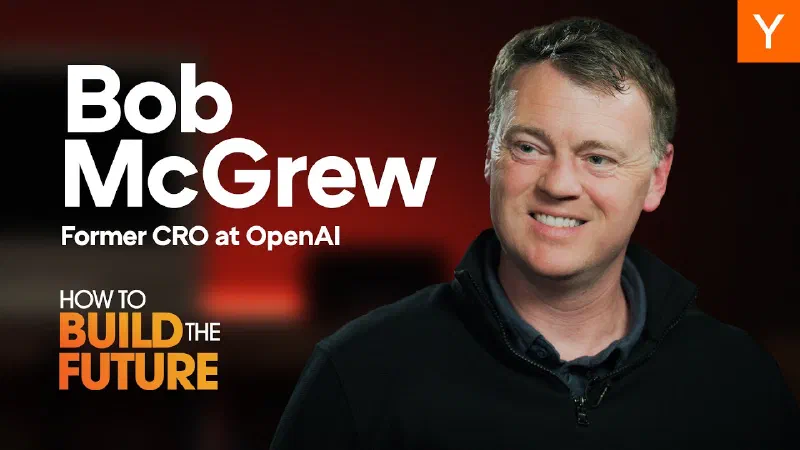
This post summarises Bob McGrew: AI Agents And The Path To AGI, a January 2025 conversation between Garry Tan and Bob McGrew, former Chief Research Officer at OpenAI, published on the Y Combinator channel. They discuss the evolution of AI, the path towards Artificial General Intelligence (AGI), and the future of jobs. McGrew talks about his time at OpenAI, scaling laws, reasoning, and advice for startups. The points below follow the video; the quotes are his words, not ours.
Key Takeaways #
- Reasoning and test-time compute are key to developing reliable AI agents.
- Early projects at OpenAI focused on robotics and gaming to improve AI capabilities.
- Scaling laws play a crucial role in AI development and performance.
- McGrew expects two kinds of jobs: the “lone genius” and the manager of a mostly-AI firm.
The Early Days at OpenAI #
Bob McGrew’s journey into AI began unexpectedly. He left Palantir intending to start a robotics company, but found himself at OpenAI, a place full of very smart people with big ambitions. He learned deep learning by teaching a robot to play checkers from vision.
At OpenAI, the goal was always to build AGI. Early projects included teaching a robot hand to solve a Rubik’s Cube and building an AI to play Dota 2. The Dota 2 work, he says, “really strengthened our belief that scale was the path to improving artificial intelligence.”
The Role of Scaling Laws #
Scaling laws became a cornerstone of OpenAI’s approach. McGrew calls the “secret idea” from Dota 2 taking huge amounts of experience, feeding it into a neural network, and watching it learn and generalize. The same idea was later applied to the robot hand. Separately, Alec Radford’s GPT-1 showed that a Transformer trained on the simple objective of guessing the next token could generate coherent text.
Key Projects at OpenAI #
- Robotics: Teaching a robot hand to solve a Rubik’s Cube.
- Gaming: Developing AI to play Dota 2, showcasing the importance of scale in learning.
- Language Models: The creation of GPT-1, which relied on predicting the next token to generate text.
The Shift Towards Reasoning #
As AI technology advanced, McGrew said pre-training is reaching a bottleneck on data. The new mechanism is reasoning and test-time compute: giving a model more time to think and getting a better answer. He says the gap that remained between pre-training and AGI was reasoning, and that it now looks cracked, leaving a clear path to scaling.
The Importance of Reliability #
For AI agents to be trusted, they must be reliable. McGrew says reasoning will “unlock the possibility of agents to do actions on your behalf,” but only if the model picks the right action often enough. His rule of thumb: adding a nine (90% to 99%, or 99% to 99.9%) is roughly an order of magnitude more compute, and reasoning lets models spend that compute by thinking longer. He says this is not easy or done, but there is a clear path.
The Future of Jobs #
One of the main discussions in the interview is the future of work. McGrew expects two roles. One is the “lone genius,” like Alec Radford working alone with a computer that leverages him. The other is the manager: “you will be the CEO of your own firm and that firm will mostly be AI.” He thinks other humans will still be in it. He compares it to the last big wave of automation, when most people were farmers in the 1880s, and says nobody then could have described today’s jobs.
The two jobs McGrew expects #
- Lone genius: a researcher or builder working alone, with a computer to leverage them.
- Manager: the CEO of your own firm, which will mostly be AI.
Advice for Startups #
For those starting AI companies, McGrew advises starting with the very best model you can, because a startup succeeds only by exploiting something at the AI frontier. Get it working, then use distillation to cut cost. Your time matters most: build the product quickly, find where the value is by iterating with users, and only then work backwards on cost. He contrasts this with Palantir taking three years to get to market.
The Road Ahead #
McGrew calls himself an optimist about humanity. He expects robotics companies to have “the ChatGPT moment for robotics” sometime in the next five years. He also calls it a “deep mystery” that AI adoption is so slow relative to what people expected in 2018, noting that AI has had some effect, particularly on people who write code. Watch the full conversation for his own words.