In this post
Beyond Primitive Search: A Journey into Compositional Design 🌱 #
Search functionality in Rails applications often begins as simple query parameters, then gradually accumulates complexity—like a garden that grows without thoughtful landscaping. Let’s explore how Form Objects and specialized Filter components can transform this complexity into an elegant, maintainable ecosystem.
The Mental Model: Lenses of Perception 🔭 #
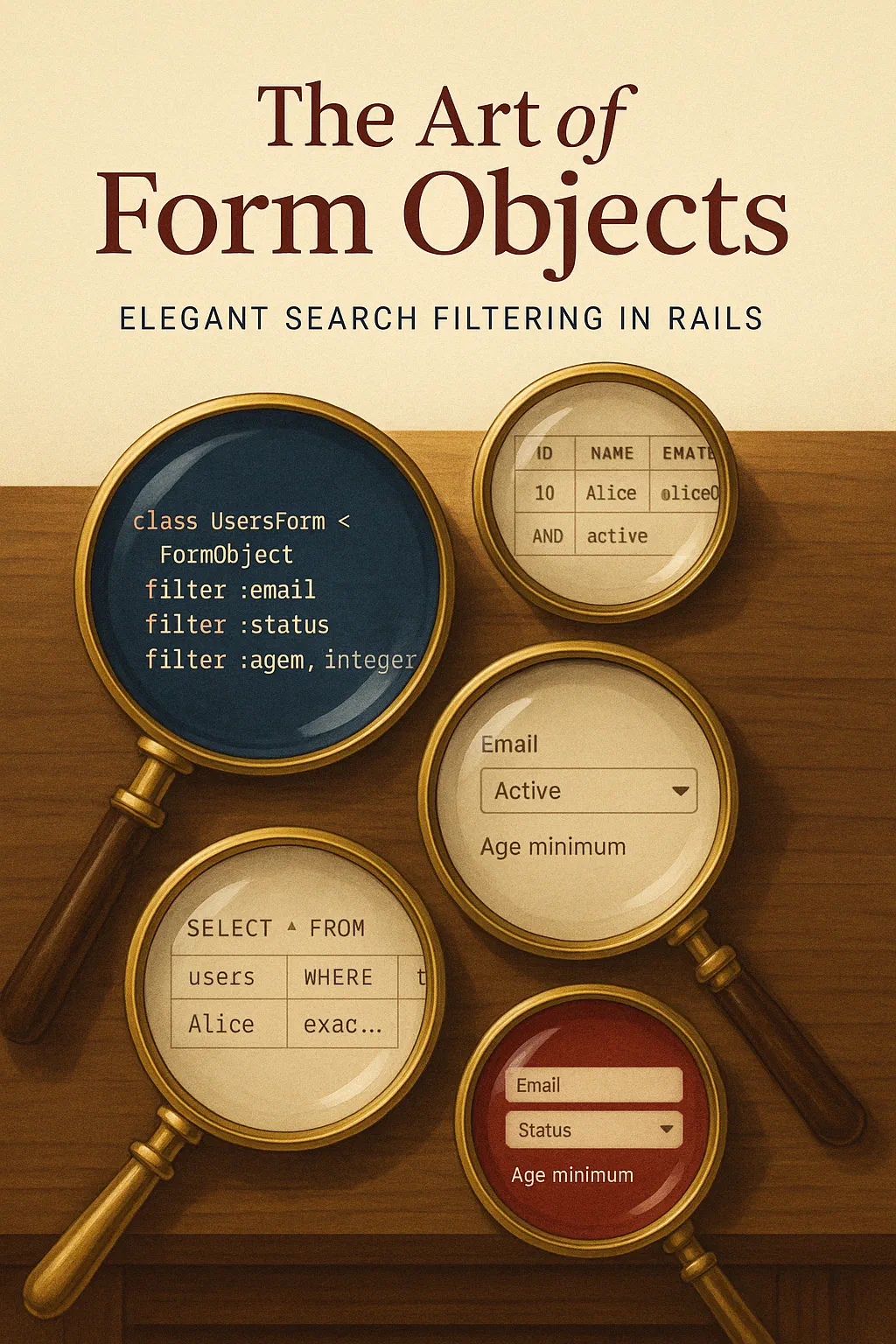
Imagine your data as a vast, multidimensional landscape. Each search parameter becomes a specialized lens, focusing on particular features:
- Query filters act as broad-spectrum lenses, capturing elements that match textual patterns
- Status filters function as polarizing filters, allowing only items with specific attributes to pass through
- Date range filters operate like temporal telescopes, focusing on specific slices of time
- Sorting mechanisms serve as compositional arrangements, organizing the perceived elements
When combined, these lenses create a precise optical system that brings exactly what users seek into perfect focus.
Architectural Poetry: The Three-Tiered Canvas 🏛️ #
The most elegant search implementations unfold across three harmonious layers:
- Form Objects → Capture intent and validate boundaries
- Filter Components → Transform intent into focused queries
- Scopes → Express database-specific implementations
This separation creates a dance of responsibilities where each element performs its role with precision and grace.
The Filter Object Pattern: Compositional Elegance ✨ #
module Filters
  class BaseFilter
    attr_reader :value

    def initialize(value)
      @value = value
    end

    def apply(scope)
      value.present? ? filter(scope) : scope
    end

    private

    def filter(scope)
      raise NotImplementedError, "Subclasses must implement #filter"
    end
  end
end
Each specific filter becomes a specialized instrument in your search orchestra:
module Filters
  class StatusFilter < BaseFilter
    private

    def filter(scope)
      scope.where(status: value)
    end
  end
end
The Form Object: Conductor of the Search Symphony 🎭 #
class SearchForm
  include ActiveModel::Model

  attr_accessor :query, :status, :date_range, :category
  validates :query, length: { maximum: 255 }

  def results
    apply_filters(base_scope)
  end

  private

  def base_scope
    Model.all
  end

  def apply_filters(scope)
    filters.reduce(scope) do |current_scope, filter|
      filter.apply(current_scope)
    end
  end

  def filters
    [
      Filters::QueryFilter.new(query),
      Filters::StatusFilter.new(status),
      Filters::DateRangeFilter.new(date_range),
      Filters::SortFilter.new(sort_direction)
    ]
  end
end
The Perceptual Shift: From Monolith to Mosaic 🧩 #
Traditional search implementations often resemble monolithic sculptures—impressive but difficult to modify. The Filter Object pattern transforms this into a modular mosaic where each piece can be:
- Individually crafted → Focused development and refinement
- Separately tested → Precise verification of behavior
- Flexibly arranged → Dynamic composition based on context
- Easily extended → New filters without disrupting existing ones
Practical Wisdom: The Filter Registry Pattern 📚 #
For applications with diverse filtering needs, consider a registry approach:
class FilterFactory
  FILTER_MAPPING = {
    query: Filters::QueryFilter,
    status: Filters::StatusFilter,
    date_range: Filters::DateRangeFilter
  }.freeze

  def self.build_filters(params)
    params.filter_map do |key, value|
      filter_class = FILTER_MAPPING[key.to_sym]
      filter_class.new(value) if filter_class && value.present?
    end
  end
end
This approach creates a fluid, context-sensitive filtering system that adapts to the specific needs of each search request.
Beyond Implementation: The Philosophical Dimensions 🔮 #
Search functionality represents more than mere data retrieval—it embodies the conversation between user intent and application domain. Each filter becomes a translational layer:
- Converting human questions into computational queries
- Transforming vague intentions into precise selections
- Bridging the gap between mental models and data structures
The Journey of Refinement: Evolution, Not Revolution 🌟 #
Implementing sophisticated search forms is rarely a single transformation, but rather an evolutionary journey:
- Begin with core patterns → Establish the Filter Object foundation
- Refine through iteration → Improve based on real usage patterns
- Expand thoughtfully → Add specialized filters as needed
- Monitor and adapt → Optimize performance bottlenecks
The most elegant search implementations emerge gradually, shaped by actual usage patterns and evolving requirements.
Transcending Mechanics: The Art of the Possible 🎨 #
The true elegance of well-designed search functionality lies not in its technical implementation, but in how it expands user capabilities—transforming what might be overwhelming complexity into intuitive, powerful exploration tools.
Remember: Great search functionality doesn’t merely find things; it illuminates pathways through your application’s domain, revealing connections and possibilities that might otherwise remain hidden.
In the end, we’re not just building search forms—we’re crafting lenses of discovery.