Reference companion to Lesson 3.1 · The One-Page Product Brief (Vibe PRD) - a worked example and common mistake for each of the five sections, the decision between a Vibe PRD and a traditional PRD, and when a paid cohort is worth it. Read the micro-lesson first for the five-section template and the do-this-now sitting; return here when you want the worked example for a section you are stuck on. The fillable form lives on the Vibe PRD Template page.
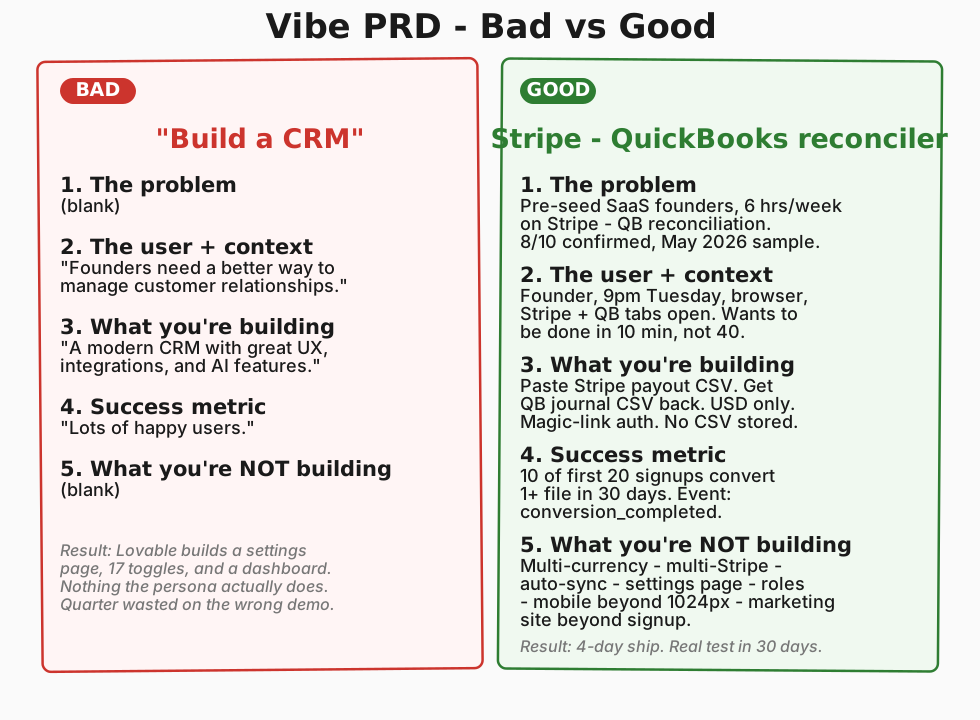
The Vibe PRD is one side of paper. Five sections, in this order. Each section is written so an AI agent or a junior contractor can act on it without a follow-up Slack thread. The simplest reliable order is problem → user → build → metric → no-go. Every section has a job. Skip one and your prompt or your contractor fills it in for you, usually wrong.
Who reads it: an AI agent or a hired junior, not a 6-person team #
| Audience | Read count | Iteration shape | Cost of a bad brief |
|---|---|---|---|
| Traditional PRD (6-person team) | 6 people read it + 1 kickoff call + refinement rounds | Long iteration loop, multiple reviewers | Team builds the wrong thing slowly; you learn in sprints |
| Vibe PRD (AI agent or junior) | 1 read, then building starts | Short iteration loop, one builder | Lovable ships you a wrong thing on Wednesday, and you spend the quarter discovering why it’s hard to evolve |
Veracode’s 2025 GenAI report found 45% of AI-generated code ships with at least one exploitable security flaw. The brief is your only chance to constrain what the agent or the junior builds for you, and what they skip.
The 5 sections in full #
Section 1 - The problem (lifted from your Lesson 2.5 synthesis) #
What goes in it: one paragraph copied directly from your validated problem statement. Named persona, named industry, dated 10-call sample, one verbatim quote, one quantified cost, and the one-line why-now from your problem statement.
Example: Pre-seed B2B SaaS founders doing their own Stripe-to-QuickBooks reconciliation lose 6 hours per week and $800 per month in CFO contractor time. 8 of 10 interviewees confirmed (May 2026 sample). One founder said: “Tuesday at 9pm I spent 40 minutes copying Stripe payouts into QuickBooks. I called my CFO. She did it in 90 seconds.”
Common mistake: rewriting the problem in your own voice for the brief because “this is a different document.” The brief inherits the problem statement word-for-word. If you find yourself softening the language, you are about to brief a build for a problem you haven’t actually validated.
Section 2 - The user and their context #
What goes in it: who the user is while they’re using your product. Not the persona’s life story. The 60 seconds before they reach for your thing and the 60 seconds after.
Example: A pre-seed founder, alone in their browser at 9pm on a Tuesday, finishing the week’s bookkeeping. They have a Stripe dashboard open in one tab and a QuickBooks ledger in another. They are tired, mildly annoyed, looking for a way to finish in 10 minutes instead of 40. They will open our app from a bookmark, paste one Stripe export, and close the tab when the numbers line up.
Common mistake: writing the persona’s company size, ARR (annual recurring revenue), and tech stack as if pitching to investors. The agent or contractor doesn’t need their TAM (Total Addressable Market - how big the whole market is in dollars; investor-pitch math, not builder math). They need to know the user is tired, has two tabs open, and wants to be done. Specific context produces a usable interface; abstract persona data produces a dashboard full of filters nobody uses.
Section 3 - What you’re building (one paragraph, plain English) #
What goes in it: one paragraph that names the smallest end-to-end thing a user can do. Verb-led. Mentions the inputs the user provides and the output they get back. No feature list, no tech stack instructions, no mention of microservices or auth strategies.
Example: A web app where the founder pastes a Stripe payout CSV (a plain spreadsheet-style file exported from Stripe) and the app returns a QuickBooks-compatible journal entry CSV they can import in one click. The first version supports USD only, one Stripe account per user, and no multi-currency. The user authenticates with email + magic link (they type their email and click a one-time sign-in link - no password to build or store). We never store the CSV after the conversion completes.
Common mistake: writing this in feature-list form (“Stripe integration · QuickBooks export · user dashboard · settings page”). The agent reads the feature list and produces a settings page nobody asked for and an integration that breaks in the first edge case. One paragraph forces you to name the thing the user does, not the menu items the engineer might build.
Section 4 - Success metric (one) #
What goes in it: one number, with a unit, that tells you whether the build worked. Measurable inside the app, not from your gut. Named timeframe.
Example: Of the first 20 users who land on the app, 10 successfully convert at least one Stripe export to a QuickBooks journal entry within 30 days of signup. Below that, the persona is wrong or the workflow is wrong. The metric is the conversion-completed event in our analytics, not signups.
Common mistake: listing three metrics (signups, retention, a satisfaction score) instead of one. Three metrics let you cherry-pick whichever one looks best. One metric forces a build/no-build decision in 30 days. The pre-PMF founder rule applies: one number, measured by you, defended in front of one advisor.
Section 5 - What you’re NOT building (the no-go list) #
What goes in it: 5 to 8 lines naming the things a competent agent or contractor might add unprompted, that you explicitly do not want in v1. The longer this list, the cheaper your build.
Example: Not in v1: multi-currency support, multi-Stripe-account support, automatic recurring sync, a settings page, a billing dashboard, user roles and permissions, a marketing site beyond the signup page, mobile responsive design beyond “works on a 1024px screen.” We will revisit each of these after metric in Section 4 is hit.
Common mistake: leaving this section blank because “we’ll just say what we want and skip what we don’t.” Lovable, Cursor (an AI coding tool developers run on their own machines), and a hired junior all fill blanks with reasonable defaults, and reasonable defaults stack into a settings page nobody asked for. The same shape is how a founder ends up with 17 settings toggles in version one - 12 wired to nothing, 2 that crash on toggle.
The 2 forks: Vibe PRD vs traditional PRD #
Not every brief is a Vibe PRD. The audience tells you which to write.
Vibe PRD if the next stop is Lovable, Cursor, or a hired junior contractor. The one-page format is enough. The junior asks clarifying questions during the kickoff call; you answer in the same plain English you wrote the brief in. A senior would expect more context; a junior with an AI assistant ships faster from less.
Traditional PRD if the next stop is a senior engineering team, an in-house product committee, or a board that needs a budget number attached. Senior engineers read briefs to find load-bearing assumptions you haven’t named, and they expect a data model, an API outline, and an integration list. Product committees expect a roadmap, a phasing plan, and a go-to-market section. Both audiences will write the missing parts themselves if you don’t include them, which is rarely what you want.
The classic trap is writing a traditional PRD for a junior or an AI agent. The 5-page document buries the one paragraph the builder needed. By page 3, the agent has skimmed past the no-go list and started building a settings page.
When a paid cohort course is worth it #
Drew Falkman runs “Vibe Coding Data-Enabled AI Apps” on Maven, a multi-week live cohort (paid - check the course page for current pricing and format). The course teaches the same five-section Vibe PRD template, plus the Lovable + Supabase + Stripe + GitHub stack, plus live community and 1:1 instructor feedback.
| Scenario | Maven cohort is worth it | This template is enough to start |
|---|---|---|
| You wrote the page tonight and can’t tell whether it is good. | Yes. Go for peer review + feedback. | Actually, post the draft in a founder Slack - free feedback in 2 hours. |
| Accountability is your blocker. (3 abandoned briefs in a drawer.) | Yes. The cohort structure + deadline forces you through. | No. You need external structure. The template alone won’t help. |
| You want to go deeper on Lovable + Supabase + Stripe stack mechanics. | Yes. The cohort spends much of its time on exactly this. | No. You’ll need the stack tutorials anyway; the template is concept-only. |
| You can sit alone for 90 minutes and finish the brief from the page above. | No. | Yes. The cohort buys peer review + deadline + deeper stack work, but you’ll ship either way. |
Rule of thumb: If you can sit alone for 90 minutes and finish the brief, start here. The cohort buys structure, deadline, and stack depth. If you can’t sit alone, the cohort fee buys the accountability that gets the brief out of you.
Further reading #
- Marty Cagan, Good Product Manager / Bad Product Manager - the canonical essay on what a PRD is for. The Vibe PRD is the AI-era compression of the same shape.
- Marty Cagan, Product vs Feature Teams - why the brief shapes what gets built. The no-go list is the part feature teams ignore.
- Jake Knapp and John Zeratsky, Foundation Sprint (Click, April 2025) - the 2-day version of the same artifact for teams that have 2 days. The Foundation Sprint workbook is freely sampled from the book site.
- Y Combinator, How to Write a PRD (Startup Library) - YC’s distilled version of the same compression.
Built by JetThoughts as a companion reference to the From Idea to First Paying Customer free curriculum.