Reference companion to Lesson 4.1 · Should You Hire? - the full Airbnb test walkthrough, each of the four build paths in depth, the shed-vs-house framing, and the Series-A off-ramp. Read the micro-lesson first for the five routing questions and the four paths; return here when you want the Airbnb test and the Series-A off-ramp in full.
Your real question: do you need to build at all #
The decision is not “code or no-code.” It is “what evidence do I have that I need to build at all?”
Y Combinator’s current position: tools and business models now let solo founders turn ideas into production products in weeks without giving 50% equity to a technical co-founder. The argument is prove the concept without code first, not “hire later.” Skip this and you burn 6-9 months learning the problem was never real.
If you cannot answer with a list of buyers who have already paid you, the answer is: not yet. Stay one box left of where you were about to start.
All three of your validation signals so far - the smoke test, the Mom Test interviews, the clickable prototype - are research, not builds. They prove the problem is real and the shape is right. They do not prove anyone will pay. That is what the Airbnb test settles before you commit a single month of build time.
The Airbnb test #
Brian Chesky and Joe Gebbia did not write code first. They blew up an air mattress in their living room, took photos with a digital camera, posted three nights at $80 on a simple hand-built page, and waited. Three guests showed up. They made $240.
The product was a website with a payment link. The validation was three strangers paying real money. Paul Graham later wrote about the same instinct in Do things that don’t scale: the founders who win are the ones who do the unscalable, manual experiment that proves demand before they industrialize it.
The 2026 version of the Airbnb test takes one afternoon: a Carrd page with a Stripe checkout for an annual plan, a Notion FAQ that explains exactly what the buyer gets, and the link sent to the 30 people from your Lesson 2.3 30-name list.
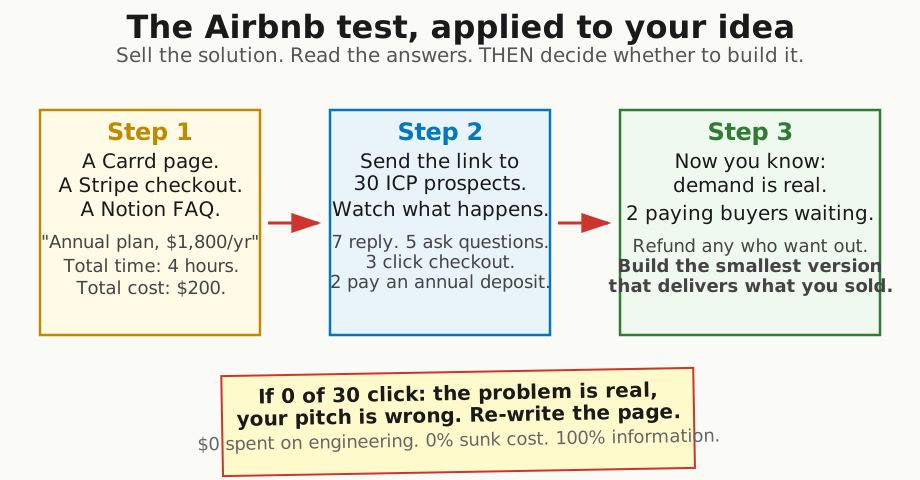
The signal you are looking for is small. Two paying buyers from 30 cold outreach hits is enough to flip the build switch.
One B2B SaaS founder sold five annual contracts at $1,800 each via a Stripe link and a Notion doc before she wrote a line of code. By the time her contractor delivered the v1 web app eight weeks later, she had $9,000 in pre-revenue and a customer-feedback loop already running. The build was constrained by what she had already promised the five buyers, which is the cheapest scope-control mechanism that exists.
Zero clicks from 30 prospects is brutal in the other direction. The problem might be real (you validated it in Lesson 2.5) but your pitch is wrong, your price is wrong, or the timing is wrong. Find out for $200 instead of $30,000.
Pick the right building before you commit to build #
Before you commit to building, you decide which building you are putting up. A shed has a different cost ceiling, talent profile, and exit strategy than a commercial building. The mistake is treating them as the same. Lesson 4.5 · Vibe Coding Ceiling Signals is the full shed → house → skyscraper diagnostic - read it after you pick your path to know when to revisit the hire decision.
The four paths in depth #
1. Validate without code #
Use when you have no MVP yet, a single untested hypothesis, and no confirmation that anyone will pay.
This week: ship a Carrd page + Stripe checkout + Notion FAQ, add a Lovable demo screen recording if you have one, and send the link to 30 ICP prospects (ICP = Ideal Customer Profile - the specific kind of person your hypothesis names as the buyer) from your Lesson 2.3 30-name list.
Cost: per-vendor tooling (Carrd annual domain + page, Stripe free until transactions, Notion free, Lovable trial), with optional LinkedIn or Google ad spend on top.
Watch for: zero clicks. That is a result, not a failure - you found it out before you spent real runway. Rewrite the pitch or pivot the problem.
2. Self-serve build #
Use when all three are true:
- The problem is validated: 10+ Mom Test interviews with strong signal in at least 7 (Lesson 2.5 rubric), plus a Lesson 1.4 smoke test that cleared the 6%+ “Promising” band. Pre-orders and paid pilots come LATER in Module 5 - do not require them as the gate.
- The scope is one workflow for one persona.
- The backend is simple: no real-time collaboration, no complex refund flows, no compliance scope.
This week: paste your one-page brief into Lovable, ship the smallest end-to-end thing it generates, and connect Supabase + Stripe + Resend (the service that sends your app’s emails) on top. The setup is Lesson 4.3; the build is Lesson 4.4.
Watch for: the architectural ceiling when the app crosses ~5,000 users or your second integration. Lesson 4.5 tells you when to move up.
3. Fractional CTO bridge #
Use when the problem is validated, the build has a queue, an integration, or a data model that needs real thinking, and you don’t have the runway to sustain a full engineering hire.
This week: hire a Fractional CTO for 5 hours per week and point them at three jobs - architecture review on the Lovable build, PR review on contractor commits, and watching the AWS and OpenAI bills. The Fractional CTO bridge reference has the sourcing script.
Cost: their fractional hourly rate ($80-$120/hour market band, around $400-$600/week for 5 hours), with $0 equity.
Watch for: the Fractional CTO drifting from structural engineer into coder. Set a quarterly review - if their hours go to shipping features instead of oversight, architecture, and hiring, you hired the wrong profile.
4. Hire a team #
Use when the build is backend-heavy (real-time, queues, AI inference at scale, multi-tenant data), integration-rich (5+ third-party APIs), or compliance-scoped (HIPAA, SOC 2, PCI) - and you have the runway to sustain engineering salaries before revenue lands.
This week:
- Read your draft SOW (statement of work - the document listing exactly what the dev shop will build) clause by clause.
- Confirm the GitHub org, AWS root, domain registrar, and database all sit under your company email before kickoff (Lesson 4.2).
- For who to hire and how to interview them, see the hire-track supplementary reference.
Cost: a team of 3-5 is material monthly burn before revenue, on top of tooling.
Watch for: the team building you a spaceship for the wrong moon. The weekly demo discipline and the Org Chart audit are how you catch that early instead of late.
The Series-A off-ramp: when the model itself changes #
All four paths above assume the same operating model: you hand a one-page brief to engineers (whether AI or human) and they build it. That is the feature-factory pattern Marty Cagan has spent 20 years criticizing. It is the right model for a non-technical founder running a half-built MVP on the burn shapes above. It is the wrong model the moment you can afford a real product team.
Around Series A (~$2-5M raised, 6-15 person team), the off-ramp activates. Stop handing specs, start handing problems. The product team owns discovery and delivery. You own outcomes and strategy. If you crossed that line and you are still writing one-page briefs week to week, you are paying senior engineering rates for junior product-manager work.
When you reach the off-ramp, read Cagan’s Inspired for the model, Empowered for the team-charter shift, and Teresa Torres’s Continuous Discovery Habits for the weekly customer cadence the empowered team needs to keep running. None of this is in scope for the rest of this course; you have graduated past it.
Further reading #
- Paul Graham, The Airbnbs - PG’s own short note on the Airbnb founders’ early experiments. 6-minute read.
- Sophia Matveeva, The Non-Technical Founder’s Guide to Hiring - the long-form companion to this lesson. Heavy on hiring, light on the validate-without-code path that comes first.
- Y Combinator, Startup School: Customer Discovery - YC’s distilled take on validating before building. The Path 1 reading list.
Built by JetThoughts as a companion reference to the From Idea to First Paying Customer free curriculum.