Reference companion to Lesson 4.5 · Vibe Coding Done Right: 5 Ceiling Signals - the deep version of each signal, the shed-house-skyscraper map, and the enterprise-buyer email template. Read the micro-lesson first for the monthly check and the decision rule; return here when a specific signal starts firing and you want the full picture before you route it.
Each signal below has the same shape: a visible symptom you can see in your dashboard tonight, the thing that is actually happening underneath, the cost of leaving it alone for another month, and the cost of addressing it now. Score each one green / yellow / red. Two reds firing for 4+ weeks means you graduate. Signals are ordered by when they typically become detectable - run Signal 1 from Week 2, Signal 5 at Week 8+.
Signal 1: AI inference cost or rate limits eating your margin (detectable: Week 2-4) #
What you see: your OpenAI bill for last month was $1,400. You have 200 paying users at $29/month. Your gross margin per user just went negative on the Pro plan.
Or: the OpenAI rate limit on your tier hits at 11am on weekdays and your “AI summary” feature returns errors for 90 minutes until usage drops.
What is happening underneath: a Lovable app that calls an LLM on every screen load (or every form submit) racks up per-request cost no founder modeled. The naive integration sends the full context every call, no caching, no model routing, no queue back-pressure when rate limits hit. Anthropic and OpenAI both publish per-token pricing; founders rarely run the per-user math until the credit-card statement arrives.
Cost of leaving it alone: runtime inference cost scales with usage, not revenue. Every new active user adds per-request LLM calls; if each user’s monthly inference cost sits above their share of the plan price, growth makes the hole deeper, not shallower. A founder who never modeled per-user inference can spend months of runway on a cost line they could have capped in an afternoon.
Cost of addressing now: a Fractional CTO models the unit economics in a spreadsheet (~$800 of work). The conversation that follows is about caching, model routing (cheap-model for the first pass, expensive-model only when needed), token budgets per plan tier, and queue back-pressure that fails gracefully when the rate limit hits.
If the math says the unit economics are unfixable at the current price, the conversation is about pricing, not engineering. Better to have it at week four of noticing the problem than at month six.
Signal 2: Data model complexity passing 5 entities with deep relations (detectable: Week 4-6) #
What you see: you ask Lovable to add a “tags” feature to your client list. Lovable rewrites the client detail screen and now the check-in form, the export-to-CSV, and the weekly email digest are all subtly off. You fix the same join error three times in one week.
New features take twice as long as they did in month two.
What is happening underneath: Lovable’s generated schema treats every prompt as a fresh design. When your data model crosses roughly 5 core entities (coaches, clients, check_ins, programs, tags, plus their joins), the implicit foreign-key reasoning the LLM holds in its head per-prompt no longer covers the full graph.
It writes a query that ignores a join, or it adds a column to one screen but not the migration. The schema decays from edits.
Cost of leaving it alone:
Illustrative composite based on patterns from real founder builds, not a single client story. A fitness-coaching SaaS reaches 11,000 lines of Lovable-generated code with no foreign keys, every model named in the singular, and three customer accounts holding corrupted data because a webhook retried a Stripe charge update four times. The founder ships six features in month four and zero in months five and six, because every change surfaces something else that broke.
Cost of addressing now: a 2-hour Fractional CTO schema review (roughly $160-$240 - two hours at the $80-$120/hour fractional band). They sketch the proper entity-relationship diagram, identify the joins your current schema is missing, and tell you whether the next 10 features fit on the current schema or need a redesign. If the verdict is “rebuild on a real ORM,” route to Reading the SOW.
Signal 3: Real-time features becoming non-negotiable (detectable: Week 4-8) #
What you see: two users open the same client record. One adds a note. The other adds a note. Whoever saves second wins - the first note is gone. Your support channel fills with “the app is acting weird again,” and each patch changes the behavior without fixing the architecture underneath.
What is happening underneath: the Lovable + Supabase REST loop is request-response: every screen reads on load and writes on submit. Real-time presence, collaborative editing, and live-updating feeds are not what auto-generated REST endpoints serve. Supabase does have a Realtime product, but wiring it into a Lovable-generated frontend that was never designed around subscriptions means rebuilding every screen the feature touches.
Cost of leaving it alone: the save-collision bug becomes a churn driver within a few months. Any customers who collaborate - coaches sharing clients, teams sharing accounts - lose work on a recurring basis, and each lost note erodes the trust that brought the user in. By the time real-time becomes a deal-breaker for a large customer, the rebuild estimate is the same one you would have gotten earlier; you have just spent the intervening months patching.
Cost of addressing now: this signal routes directly to a hire-a-team decision, not a Fractional CTO bridge. Real-time done right needs an engineer who has shipped Action Cable on Rails or Channels on Django and knows the queue, broadcast, and reconnection edge cases. The SOW reading guide walks the contract. Estimated rebuild on Rails: 6 to 10 weeks for one senior + one mid engineer.
Signal 4: Auth complexity passing the email + OAuth ceiling (detectable: Week 6-10) #
What you see: an enterprise prospect asks: “do you support SAML SSO (Security Assertion Markup Language Single Sign-On - corporate login standards) with our Okta (the enterprise login vendor) tenant, with role-based access where managers see their direct reports’ data but not the whole organization, and an audit log of every read?” You answer yes because the deal is $50K ARR (Annual Recurring Revenue - what one customer pays per year).
You then realize Supabase RLS does not model that role hierarchy without writing your own policy DSL on top. The recurring shape: a founder says yes, spends 6 weeks building a workaround in Supabase, ships it, and the customer’s security team finds a read-through gap in the policy by week 2.
The contract has a data-handling clause. The workaround was not reviewed by anyone with security experience. That is a breach disclosure conversation, not a feature fix.
What is happening underneath: Supabase’s row-level security is excellent for “user X can only read rows where user_id = X.” It strains under role matrices (manager-reads-team, admin-reads-org, super-admin-reads-everything), multi-tenant isolation across an organization, SAML federation, and audit trails. Each of those needs first-class engineering, not a configurable policy.
Cost of leaving it alone: you write the SOC2 (a security-audit standard B2B buyers ask for) letter and the SAML promise into the contract and ship a workaround. Months later, the workaround becomes the breach incident. The vibe-coded auth shape - public URL-based access controls, BOLA-class vulnerabilities (Broken Object Level Authorization - a URL where changing the ID in the address bar lets you read someone else’s data), no audit log to diagnose what got read - is what deferred auth complexity produces.
Cost of addressing now: a Fractional CTO scopes the role matrix on paper (1-2 weeks of part-time work at the $80-$120/hour fractional band), then hands the spec to a hired engineering team for the production build on Devise + Pundit (Rails) or django-allauth + django-guardian. Total auth-shaped rebuild: 4 to 8 weeks.
Signal 5: Compliance or security audit landing on the calendar (detectable: Week 8-12+) #
What you see: a customer’s procurement team emails you the SOC2 (security-audit standard) questionnaire. Or HIPAA: they need a Business Associate Agreement (BAA - the contract US health-data law requires between you and any vendor that touches Protected Health Information / PHI) before they can send a single PHI record. Or PCI (Payment Card Industry rules): you wanted to handle card data directly instead of using Stripe Checkout and now you need to pass a quarterly scan.
The self-serve stack cannot pass any of these, not because it is insecure in every way, but because it has no audit log, no documented data handling, no formally reviewed access control.
What is happening underneath: compliance is mostly process plus a small amount of code. The process is documented data flow, access logs, encryption at rest and in transit, vulnerability disclosure, vendor reviews. The code is the implementation underneath.
A Lovable + Supabase stack passes some checks (Supabase encrypts at rest, Stripe handles PCI-sensitive paths) and misses others (no audit log, no documented data lifecycle, no senior engineer to sign the security policy).
The auditor needs a person to ask “show me how you decommission a leaver’s access” and a non-technical founder cannot answer that question alone.
Cost of leaving it alone: you either pass on the deal or sign it with a workaround, which becomes the breach narrative when the customer’s auditor finds it 11 months in.
Cost of addressing now: this is a hire-a-team decision from day one, not a bridge. A senior engineer architects the audit surface (audit logs, access controls, vendor inventory, data flow diagrams) before you take the deal.
Vanta, Drata, and Secureframe automate the SOC2 paperwork; the engineering work underneath them needs a real architect, not a Lovable rebuild. Budget: 8 to 16 weeks to first-time SOC2 readiness, plus ongoing process work.
What to bring to Vanta / Drata / Secureframe onboarding from your existing artifacts. Your Lesson 4.2 ownership audit third-party-API-keys section is your starting vendor inventory (Lovable, Supabase, Stripe, Resend, OpenAI, etc.). Your one-page brief Section 1 (problem, named persona, data flow) feeds the data-flow diagram. Without these two inputs ready, the first onboarding call burns on collecting basics the audit could have surfaced in 15 minutes.
What to say to the customer this week (when they ask for SOC2 / HIPAA BAA / PCI before you can deliver it): respond within 48 hours with a 3-sentence email - do not ghost. Use this template:
“Thank you for the SOC2 / [BAA / PCI] questionnaire. We are pre-SOC2 [OR_PRE_BAA] today and are starting the readiness work in Q3. In the meantime, I can share our security one-pager (encryption at rest via Supabase, payments via Stripe Checkout, data deletion on request) and offer a 90-day pilot with the data-handling restrictions of your choice - including hosting in a sandboxed instance if that helps your security team approve. Would that bridge work while we complete the formal certification?”
This buys you 60-90 days to start the engineering work. Some enterprise security teams will accept a documented bridge for a small pilot; the rest will say “come back when SOC2 is done” - which is the same answer you would get from ghosting them, plus you have preserved the relationship for the rebid 6 months later.
Keep the security one-pager as a shared Google Doc with: data flow diagram, encryption-at-rest summary, vendor list (Supabase, Stripe, Lovable, Loom, etc.), and a one-line incident-response contact. 30 minutes to draft; reusable across every enterprise sales conversation.
Shed → House → Skyscraper #
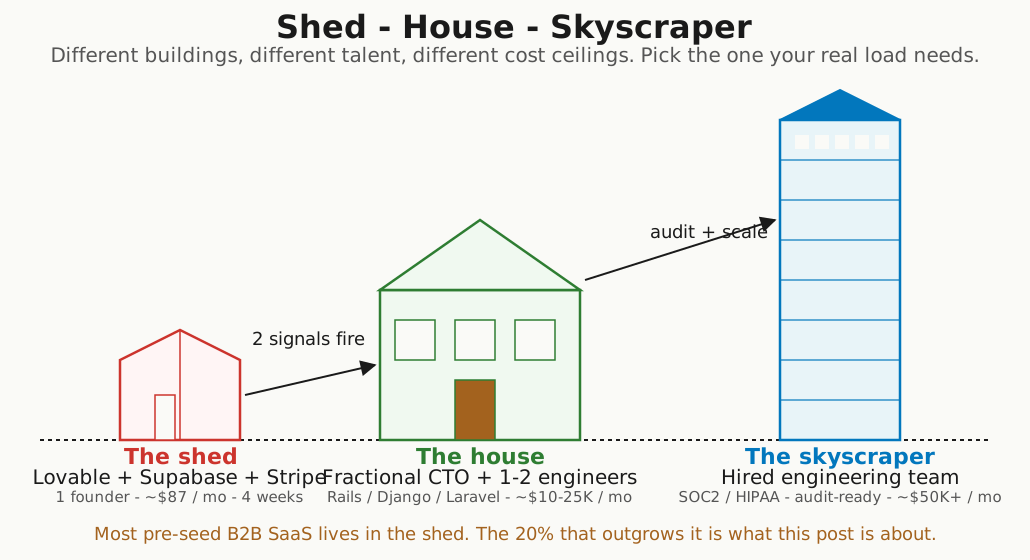
Rob Walling’s shed analogy from Should You Hire? is the right map.
A shed holds one workflow with one persona moving down a single happy path. Add a second story (a second workflow, a second persona, a real data model) and you have a house that needs a structural engineer to plan the load.
A skyscraper - compliance-bound, multi-tenant, real-time, AI-heavy - needs a hired engineering team and an architect from day one. You can’t add ten more floors to a shed. When the load requires a skyscraper, you start a new building.
The Salvage vs Rebuild decision tree tells you which signal-firing pieces salvage and which the Fractional CTO triages first.
Further reading #
- Supabase, Realtime documentation and Row-Level Security guide - the official boundary between what Supabase serves well and where the data-model and real-time signals begin.
- OpenAI, Rate limits documentation - the per-tier request and token caps that drive the AI-inference signal once your traffic crosses a threshold.
- Vanta, SOC2 readiness for early-stage SaaS - the audit-surface checklist a founder usually meets for the first time when an enterprise customer asks for a SOC2 letter.
Built by JetThoughts as a companion reference to the From Idea to First Paying Customer free curriculum.