In this post
The senior dev who told you TDD was overkill learned it on a project where the test suite took twenty minutes to run and every PR needed two rounds of mock refactoring. So did we. The “TDD is too slow” complaints we hear in rescue kickoffs describe a workflow that has nothing to do with the cycle Kent Beck wrote up in 2003.
If you want the rhythm worked out on real Ruby code, we walk through four cycles on a small Order class in TDD in Ruby: A Step-by-Step Guide.
The “TDD is overkill” myth comes from heavyweight habits #
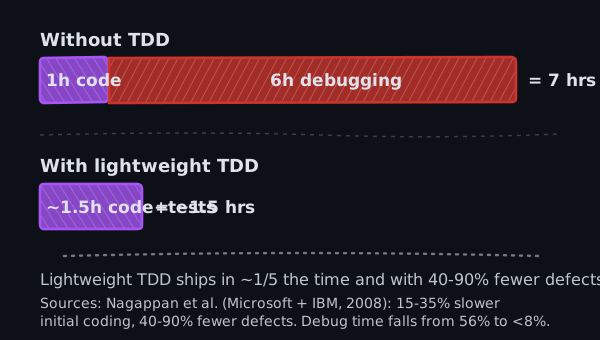
The Agile Institute frames the time ledger of TDD plainly: one hour of writing code without tests usually buys you six hours of debugging the following week. Lightweight TDD costs 15-35% more upfront and cuts defect density by 40-90% (Nagappan et al., Microsoft + IBM, 2008). Same feature ships in 1.5 hours instead of 7, with a design you can still change next month.
On a billing-platform rescue last quarter the average red-green cycle ran 38 minutes because each spec booted Rails before asserting anything. Beck’s cycle measures in seconds and minutes. The team kept TDD and learned to write unit tests that ran in 8ms instead - thirty-second feedback loops are the practice; thirty-minute ones are integration tests with extra typing.
Watch what happens when a new developer takes “test in isolation” literally. They wrap each collaborator in a stub, and the suite ends up asserting the structure of the code instead of its behaviour. Rename a method; twenty tests fail, and none of them caught a real bug. We walked through the shape of this failure in Mock Everything: A Good Way to Sink TDD Testing.
ATDD, BDD, and Cucumber all promised non-technical stakeholders could write executable specs. In practice, your PM never wrote a single Gherkin scenario, and your engineers maintained a 4,000-line features/ directory nobody trusted while the unit tests did the actual work.
What lightweight TDD actually feels like #
Write one assertion that fails for the right reason. Type the smallest method body that makes it green - a hardcoded return value is fine, that’s what Sandi Metz means by Shameless Green: code cheap enough to throw away when the next test forces a better shape. Commit. Refactor only when a real duplication has appeared, then commit again, separately.
Here is the first cycle on a fresh Order class. Don’t laugh:
# test
assert_equal 0, Order.new.total

# implementation
class Order
  def total = 0
end
That’s not a typo. The simplest method body that turns the test green is a hardcoded zero. Two more cycles - adding an item, summing two items - replace the hardcode with the actual logic. The full progression lives in the step-by-step guide.
Each cycle ends with a green test and a commit, so reverting to the last good state costs ninety seconds of work, not an afternoon. Heavyweight TDD - the kind that prompted “TDD is overkill” - has cycles measured in tens of minutes; once cycles drift past thirty, the safety net stops paying for itself.
Design pressure, not coverage #
When a test is hard to write, the design is wrong. Setup that runs ten lines means your object has too many dependencies, and behaviour changes that cascade into eight test rewrites mean the seams are in the wrong place. J.B. Rainsberger writes about this in The Myth of Advanced TDD - the test pain is design feedback, not a reason to abandon the practice.
With a green suite under you, renaming a class is a thirty-second move. Without it, the rename becomes a four-hour archaeology project where you read each caller and pray. The last three Rails rescues we picked up all had tests in the 2-5% range, and refactor proposals turned into “let’s not touch it” at every standup.
There is a second prize that compounds: the test forces you to write the call site before the implementation. If the call site reads badly, you find out in ninety seconds, before any production code commits to the bad shape.
Code with tests around it is also safe to delete. That 600-line service object nobody calls anymore? Run the suite, delete it, run the suite again. Without tests, dead code rots in the repo for years because the cost of being wrong about whether anything still uses it is too high.
Teams that chase coverage as the goal end up with suites full of assert_not_nil(@order) assertions that don’t test any behaviour at all.
When TDD really is overkill #
A 40-line Rake task that backfills one column on one production table - the one you will run twice and delete next week - does not need a test. Run it on staging, eyeball the output, run it on production, delete the file. The same logic covers most one-off data migrations: the script is a transaction that runs once, and writing a test against a populated dev database often costs more than running the migration twice.
Prototype spikes and hackathon demos earn the same exemption. The point of the spike is to learn whether an idea is worth building - write the messy code, get the answer, throw it away. With eighteen hours on the clock and judges who will not open the repo, optimise for the demo running. If the spike survives, you will rewrite it with tests on the way to production, and that rewrite is when the discipline starts paying.
The rule of thumb that catches each: will this code be touched again? If the answer is no, skip TDD and feel no guilt. If the answer is yes, even “yes, in three months,” the ledger flips and you should write the test. The Rails app you are still maintaining six months later is the one where the missing tests cost you four hours per change.
What changes when your team adopts the rhythm #
Code review gets shorter. Separate structural commits (rename, extract) from behavioural ones (new branch, new result), and reviewers scan the structural moves in seconds while focusing on actual behaviour changes. Beck argues for this separation in Tidy First? (2023). Look at the difference in commit shape.
# bundled commit (3 files changed, 47 lines)
# - extracted PriceCalculator
# - added bulk discount branch
# - renamed total -> total_with_tax

# separated commits
# (1) Tidy: extract PriceCalculator   (refactor, no behaviour change)
# (2) Tidy: rename total              (refactor, no behaviour change)
# (3) Feat: bulk discount branch      (behaviour change, with new test)
The bundled commit needs a careful reviewer for an hour. The three separated commits review in twelve minutes total because (1) and (2) only need to confirm the suite stayed green. Tidy First commits are cheap to review precisely because TDD made them safe to make. We work through the 3-line micro-refactor mechanics that keep Tidy First sustainable in Refactor Without Breaking Tests.
Regressions surface during the cycle that introduces them. The red bar interrupts you while the change is still in your head; production logs interrupt you three weeks later, mid-context-switch on something else. Debugging cost drops as a side effect, because each micro-commit is a known-good state. A CI failure two commits later costs you a two-minute git bisect and a ninety-second revert, instead of an hours-long unwind.
A 200-line setup block is your object asking to be split. When a test needs eight mocks to run, the collaborator graph wants flattening. The Ruby and Rails patterns we see most often when this happens are catalogued in Test-Driven Thinking for Solving Common Ruby Pitfalls.
What a TDD rescue actually starts with #
Last quarter we picked up a HealthTech rescue: 2% line coverage, no CI worth running, and 217 paying users already hitting the auth flow on day nine. The pattern was the third one we’d seen this year.
The fix never starts with adding test coverage to the existing code - that’s the trap. We write one failing test for the bug the founder is currently bleeding from, fix it inside the 90-second loop, and ship the patch the same day. Then we write the next failing test for the next bleeding bug. The rationale lives in Why and How to Use TDD: Tips for Testing.
Need engineers for this? See how we work.
Try this on Monday. Pick the next bug in your tracker. Write the failing test before you fix it. If setup takes longer than ninety seconds, the test is telling you something about the design - and that is worth more than the bug itself.