In this post
A solo Claude Code agent compresses product, design, engineering, and QA into one process. The diff compiles, tests stay green, but the feature solves a problem nobody actually has. We covered this founder pain in Vibe Coding Crisis. After that we wrapped the agent in the rest of a product team and what got shipped changed.
The roles we replicated #
Driver-plus-tests is not a team. Each role we added closed a gap that solo agents kept reproducing on every ticket.
| Role | What it does | Where it lives |
|---|---|---|
| Business Strategist | Sets the north star - markets, customers, where we don’t compete | Founder plus a strategy doc the agents read |
| Product Manager | Runs Shape Up pitches, decides which bets to ship, holds the customer voice from interview transcripts, confirms the data signal supports each bet | PM agent (in our setup, lead-shaper) reading the strategy doc plus interview notes |
| UI/UX Designer | Runs synthetic-user walkthroughs against assumptions, then produces the screen flow before any code lands | Discovery agent (in our setup, critic-discovery) plus Google Stitch as the design canvas |
| Tech Lead | Calls feasibility risk, surfaces the architectural patterns the solution must fit, then drives and navigates the code in micro-step pairs during delivery | Tech-lead agent reading the codebase and ADRs; two Claude Code agents on the same diff during delivery |
| Critic Panel | Catches scope creep, design drift, premature abstractions | PM, Designer, Rails, Simplicity critics in parallel |
| QA / Visual Verifier | Confirms the change works in a browser, not just in tests | chrome-devtools MCP screenshots desktop and mobile |
| DevOps Gates | Runs the full test suite, type-check, lint, build, then opens the PR | CI plus auto-reviewer reading the diff |
| Reflection / Kaizen | Captures repeated failures into rule updates and skills | Incident log feeding the rule files and skills.sh |
Solo agents fill one seat and act like the rest don’t exist.
How the team works together #
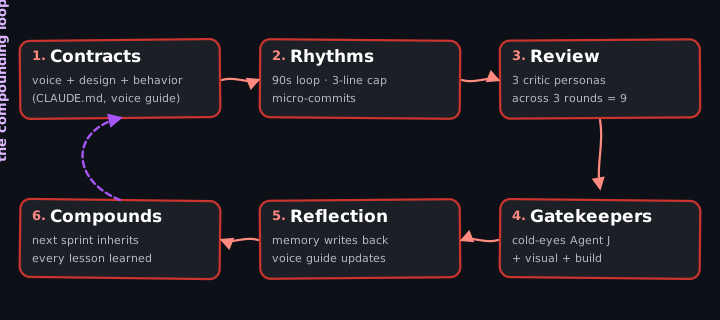
These seats link into actual team behavior through a sequence of formations. Each one produces a specific artifact (pitch doc, file map, screen flow) before delivery starts.
Pitch and bet (Business Strategist + PM + Tech Lead) #
We use Shape Up pitches as the input format. The PM writes a pitch in docs/pitches/<slug>.md covering the Shape Up sections (Problem, Appetite, Solution, Rabbit Holes, No-Gos). Then we run our own betting variant: the bet goes through three lenses (Tech feasibility, Product fit, Design patterns) each producing SIMPLE / MEDIUM / COMPLEX with one-sentence rationale. The PM consolidates - lowest-complexity path with highest-impact outcome. We work in 1-2 week sprints rather than Basecamp’s 6-week appetite, so we call this Shape-Up-inspired, not Shape Up itself.
Slicing and design (PM + Designer + Tech Lead) #
The bet gets sliced into vertical AC items, each one shippable end-to-end. Designer sketches the solution shape in Google Stitch; Tech Lead writes a file map and boundary notes flagging where existing patterns must be reused.
Delivery (Tech Lead pair + Critic Panel) #
The Tech Lead splits into a Driver/Navigator pair: one agent writes, the other reviews each micro-step before commit. XP shows up as test-driven development and refactor-step-tdd micro-commits. RED test commits before each GREEN feat commit (we verify commit order in CI). Kent Beck’s Tidy First? rule applies - structural refactor commits land before behavior changes. The critics run after each green test, not at PR time.
QA gates and shipping (QA + DevOps Gates) #
Visual verification happens in a real browser via chrome-devtools MCP - screenshots desktop and mobile, console clean, network clean. CI runs the full test suite, type-check, lint, and build. The auto-reviewer reads the diff against project conventions. WIP=1 is enforced: one slice ships before the next slice starts.
Reflection (every role) #
Every repeated failure becomes a rule update or a new skill published to skills.sh. Next sprint inherits the lesson.
The cadences we run #
The sprint cycle runs the outermost loop - pitch, betting, slicing, design, delivery, QA, wrap-up. Cadence: one to two weeks per shaped bet.
The development cycle runs inside the sprint - Tech Lead pair on a slice, micro-commits ship behind tests, the critic panel runs after every test pass. Cadence: minutes to hours per slice.
Tightest of all, the Ralph loop runs a single agent iterating on its own output, retrying the same prompt with a stricter rubric until the diff passes the simplicity critic. Anthropic ships it as a built-in Claude Code plugin. Cadence: seconds to minutes per attempt.
Each cadence nests inside the larger one - sprint scope informs development tickets, and Ralph catches small failures inside development without escalating to a human.
Tools that make this possible #
Claude Code provides the runtime and the rule files in CLAUDE.md and .claude/ that each role pulls from. Google Stitch holds the design-system tokens and screen flows - Designer paints there, coding agents read constraints back from the same canvas. chrome-devtools MCP gives QA actual eyes through screenshots, console logs, and mobile emulation; without it, tests go green on builds that are visibly broken in the browser.
Semantic search through claude-context finds existing patterns before agents reinvent them - Sonnet 4.5 still autocompletes Rails 7 syntax inside our Rails 8 apps until claude-context forces it to read the actual Gemfile first. The skill marketplace at skills.sh lets us publish a pattern once (database resets, payment-diff test enforcement) and every project pulls it. CI runs the full test suite, type-check, lint, and build, with an auto-reviewer reading the diff against project conventions before a human ever sees the PR.
Team mode beats solo mode #
Product teams keep failing the same way: one role swallows another’s job. On the last fintech rescue we picked up, the PM had written ACs the Rails team had silently dropped two sprints earlier - the Designer’s Figma had been reinterpreted by the front-end engineer with nobody flagging the drift, and QA was finding the bugs the team had already shipped. Each handoff lost signal.
Solo agents inherit all of that, compressed into one process. One agent makes the product call, the design call, the code call, and the self-review in a single shot - nobody to disagree, no record of what got skipped.
Team mode splits those decisions across collaborative agents, each holding one job, accountable through a written rule set. A PM agent blocks tickets without acceptance criteria. A simplicity critic stops unrequested abstractions before the diff lands. When two agents disagree, the rule file decides - we don’t let the last-run agent win by default.
The exit we were missing #
Team mode fixed who decides. It did not fix whether to proceed at all.
Each formation above ends in an artifact. Pitching produces a pitch doc, slicing produces AC items, delivery produces a diff, and the critics answer revise or approve. Nothing in that set can return “this should not be built.”
The gap stayed invisible while we pointed the setup at code, because a ticket that reaches an agent has usually already earned its existence. Content exposed it inside a week.
We aimed the same machinery at this blog - one agent picks the next post from live search data, another writes it. The picker ran twice in one day and both times concluded the queued topic wasn’t worth writing. One rested on a statistic that fell apart on a fresh pull; the other collided with a post we’d already published.
Both calls were right.
With two outcomes available it would have written both posts anyway. “Try again” is all a loop can do when nothing lets it stop.
So the rule file grew a third exit. A run now ends SHIPPED, or HOLD with the evidence that killed it, or BLOCKED on a decision it names out loud - and HOLD gets filed as a success rather than a failed run.
That last clause carries the weight. An agent that reads stopping as failure will find a reason to keep going.
The finish condition had to move with it, away from quality and toward checks. “The post is good” is not a claim anyone can catch an agent being wrong about. “A critic that didn’t write it scored the draft, and every external claim was fetched rather than recalled” is.
Four-eyes only counts across agent types #
The critic panel assumes the critics see what the writer missed. That assumption breaks quietly when a critic runs on the same model as the writer, because a fresh context window resets what an agent knows without touching what it finds plausible.
Different type, or it doesn’t count.
Four things got caught this month that self-review had already passed, each one held with confidence at the time:
- a skill file sitting in a directory the runtime never loads, which looked installed and did nothing
- a
.gitignorerule that swallowed the deliverable, so the work existed locally and would never have shipped - a query subtotal reported as a whole page’s performance, where the numbers were real and the label was wrong
- a filtered data pull read as complete, when the filter had quietly dropped half the rows
None of those are exotic. Each looks correct to whoever made it, and that is the failure a same-type second opinion is worst at catching.
Why the rules need to change every sprint #
A rigid rule set ships yesterday’s bias. Strategy docs get revised when the market signal changes. Rule files change when reflection surfaces a failure the current rules let through. And sprint goals shift mid-sprint when discovery surfaces new evidence about what users actually need.
Standups happen at the agent level: the discovery agent posts what it learned from this week’s interviews, the simplicity critic logs which abstractions it blocked, and the customer voice agent surfaces new pain points from fresh transcripts. Decisions get re-opened when evidence demands it.
Where to start #
You don’t need every role from day one. Begin with a strategy doc the agent reads at session start, a critic panel that blocks merges, and a reflection log that turns failures into rules. From there, add a designer when the UI starts drifting, a customer-voice capability into the PM agent when feature requests stop matching user pain, and a QA/visual verifier when builds keep going green on broken screens.
Write the three exits into the rule file on day one, though. It costs a paragraph and it’s the piece we added last, after watching a two-outcome loop reach for work that didn’t need doing.
Setup eats one sprint of overhead. Rule files need writing, agent definitions need configuring, and the team needs convincing. By sprint two, the rule files write themselves from reflection logs and the overhead drops to about 30 minutes per week.
Cost on a small slice (one AC item, 50-100 lines of diff) runs $4-6 on Sonnet or $20-30 on Opus with prompt caching on, plus 30-45 minutes of wall-clock time when the 4-agent critic panel (PM, Designer, Rails, Simplicity) runs in parallel. Larger bets and Ralph-loop retries push the bill higher, but it’s still cheaper than the rework on a vibe-coded PR that ships the wrong feature.
What to do next #
Send us one sentence (which role your solo Claude Code agent keeps skipping - PM, designer, tech lead, QA, or critic panel) plus your repo URL. We’ll reply with the actual .claude/agents/<role>.md file we run for that seat, plus a one-page note naming the next two seats to staff for your stack. Reach us at /contact-us/.